


High immunoglobulin G2 (IgG2) and low IgG4 levels are associated with human resistance to Plasmodium falciparum malaria
- PMID: 10678934
- PMCID: PMC97275
- DOI: 10.1128/IAI.68.3.1252-1258.2000
High immunoglobulin G2 (IgG2) and low IgG4 levels are associated with human resistance to Plasmodium falciparum malaria
Abstract
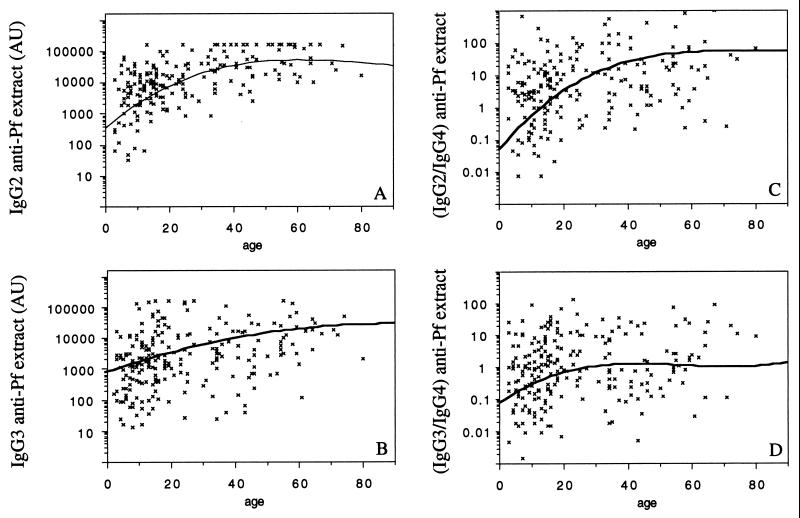
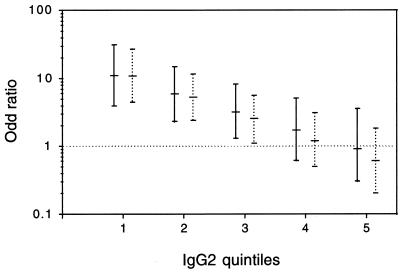
There is accumulating evidence for a role of immunoglobulin G (IgG) in protection against malarial infection and disease. Only IgG1 and IgG3 are considered cytophilic and protective against P. falciparum, whereas IgG2 and IgG4 were thought to be neither and even to block protective mechanisms. However, no clear pattern of association between isotypes and protection has so far emerged. We analyzed the isotypic distribution of the IgG response to conserved epitopes and P. falciparum blood-stage extract in 283 malaria-exposed individuals whose occurrence of infection and malaria attack had been monitored for about 1 year. Logistic regression analyses showed that, at the end of the season of transmission, high levels of IgG2 to RESA and to MSP2 epitopes were associated with low risk of infection. Indeed, IgG2 is able to bind FcgammaRIIA in individuals possessing the H131 allele, and we showed that 70% of the study subjects had this allele. Also, high specific IgG4 levels were associated with an enhanced risk of infection and with a high risk of malaria attack. Moreover, specific IgG2 and IgG3 levels, as well as the IgG2/IgG4 and IgG3/IgG4 ratios, increased with the age of subjects, in parallel with the protection against infection and disease. IgG4 likely competes with cytophilic antibodies for antigen recognition and may therefore block cytotoxicity mediated by antibody-activated effector cells. In conclusion, these results favor a protective role of IgG3 and IgG2, which may activate effector cells through FcgammaRIIA, and provide evidence for a blocking role of IgG4 in malarial infection and disease.
Figures
References
-
- Aribot G, Rogier C, Sarthou J L, Trape J F, Balde A T, Druilhe P, Roussilhon C. Pattern of immunoglobulin isotype response to Plasmodium falciparum blood-stage antigens in individuals living in a holoendemic area of Senegal (Dielmo, West Africa) Am J Trop Med Hyg. 1996;54:449–457. - PubMed
-
- Baird J K. Host age as a determinant of naturally acquired immunity to Plasmodium falciparum. Parasitol Today. 1995;11:105–113. - PubMed
-
- Ball J M, Henry N L, Montelaro R C, Newman M J. A versatile synthetic peptide-based ELISA for identifying antibody epitopes. J Immunol Methods. 1994;171:37–44. - PubMed
-
- Bouharoun-Tayoun H, Attanath P, Sabchareon A, Chongsuphajaisiddhi T, Druilhe P. Antibodies that protect humans against Plasmodium falciparum blood stages do not on their own inhibit parasite growth and invasion in vitro, but act in cooperation with monocytes. J Exp Med. 1990;172:1633–1641. - PMC - PubMed
Publication types
MeSH terms
Substances
LinkOut - more resources
Full Text Sources
Other Literature Sources
Molecular Biology Databases
