. 2000 Mar;44(3):622-32.
doi: 10.1128/AAC.44.3.622-632.2000.

Biochemical sequence analyses of GES-1, a novel class A extended-spectrum beta-lactamase, and the class 1 integron In52 from Klebsiella pneumoniae

Affiliations

Biochemical sequence analyses of GES-1, a novel class A extended-spectrum beta-lactamase, and the class 1 integron In52 from Klebsiella pneumoniae

L Poirel et al. Antimicrob Agents Chemother. 2000 Mar.

Abstract

Klebsiella pneumoniae ORI-1 was isolated in 1998 in France from a rectal swab of a 1-month-old girl who was previously hospitalized in Cayenne Hospital, Cayenne, French Guiana. This strain harbored a ca. 140-kb nontransferable plasmid, pTK1, that conferred an extended-spectrum cephalosporin resistance profile antagonized by the addition of clavulanic acid, tazobactam, or imipenem. The gene for GES-1 (Guiana extended-spectrum beta-lactamase) was cloned, and its protein was expressed in Escherichia coli DH10B, where this pI-5. 8 beta-lactamase of a ca. 31-kDa molecular mass conferred resistance to oxyimino cephalosporins (mostly to ceftazidime). GES-1 is weakly related to the other plasmid-located Ambler class A extended-spectrum beta-lactamases (ESBLs). The highest percentage of amino acid identity was obtained with the carbenicillinase GN79 from Proteus mirabilis; with YENT, a chromosome-borne penicillinase from Yersinia enterocolitica; and with L-2, a chromosome-borne class A cephalosporinase from Stenotrophomonas maltophilia (36% amino acid identity each). However, a dendrogram analysis showed that GES-1 clustered within a class A ESBL subgroup together with ESBLs VEB-1 and PER-1. Sequencing of a 7,098-bp DNA fragment from plasmid pTK1 revealed that the GES-1 gene was located on a novel class 1 integron named In52 that was characterized by (i) a 5' conserved segment containing an intI1 gene possessing two putative promoters, P(1) and P(2), for coordinated expression of the downstream antibiotic resistance genes and an attI1 recombination site; (ii) five antibiotic gene cassettes, bla(GES-1), aac(6')Ib' (gentamicin resistance and amikacin susceptibility), dfrXVb (trimethoprim resistance), a novel chloramphenicol resistance gene (cmlA4), and aadA2 (streptomycin-spectinomycin resistance); and (iii) a 3' conserved segment consisting of qacEDelta1 and sulI. The bla(GES-1) and aadA2 gene cassettes were peculiar, since they lacked a typical 59-base element. This work identified the second class A ESBL gene of a non-TEM, non-SHV series which was located in the plasmid and integron, thus providing it additional means for its spread and its expression.


Figures
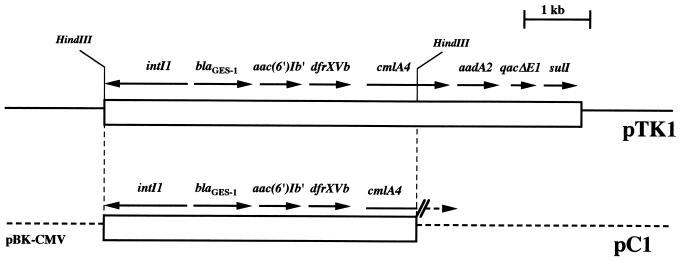
FIG. 1
FIG. 1
Schematic restriction endonuclease map of the natural plasmid pTK1 and the recombinant plasmid pC1 that contain blaGES-1. pC1 possesses a 4.5-kb HindIII fragment from pTK1 inserted into the HindIII site of pBK-CMV. The open boxes represents the sequenced part of plasmid pTK1 and the insert cloned in pC1, the dotted lines indicate the vector pBK-CMV, and the thin line represents the unsequenced part of pTK1. The GES-1 β-lactamase gene and the other ORFs are indicated.
FIG. 2
FIG. 2
Nucleotide sequence of a 7,098-bp fragment of pTK1 containing the GES-1 coding region. The deduced amino acid sequence is designated in single-letter code below the nucleotide sequence. The start codons of the ORFs are indicated by horizontal arrows, and the deduced proteins are reported below the nucleotide sequence. Stop codons for each ORF are indicated by asterisks. Dashes in several nucleotide sequences indicate where the reported sequence was identical to already-published sequences. The −35 and −10 sequences of the promoters P1, P2, P3, Pa, and Pb for cmlA4 are indicated; RBS indicates the putative ribosomal binding site for cmlA4. The conserved core and inverse core sites located at each cassette boundary are boxed, and the composite 59-be's are italicized. The cassette boundaries are indicated by vertical arrows. The attI1 site is underlined with a dotted line. Within the GES-1 protein, the conserved residues of Ambler class A β-lactamases are underlined. The amino acids of CMLA-1 that differ from those of CMLA-4 are indicated below the amino acid sequence of CMLA-4. The nucleotide sequence for putative translational attenuation regulation of cmlA4 (nucleotide positions 3521 to 3551) is underlined.
FIG. 2
FIG. 2
Nucleotide sequence of a 7,098-bp fragment of pTK1 containing the GES-1 coding region. The deduced amino acid sequence is designated in single-letter code below the nucleotide sequence. The start codons of the ORFs are indicated by horizontal arrows, and the deduced proteins are reported below the nucleotide sequence. Stop codons for each ORF are indicated by asterisks. Dashes in several nucleotide sequences indicate where the reported sequence was identical to already-published sequences. The −35 and −10 sequences of the promoters P1, P2, P3, Pa, and Pb for cmlA4 are indicated; RBS indicates the putative ribosomal binding site for cmlA4. The conserved core and inverse core sites located at each cassette boundary are boxed, and the composite 59-be's are italicized. The cassette boundaries are indicated by vertical arrows. The attI1 site is underlined with a dotted line. Within the GES-1 protein, the conserved residues of Ambler class A β-lactamases are underlined. The amino acids of CMLA-1 that differ from those of CMLA-4 are indicated below the amino acid sequence of CMLA-4. The nucleotide sequence for putative translational attenuation regulation of cmlA4 (nucleotide positions 3521 to 3551) is underlined.
FIG. 3
FIG. 3
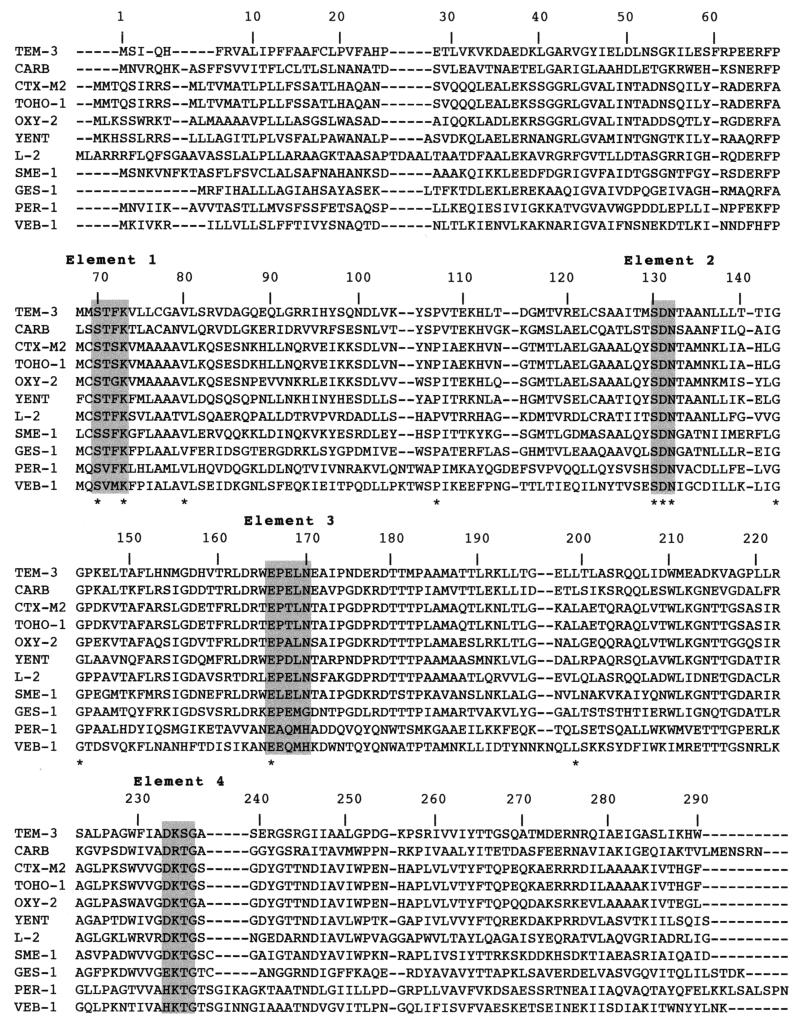
Alignment of the amino acid sequence of GES-1 with those of the closest class A β-lactamases. Numbering is according to Ambler (2). Asterisks indicate the conserved amino acid residues among these class A sequences. Highlighted amino acids are those surrounding the active sites of class A sequences. The β-lactamases included in the alignment are TEM-3 from K. pneumoniae, CARB from P. mirabilis, CTX-M-2 from S. enterica serovar Typhimurium, TOHO-1 from E. coli, OXY-2 from K. oxytoca, YENT from Y. enterocolitica, L-2 from S. maltophilia, SME-1 from S. marcescens, GES-1 from K. pneumoniae, PER-1 from P. aeruginosa, and VEB-1 from E. coli. Dashes indicate gaps introduced to optimize the alignment.
FIG. 4
FIG. 4
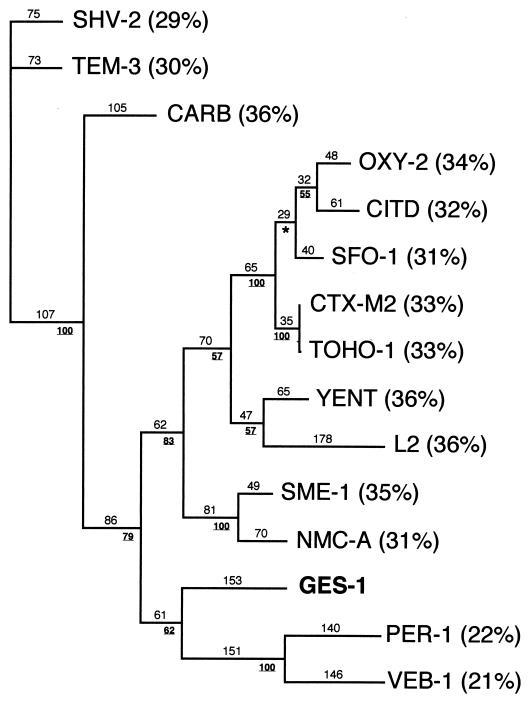
Dendrogram obtained for 15 representative Ambler class A β-lactamases by the parsimony method (60). Branch lengths are drawn to scale and are proportional to the number of amino acid changes. The percentages at branching points (underlined) refer to the number of times a particular node was found in 100 bootstrap replications (the asterisk indicates uncertainty of nodes with bootstrap values of less than 50%). The distance along the vertical axis has no significance. Designations for β-lactamases are given in Materials and Methods. Percentages in parentheses are amino acid identities to GES-1.

References

    1. Adrian P V, Du Plessis M, Klugman K P, Amyes S G B. New trimethoprim-resistant dihydrofolate reductase cassette, dfrXV, inserted in a class 1 integron. Antimicrob Agents Chemother. 1998;42:2221–2224. - PMC - PubMed
    1. Ambler R P. The structure of beta-lactamases. Trans R Soc Lond B Biol Sci. 1980;289:321–331. - PubMed
    1. Arakawa Y, Murakami M, Suzuki K, Ito H, Wachacotyankun R, Ohsuka S, Kato N, Otha M. A novel integron-like element carrying the metallo β-lactamase gene blaIMP-1. Antimicrob Agents Chemother. 1995;39:1612–1615. - PMC - PubMed
    1. Bauernfeind A, Stemplinger I, Jungwirth R, Ernst S, Casellas J M. Sequences of beta-lactamase genes encoding CTX-M-1 (MEN-1) and CTX-M-2 and relationship of their amino acid sequences with those of other β-lactamases. Antimicrob Agents Chemother. 1996;40:509–513. - PMC - PubMed
    1. Bauernfeind A, Stemplinger I, Jungwirth R, Mangold P, Amann S, Akalin E, Ang O, Bal C, Casellas J M. Characterization of β-lactamase gene blaPER-2, which encodes an extended-spectrum class A β-lactamase. Antimicrob Agents Chemother. 1996;40:616–620. - PMC - PubMed

Publication types

MeSH terms

Associated data

LinkOut - more resources