. 2000 Feb;105(4):469-78.
doi: 10.1172/JCI6899.

Impaired mucosal defense to acute colonic injury in mice lacking cyclooxygenase-1 or cyclooxygenase-2

Affiliations

Impaired mucosal defense to acute colonic injury in mice lacking cyclooxygenase-1 or cyclooxygenase-2

O Morteau et al. J Clin Invest. 2000 Feb.

Abstract

To investigate roles in intestinal inflammation for the 2 cyclooxygenase (COX) isoforms, we determined susceptibility to spontaneous and induced acute colitis in mice lacking either the COX-1 or COX-2 isoform. We treated wild-type, COX-1(-/-), COX-2(-/-), and heterozygous mice with dextran sodium sulfate (DSS) to provoke acute colonic inflammation, and we quantified tissue damage, prostaglandin (PG) E(2), and interleukin-1beta. No spontaneous gastrointestinal inflammation was detected in mice homozygous for either mutation, despite almost undetectable basal intestinal PGE(2) production in COX-1(-/-) mice. Both COX-1(-/-) and COX-2(-/-) mice showed increased susceptibility to a low-dose of DSS that caused mild colonic epithelial injury in wild-type mice. COX-2(-/-) mice were more susceptible than COX-1(-/-) mice, and selective pharmacologic blockade of COX-2 potentiated injury in COX-1(-/-) mice. At a high dose, DSS treatment was fatal to 50% of the animals in each mutant group, but all wild-type mice survived. DSS treatment increased PGE(2) intestinal secretion in all groups except COX-2(-/-) mice. These results demonstrate that COX-1 and COX-2 share a crucial role in the defense of the intestinal mucosa (with inducible COX-2 being perhaps more active during inflammation) and that neither isoform is essential in maintaining mucosal homeostasis in the absence of injurious stimuli.


Figures

Figure 1
Figure 1
Basal PGE2 concentration in unstimulated colonic tissues from WT and COX-1– and COX-2–deficient mice. Tissue PGE2 concentrations were measured by RIA in snap-frozen tissues homogenized in PBS buffer containing the following antiproteases: 50 μg/mL antipain-dihydrochloride, 2 μg/mL aprotinin, and 0.5 μg/mL leupeptin. Mean ± SEM, n = 7. *P < 0.05 versus WT and COX-2–/–, n = 7.
Figure 2
Figure 2
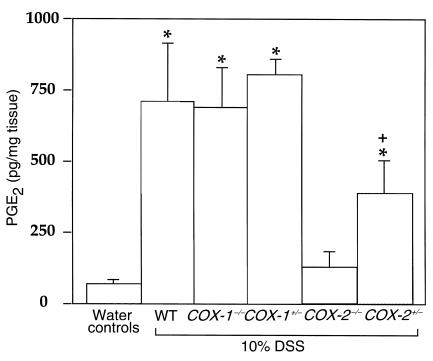
Colonic PGE2 levels in 24-hour culture supernatants from either untreated mice (water controls) or WT, heterozygous, or homozygous mice for COX-1 or COX-2 deletion treated for 5 days with 10% DSS. The colons were removed, opened longitudinally, washed in PBS buffer containing penicillin, streptomycin, and fungizone (P/S/F, 100 U/mL) and kept in cold serum-free media (RPMI 1640 1× with P/S/F). The organs were cut into small pieces in a Petri dish containing fresh media and 100 mg of tissues were incubated at 37°C in 1 mL of fresh media for 24 hours. Culture supernatants were harvested and assayed for PGE2 secretion by RIA. Mean ± SEM, n = 6. *P < 0.05 versus water controls; +P < 0.05 versus COX-1+/–.
Figure 3
Figure 3
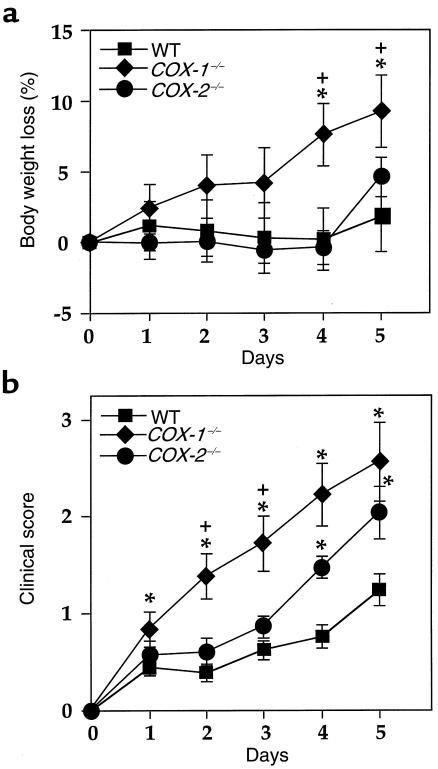
Body weight loss (a) and clinical score (b) induced by low-dose (2.5%) DSS oral treatment in WT, COX-1–/–, and COX-2–/– mice. Mean ± SEM, n = 7. *P < 0.05 versus WT; +P < 0.05 versus COX-1–/–.
Figure 4
Figure 4
Photomicrographs of the proximal colon of mice treated with low-dose DSS (2.5%) or water only for 5 days, and a DSS-treated COX-1–/– mouse treated with the selective COX-2 inhibitor NS-398 (1 mg/kg every 8 hours) for 5 days. (a) WT mouse that received water (negative control) showing no mucosal damage. (b) WT mouse that received DSS for 5 days. Focal ulceration is present, but the majority of the mucosa shows no damage. (c) COX-1–/– mouse that received DSS developed a slightly larger mucosal ulcer. (d) COX-2–/– mouse developed more extensive mucosal ulceration with inflammation extended into the submucosa. (e) COX-1–/– mouse that received NS-398 developed extensive colonic ulceration and inflammation. Magnification of all photomicrographs is ×33.
Figure 5
Figure 5
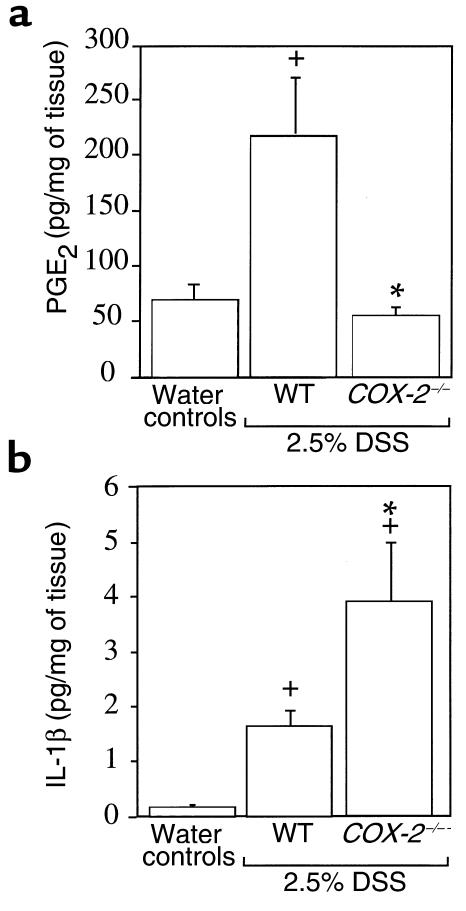
PGE2 levels (a) and IL-1β levels (b) in 24-hour culture supernatants of colonic tissues from untreated (water controls) or DSS-treated (2.5%) WT and COX-2–/– mice. The colons were removed, opened longitudinally, washed in PBS buffer containing penicillin, streptomycin, and fungizone (P/S/F, 100 U/mL), and kept in cold serum-free media (RPMI 1640 1× with P/S/F). The organs were cut into small pieces in a Petri dish containing fresh media, and 100 mg of tissues was incubated at 37°C in 1 mL of fresh media for 24 hours. Culture supernatants were harvested and assayed for PGE2 secretion by RIA and for IL-1β by ELISA (Genzyme Diagnostics). Mean ± SEM, n = 7. *P < 0.05 versus WT; +P < 0.05 versus water controls.
Figure 6
Figure 6
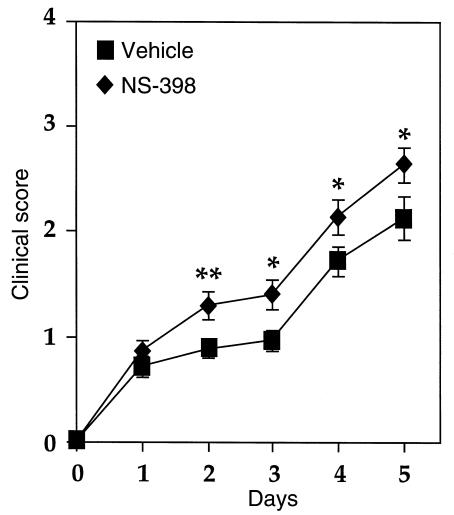
Effect of the selective COX-2 inhibitor NS-398 on the clinical score in 2.5% DSS-treated COX-1–/– mice. NS-398 (1 mg/kg) was injected intraperitoneally every 8 hours, leading to a cumulative dosage of 3 mg/kg daily. NS-398 was administered starting 2 hours before treatment with 2.5% DSS and for 5 days consecutively until the end of DSS treatment. Control COX-1–/– mice treated with 2.5% DSS were administered the vehicle for NS-398 under the same conditions. Ten to 15 mice per group were investigated. Mean ± SEM. *P < 0.05 versus vehicle-treated group; **P < 0.01 versus vehicle-treated group.

References

    1. Sartor, R.B., and Powell, D.W. 1991. In Diarrheal diseases. M. Field, editor. Elsevier Science. New York, NY. 75–114.
    1. Sharon P, Ligumsky M, Rachmilewitz D, Zor U. Role of prostaglandins in ulcerative colitis. Enhanced production during active disease and inhibition by sulfasalazine. Gastroenterology. 1978;75:638–640. - PubMed
    1. Allgayer H, Deschryver K, Stenson WF. Treatment with 16,16’-dimethyl PGE2 before and after induction of colitis with trinitrobenzene sulfonic acid in rats decreases inflammation. Gastroenterology. 1989;96:1290–1300. - PubMed
    1. Rachmilewitz D, et al. Inflammatory mediators of experimental colitis in rats. Gastroenterology. 1989;97:326–327. - PubMed
    1. Hoult JRS, Moore PK. Sulphasalazine is a potent inhibitor of prostaglandin 15 hydroxydehydrogenase: possible basis for therapeutic action in ulcerative colitis. Br J Pharmacol. 1978;64:6–8. - PMC - PubMed

Publication types

MeSH terms