. 2000 Mar 14;97(6):2521-6.
doi: 10.1073/pnas.050579797.

Mammalian thioredoxin reductase: oxidation of the C-terminal cysteine/selenocysteine active site forms a thioselenide, and replacement of selenium with sulfur markedly reduces catalytic activity

Affiliations

Mammalian thioredoxin reductase: oxidation of the C-terminal cysteine/selenocysteine active site forms a thioselenide, and replacement of selenium with sulfur markedly reduces catalytic activity

S R Lee et al. Proc Natl Acad Sci U S A. .

Abstract

Mammalian cytosolic thioredoxin reductase (TrxR) has a redox center, consisting of Cys(59)/Cys(64) adjacent to the flavin ring of FAD and another center consisting of Cys(497)/selenocysteine (SeCys)(498) near the C terminus. We now show that the C-terminal Cys(497)-SH/SeCys(498)-Se(-) of NADPH-reduced enzyme, after anaerobic dialysis, was converted to a thioselenide on incubation with excess oxidized Trx (TrxS(2)) or H(2)O(2). The Cys(59)-SH/Cys(64)-SH pair also was oxidized to a disulfide. At lower concentrations of TrxS(2), the Cys(59)-SH/Cys(64)-SH center was still converted to a disulfide, presumably by reduction of the thioselenide to Cys(497)-SH/SeCys(498)-Se(-). Specific alkylation of SeCys(498) completely blocked the TrxS(2)-induced oxidation of Cys(59)-SH/Cys(64)-SH, and the alkylated enzyme had negligible NADPH-disulfide oxidoreductase activity. The effect of replacing SeCys(498) with Cys was determined by using a mutant form of human placental TrxR1 expressed in Escherichia coli. The NADPH-disulfide oxidoreductase activity of the purified Cys(497)/Cys(498) mutant enzyme was 6% or 11% of that of wild-type rat liver TrxR1 with 5, 5'-dithiobis(2-nitrobenzoic acid) or TrxS(2), respectively, as substrate. Disulfide formation induced by excess TrxS(2) in the mutant form was 12% of that of the wild type. Thus, SeCys has a critical redox function during the catalytic cycle, which is performed poorly by Cys.


Figures
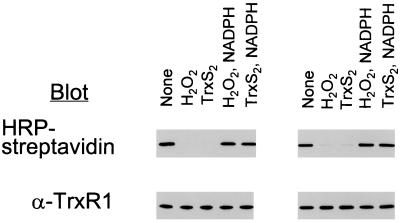
Figure 1
Figure 1
Effect of exposure of NADPH-reduced TrxR1 to H2O2 or TrxS2 on labeling with BIAM. NADPH-reduced TrxR1 was dialyzed anaerobically to remove NADPH and then incubated for 10 min at room temperature with 200 μM H2O2 or 12 equivalents of TrxS2 per subunit to produce E-H2O2 and E-TrxS2. The H2O2 reaction was stopped by adding catalase, and the E-TrxS2 mixture was adjusted to pH 5.2. One-half of each oxidized enzyme sample was incubated for 20 min with 200 μM NADPH at pH 7.2 to produce E-H2O2-NADPH or E-TrxS2-NADPH. An aliquot (5 μg) of each was incubated with 50 μM BIAM for 10 min in the absence (Left) or presence (Right) of 6 M guanidine-HCl in PBS buffer (pH 7.2) containing 1 mM EDTA and then with 1 mM IAM for 5 min at pH 8.8. The samples shown at Right were dialyzed against 20 mM Tris⋅HCl (pH 8.0) buffer containing 1 mM EDTA to remove guanidine. All samples were subjected to SDS/PAGE on a 10% gel and then transferred to a nitrocellulose membrane. The biotinyl carboxamidomethyl [(B)CAM]-labeled proteins were detected by streptavidin blotting with horseradish peroxidase (HRP)-conjugated streptavidin and enhanced chemiluminescence detection. Equal application of protein among gel lanes was confirmed by immunoblot analysis with antibodies to TrxR1.
Figure 2
Figure 2
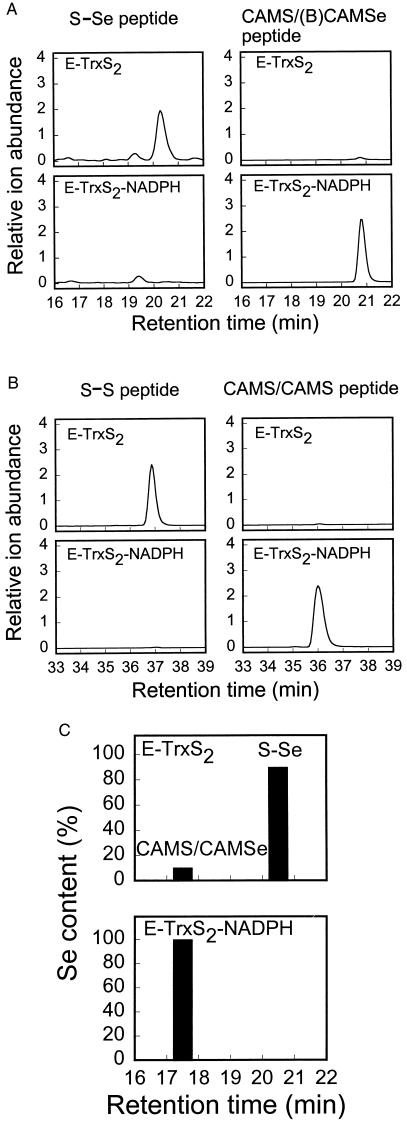
Identification and quantitation of the Cys497/SeCys498 thioselenide and the Cys59/Cys64 disulfide in E-TrxS2 and E-TrxS2-NADPH. (A and B) E-TrxS2 and E-TrxS2-NADPH were prepared from the NADPH-reduced TrxR1 as described in Fig. 1. The resulting enzymes (10 μg) were labeled with 50 μM BIAM for 20 min in oxygen-free PBS buffer (pH 7.2) containing 1 mM EDTA and then with 1 mM IAM for 5 min in 50 mM Tris⋅HCl (pH 8.8) containing 6 M guanidine-HCl. After adjustment to pH 5.2, the samples were dialyzed for 4 h against 10 mM sodium acetate buffer (pH 5.2) and then for 2 h against 20 mM Tris⋅HCl buffer (pH 8.0). The dialyzed samples were diluted to 10% (vol/vol) in acetonitrile and then incubated with endoproteinase Lys-C at 37°C overnight. The resulting peptide mixtures were analyzed by HPLC-MS. (A) Extracted ion chromatograms for m/z = 649.6 (1,297.7 mu) of the Cys497/SeCys498-containing peptide (Left) and for m/z = 842.5 (1,682.8 mu) of the CAM-Cys497/(B)CAM-SeCys498-containing peptide (Right). (B) Extracted ion chromatograms for m/z = 1,043.9 (3,129.3 mu) of the Cys59/Cys64-containing peptide (Left) and for m/z = 1,082.6 (3,245.5 mu) of the CAM-Cys59/CAM-Cys64-containing peptide (Right). (C) E-TrxS2 and E-TrxS2-NADPH (20 μg) prepared from the NADPH-reduced TrxR1 as described in Fig. 1 were reacted with 1 mM IAM for 5 min in 50 mM Tris⋅HCl (pH 8.8) containing 6 M guanidine-HCl. Lys-C peptides were prepared and fractionated on a C18 HPLC column. Fractions (0.2 ml) were collected manually, and each was analyzed for selenium with a Perkin–Elmer model 4100 ZL atomic absorption spectrometer. The amount of selenium in the total soluble peptide mixture was 100%. The identity of the selenium-containing peptide eluting at 17.5 min was confirmed by matrix-assisted laser desorption ionization time-of-flight MS (measured = 1,413.8 mu; calculated = 1,413.4 mu). When the oxidized peptide eluting at 20.5 min was reduced with DTT, alkylated, and rechromatographed, it eluted at 17.5 min as expected (not shown).
Figure 3
Figure 3
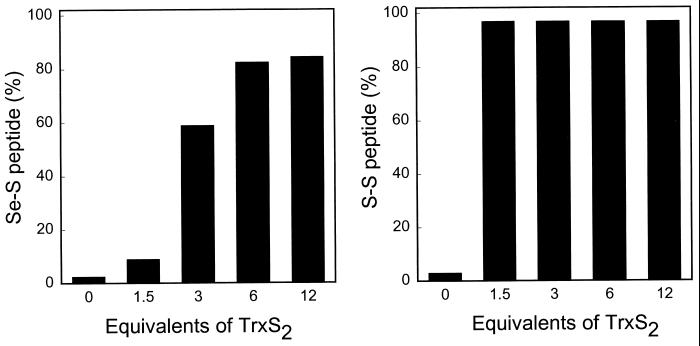
Effect of varying the concentration of TrxS2 on the formation of the Cys497/SeCys498 thioselenide and the Cys59/Cys64 disulfide. NADPH-reduced TrxR1 (20 μg) was incubated for 10 min at room temperature with the indicated amount of TrxS2 in oxygen-free PBS buffer (pH 7.2) containing 1 mM EDTA. The samples were then reacted with 1 mM IAM at pH 8.8 in 6 M guanidine-HCl as described in the legend to Fig. 2C. The reaction mixtures after dialysis were digested with Lys-C; peptides were purified by HPLC; and the selenium contents of the S-Se peptide and the CAM-Cys/CAM-SeCys peptide were determined by atomic absorption spectroscopy. The amounts of Cys/Cys peptide and CAM-Cys/CAM-Cys peptide were estimated from the HPLC peak areas. (Left) The formation of the oxidized, thioselenide-containing peptide, expressed as a percentage of the sum of the oxidized (S-Se) and alkylated (CAM-Cys/CAM-SeCys) derivatives of reduced Cys497/SeCys498. (Right) The formation of the disulfide-containing peptide, expressed as a percentage of the sum of the oxidized (S-S) and alkylated (CAM-Cys/CAM-Cys) derivatives of the reduced Cys59/Cys64 pair.
Figure 4
Figure 4
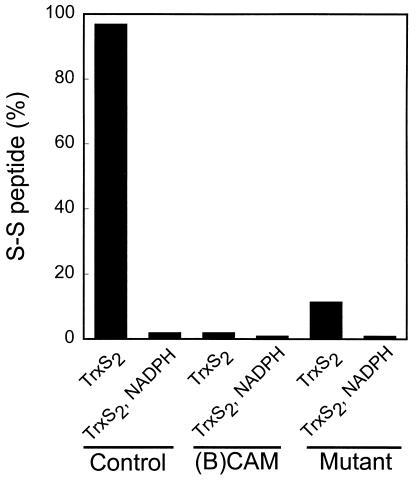
TrxS2-induced oxidation of the Cys59-SH/Cys64-SH pair in native, (B)CAM-modified, and SeCys498 → Cys498 mutant TrxR1 enzymes. (B)CAM-labeled enzyme was prepared by labeling NADPH-reduced TrxR1 with 50 μM BIAM alone. E. coli-expressed SeCys498 → Cys498 mutant TrxR1 was prepared as described in Experimental Procedures. Control, (B)CAM-modified, and mutant enzymes (30 μg) were incubated with three equivalents of Tris(2-carboxyethyl)phosphine per subunit to assure complete reduction of redox centers (9) and then oxidized by exposure for 2 min at 25°C to six equivalents of TrxS2 per subunit in PBS buffer (pH 7.2) containing 1 mM EDTA. One-half of each TrxS2-treated enzyme sample was reduced with 200 μM NADPH. Each of the resulting enzyme samples was labeled with IAM, digested with Lys-C, and subjected to HPLC analysis for the Cys59/Cys64 containing-peptide as described in the legend to Fig. 3.
Figure 5
Figure 5
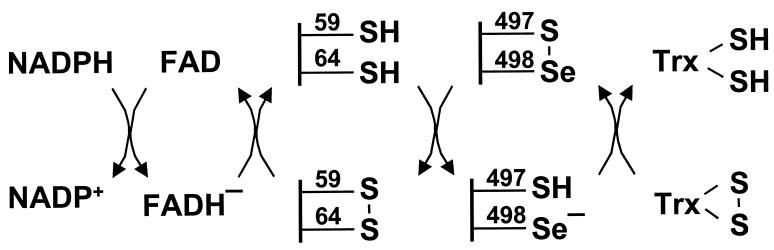
Proposed reaction mechanism for TrxR1.

References

    1. Russel M, Model P. J Biol Chem. 1988;263:9015–9019. - PubMed
    1. Chae H Z, Chung S J, Rhee S G. J Biol Chem. 1994;269:27670–27678. - PubMed
    1. Luthman M, Holmgren A. Biochemistry. 1982;21:6628–6633. - PubMed
    1. Tamura T, Stadtman T C. Proc Natl Acad Sci USA. 1996;93:1006–1011. - PMC - PubMed
    1. Gladyshev V N, Jeang K-T, Stadtman T C. Proc Natl Acad Sci USA. 1996;93:6146–6151. - PMC - PubMed

MeSH terms

LinkOut - more resources