Comparative Study
. 2000 Mar 28;97(7):3428-32.
doi: 10.1073/pnas.97.7.3428.

Recombinant adeno-associated virus type 2, 4, and 5 vectors: transduction of variant cell types and regions in the mammalian central nervous system

Affiliations
Comparative Study

Recombinant adeno-associated virus type 2, 4, and 5 vectors: transduction of variant cell types and regions in the mammalian central nervous system

B L Davidson et al. Proc Natl Acad Sci U S A. .

Abstract

Recombinant adeno-associated virus vectors based on serotype 2 (rAAV2) can direct transgene expression in the central nervous system (CNS), but it is not known how other rAAV serotypes perform as CNS gene transfer vectors. Serotypes 4 and 5 are distinct from rAAV2 and from each other in their capsid regions, suggesting that they may direct binding and entry into different cell types. In this study, we examined the tropisms and transduction efficiencies of beta-galactosidase-encoding vectors made from rAAV4 and rAAV5 compared with similarly designed rAAV2-based vectors. Injection of rAAV5 beta-galactosidase (betagal) or rAAV4betagal into the lateral ventricle resulted in stable transduction of ependymal cells, with approximately 10-fold more positive cells than in mice injected with rAAV2betagal. Major differences between the three vectors were revealed upon striatal injections. Intrastriatal injection of rAAV4betagal resulted again in striking ependyma-specific expression of transgene, with a notable absence of transduced cells in the parenchyma. rAAV2betagal and rAAV5betagal intrastriatal injections led to beta-gal-positive parenchymal cells, but, unlike rAAV2betagal, rAAV5betagal transduced both neurons and astrocytes. The number of transgene-positive cells in rAAV5betagal-injected brains was 130 and 5,000 times higher than in rAAV2betagal-injected brains at 3 and 15 wk, respectively. Moreover, transgene-positive cells were widely dispersed throughout the injected hemisphere in rAAV5betagal-transduced animals. Together, our data provide in vivo support for earlier in vitro work, suggesting that rAAV4 and rAAV5 gain cell entry by means of receptors distinct from rAAV2. These differences could be exploited to improve gene therapy for CNS disorders.


Figures
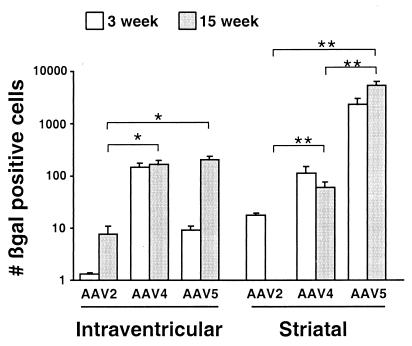
Figure 1
Figure 1
The number of β-galactosidase-positive cells after intracerebral injection. Animals were injected with rAAV2βgal, rAAV4βgal, or rAAV5βgal into the ventricle or striatum of mice, and brains taken at the times indicated. Blocks (2.6 mm, surrounding the injection site) were sectioned, processed for β-galactosidase histochemistry, and transgene-positive cells were counted. Data represent mean ± SEM. *, P < 0.05; **, P < 0.005.
Figure 2
Figure 2
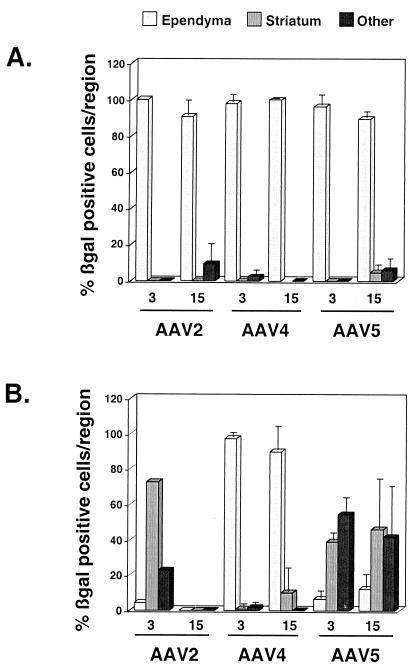
The distribution of β-galactosidase positive cells in brains of mice at 3 or 15 wk after injection of rAAV2βgal, rAAV4βgal, or rAAV5βgal. β-galactosidase-positive cells within the ependymal, striatal, or “other” (septal and fornix regions, corpus callosum, and neocortex) regions, from sections encompassing the injection site, were counted and that value represented as a percent of the total number of transgene positive cells. (A) Data from sections obtained 3 or 15 wk after intraventricular injection. (B) Data from sections obtained 3 or 15 wk after injection into the striatum. Data represent means ± SEM.
Figure 3
Figure 3
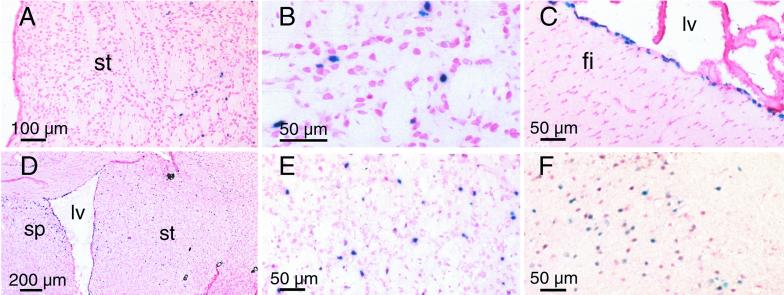
β-galactosidase histochemistry for transgene-positive cells after striatal injection of rAAV vectors. (A and B) Representative photomicrograph of sections from mice injected with rAAV2βgal. (B) A magnified photograph of the transgene positive striatal region seen in A. (C) Demonstration of distinctive ependymal-specific staining for β-galactosidase in sections from animals injected with rAAV4βgal. (D–F). Photomicrographs illustrating the extensive distribution of transgene-positive cells after rAAV5βgal injection. (E) Magnification of the striatal region in D. (F) Transgene positive cells in the cortex distant from the injection site. The photomicrographs are representative of at least three independent experiments. fi, fimbria region; lv, lateral ventricle; sp, medial septal region; st, striatum.
Figure 4
Figure 4
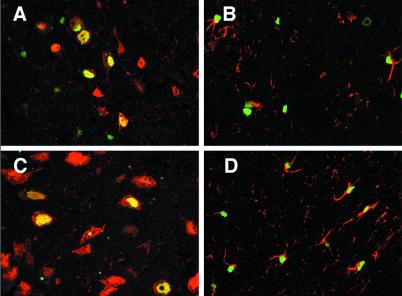
Identification of transduced cells after intrastriatal injection of rAAV5βgal. Fifteen weeks after injection of rAAV5βgal, coronal brain sections were dual stained for β-galactosidase (green nuclei) and NeuN (neuronal-specific, red nuclei and light red cytoplasm), or for β-galactosidase and GFAP (astrocyte-specific, red cell processes). Confocal microscopy image analysis was performed, and representative two-color-merged images of single z-series slices are shown. In the striatum, both transduced neurons (yellow cell nuclei in A) and transduced astrocytes (B) were detected. In the medial septal region, transduction appeared to be restricted to neurons (C), whereas in the corpus callosum, the transduced cells were GFAP-positive astrocytes (D). Images were captured by using a ×40 (A, B, and D) or ×63 (C) oil-immersion objective.

References

    1. Berns K I. In: Virology. Fields B N, Knipe D M, editors. New York: Raven; 1990. pp. 1743–1763.
    1. Zhang L, Wang D, Fischer H, Fan P-D, Widdicombe J H, Kan Y W, Dong J-Y. Proc Natl Acad Sci USA. 1998;95:10158–10163. - PMC - PubMed
    1. McCown T J, Xiao X, Li J, Breese G R, Samulski R J. Brain Res. 1996;713:99–107. - PubMed
    1. Herzog R W, Hagstrom J N, Kung S-H, Tai S J, Wilson J M, Fisher K J, High K A. Proc Natl Acad Sci USA. 1997;94:5804–5809. - PMC - PubMed
    1. Snyder R O, Miao C H, Patijn G A, Spratt S K, Danos O, Nagy D, Gown A M, Winther B, Meuse L, Cohen L K, et al. Nat Genet. 1997;16:270–276. - PubMed

Publication types

Substances

LinkOut - more resources