. 2000 Mar;119(3):456-63.
doi: 10.1046/j.1365-2249.2000.01155.x.

Bacteroides fragilis enterotoxin induces the expression of IL-8 and transforming growth factor-beta (TGF-beta) by human colonic epithelial cells

Affiliations

Bacteroides fragilis enterotoxin induces the expression of IL-8 and transforming growth factor-beta (TGF-beta) by human colonic epithelial cells

L Sanfilippo et al. Clin Exp Immunol. 2000 Mar.

Abstract

Bacteroides fragilis toxin (BFT) has been shown to be capable of inducing intestinal mucosal inflammation in animals. Such inflammation may be responsible for diarrhoea, which occurs in some, but not all human carriers of enterotoxigenic strains of B. fragilis (ETBF). We have studied responses to BFT by different human intestinal epithelial cell lines and subsequently investigated the expression of IL-8 and TGF-beta by T84 cells. The latter were selected because their responses to BFT, characterized by morphological changes and cell death by apoptosis, were similar to those we have recently observed in primary human colonocytes. We show that BFT dose-dependently increased the expression of transcripts and protein of the polymorphonuclear cell chemoattractant IL-8. BFT also dose-dependently induced the release of TGF-beta, which has been shown to enhance the repair of the injured intestinal epithelium. However, the secreted TGF-beta was almost exclusively in the biologically inactive form, as determined by Mv1Lu bioassay. Our studies therefore suggest that exposure of colonic epithelial cells in vivo to high concentrations of BFT can initiate an inflammatory response via secreted IL-8. BFT-induced release of latent TGF-beta may facilitate the subsequent repair of the injured epithelium, following its activation by proteases from neighbouring cells. Variation in cytokine responses by colonic epithelial cells in vivo could be an important determinant in the development of mucosal disease and symptoms in response to ETBF.


Figures
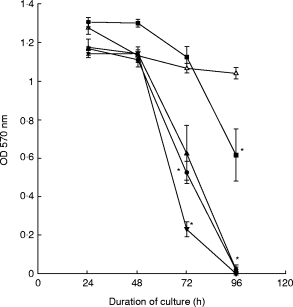
Fig. 1
Fig. 1
MTT assays on T84 monolayers exposed to Bacteroides fragilis toxin (BFT). Confluent monolayers of T84 cells were grown in 96-well plates in medium only or in medium containing 4 (▪), 40 (▴), 400 (•) or 4000 (▾) cytotoxic units (CU)/ml of BFT. After culture for varying time periods, MTT assays (which reflect cellular mitochondrial dehydrogenase activity) were performed. Assays were performed in triplicate and data points represent means (± s.e.m.). The figure shows one of three representative experiments. Δ, Control cells. *Statistically significant compared with control cells (P < 0·05).
Fig. 2
Fig. 2
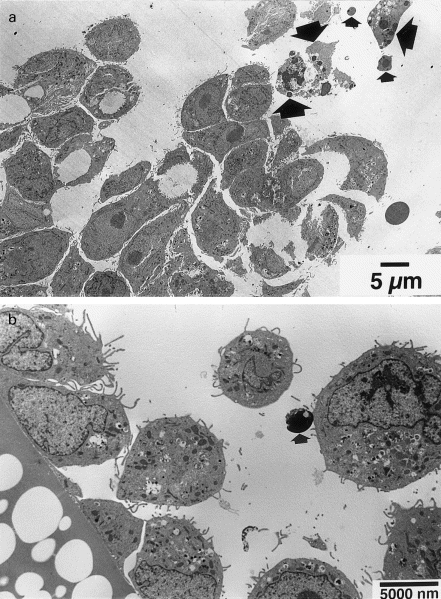
Transmission electron micrographs (TEM) of T84 cells exposed to Bacteroides fragilis toxin (BFT). Confluent monolayers of T84 cells were exposed to 4000 cytotoxic units (CU)/ml of BFT for 96 h before examination by TEM. In both (a) and (b), detached rounded epithelial cells are seen and some of these show characteristic morphological features of cells undergoing apoptosis (large arrows) and also apoptotic bodies (small arrows).
Fig. 3
Fig. 3
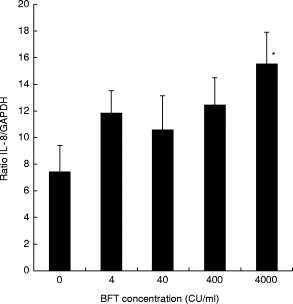
Expression of IL-8 transcripts by T84 cells exposed to Bacteroides fragilis toxin (BFT). Monolayers of T84 cells were exposed for 24 h to medium only or medium containing different concentrations of the toxin (4, 40, 400 or 4000 cytotoxic units (CU)/ml). Total RNA extracted from each sample was used for semiquantitative reverse transcriptase-polymerase chain reaction (RT-PCR) and enzyme-linked oligonucleotide chemiluminescent assay, as explained in Materials and Methods. The expression of IL-8 transcripts in each sample, relative to that of the constitutive marker glyceraldehyde-3-phosphate dehydrogenase (GAPDH), was calculated by dividing the quantified IL-8 PCR products by the corresponding value for GAPDH products. The data represent mean (± s.e.m.) of four separate experiments. *Statistically significant compared with cells grown in control medium (P < 0·05).
Fig. 4
Fig. 4
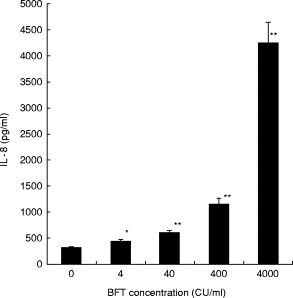
IL-8 production by T84 monolayers exposed to Bacteroides fragilis toxin (BFT). Monolayers of T84 cells were grown to confluence in 12-well plates and exposed to different concentrations of BFT (4, 40, 400 or 4000 cytotoxic units (CU)/ml) or control medium. After 24 h, culture supernatants were collected and assayed for IL-8 levels by ELISA. The data represent mean (± s.e.m.) of six separate experiments. *P < 0·05; **P < 0·001, versus cells grown in control medium.
Fig. 5
Fig. 5
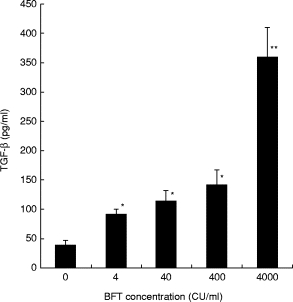
TGF-β1 production by T84 cells exposed to Bacteroides fragilis toxin (BFT). Monolayers of T84 cells were grown to confluence in 12-well plates and exposed to different concentrations of BFT (4, 40, 400 or 4000 cytotoxic units (CU)/ml) or control medium. After 24 h, culture supernatants were collected and acid-treated to activate latent TGF-β. Following neutralization, the supernatant samples were assayed for TGF-β1 levels by ELISA. The data represent mean (± s.e.m.) of six separate experiments. *P < 0·05; **P < 0·001, versus cells grown in control medium.

References

    1. Myers LL, Firehammer BD, Shoop DS, Border MM. Bacteroides fragilis: a possible cause of acute diarrheal disease in newborn lambs. Infect Immun. 1984;44:241–4. - PMC - PubMed
    1. Myers LL, Shoop DS, Firehammer BD, Border MM. Association of enterotoxigenic Bacteroides fragilis with diarrhea disease in calves. J Infect Dis. 1985;152:344–7. - PMC - PubMed
    1. Myers LL, Shoop DS, Byars TD. Diarrhea associated with enterotoxigenic Bacteroides fragilis in foals. Am J Vet Res. 1987;48:1565–7. - PubMed
    1. Myers LL, Shoop DS. Association of enterotoxigenic Bacteroides fragilis with diarrhea disease in young pigs. Am J Vet Res. 1987;48:774–5. - PubMed
    1. Sack RB, Myers LL, Almeido-Hill J, Shoop DS, Bradbury WC, Reid R, Santosham M. Enterotoxigenic Bacteroides fragilis: epidemiologic studies of its role as a human diarrhoeal pathogen. J Diarrhoeal Dis Res. 1992;10:4–9. - PubMed

Publication types

MeSH terms