. 2000 Jan;129(2):323-30.
doi: 10.1038/sj.bjp.0703060.

Effects of mefloquine on cardiac contractility and electrical activity in vivo, in isolated cardiac preparations, and in single ventricular myocytes

Affiliations

Effects of mefloquine on cardiac contractility and electrical activity in vivo, in isolated cardiac preparations, and in single ventricular myocytes

S J Coker et al. Br J Pharmacol. 2000 Jan.

Abstract

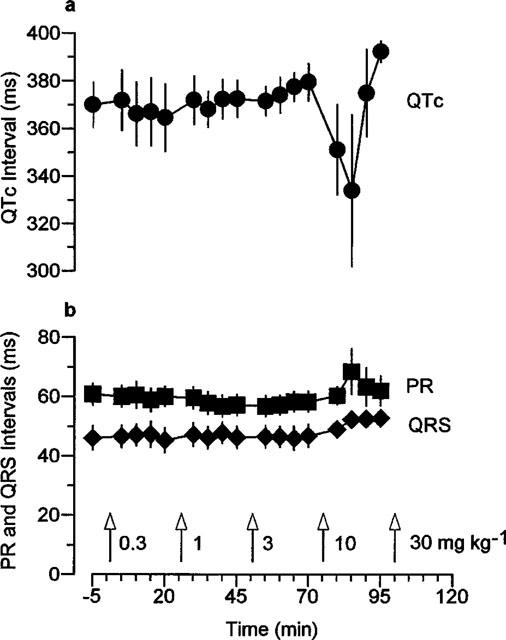
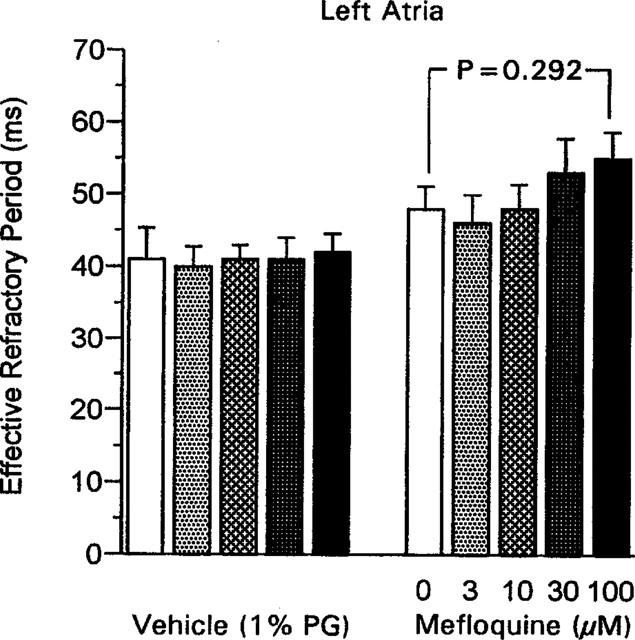
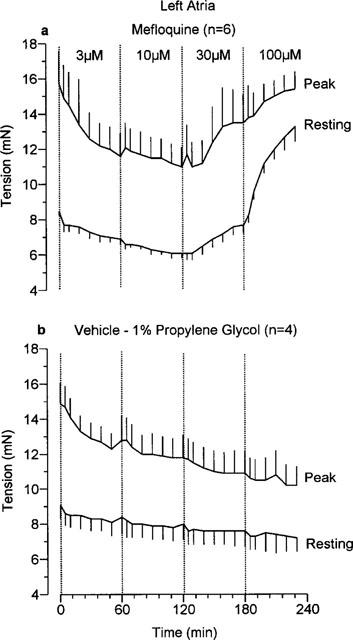
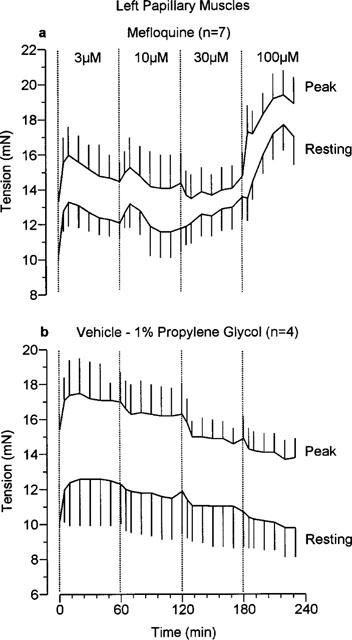
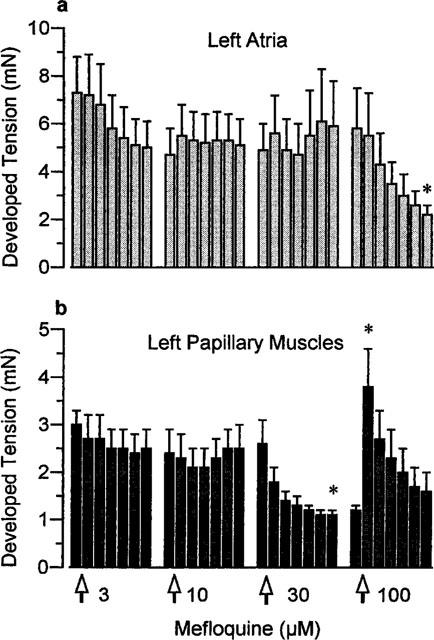
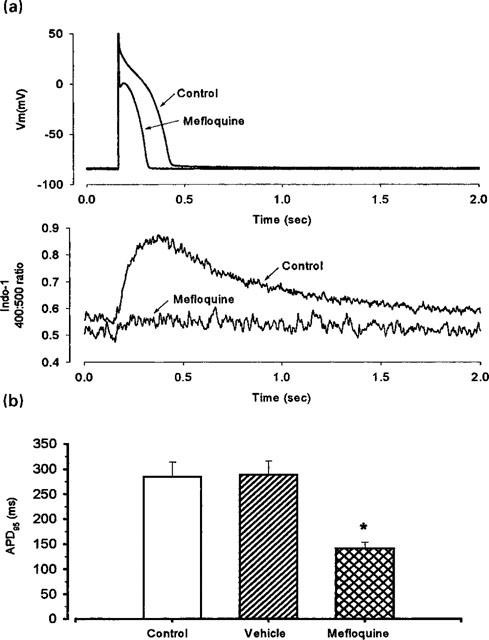
1. To examine the possible cardiotoxicity of the antimalarial drug mefloquine, increasing doses (0.3 - 30 mg kg(-1)) were given i.v. to anaesthetized guinea-pigs. Mefloquine did not alter ECG intervals significantly but gradually increased systolic blood pressure (at 3 mg kg(-1)) then had a depressor effect (at 10 mg kg(-1)). Death due to profound hypotension, probably resulting from cardiac contractile failure or AV block, occurred after either 10 mg kg(-1) (2/6) or 30 mg kg(-1) (4/6) mefloquine. 2. In isolated cardiac preparations mefloquine (3 - 100 microM) did not alter the effective refractory period but at the higher concentrations resting tension increased. Developed tension was reduced by 100 microM mefloquine in left atria (from 5.8+/-1.7 to 2.2+/-0.4 mN) whereas in papillary muscles although 30 microM mefloquine reduced developed tension (from 2. 6+/-0.5 to 1.1+/-0.1 mN) subsequent addition of 100 microM caused a marked, but not sustained, positive inotropic effect (from 1.2+/-0.1 to 3.8+/-0.8 mN). 3. In single ventricular myocytes, mefloquine (10 microM) shortened action potential duration (e.g. APD(90) from 285+/-29 to 141+/-12 ms) and reduced the amplitude of the systolic Ca(2+) transient. 4. These effects were accompanied by a decrease in the L-type Ca(2+) current. These results indicate that the main adverse effect of mefloquine on the heart is a negative inotropic action. This action can be explained by blockade of L-type Ca(2+) channels.


Figures
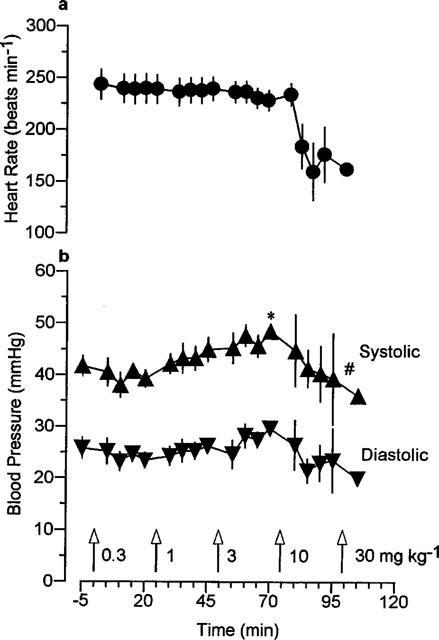
Figure 1
Figure 1
The effects of increasing doses of mefloquine on (a) heart rate and (b) systolic and diastolic arterial blood pressure in anaesthetized guinea-pigs. Values are mean with vertical bars indicating s.e.mean, n=6. *P<0.01 compared with time=−5 min, #P<0.01 compared with time=70 min, Friedman test.
Figure 2
Figure 2
The effects of increasing doses of mefloquine on (a) the QTc interval and (b) the PR and QRS intervals in anaesthetized guinea-pigs. Values are mean with vertical bars indicating s.e.mean, n=6.
Figure 3
Figure 3
The effective refractory period in guinea-pig isolated left atria measured 50 min after addition of each concentration of mefloquine, or equivalent volumes of propylene glycol (PG; 1% final concentration) in the vehicle group. Values are mean with vertical bars indicating s.e.mean; vehicle group n=5, mefloquine group n=6. Statistical comparison, Wilcoxon test.
Figure 4
Figure 4
The effective refractory period in guinea-pig isolated left papillary muscles measured 50 min after addition of each concentration of mefloquine, or equivalent volumes of propylene glycol (PG; 1% final concentration) in the vehicle group. Values are mean with vertical bars indicating s.e.mean; vehicle group n=4, mefloquine group n=7. Statistical comparison, Wilcoxon test.
Figure 5
Figure 5
The effects of (a) mefloquine and (b) vehicle (propylene glycol, 1% final concentration) on resting tension and peak tension (resting+developed tension) in guinea-pig isolated left atria. Values are mean with vertical bars indicating s.e.mean.
Figure 6
Figure 6
The effects of (a) mefloquine and (b) vehicle (propylene glycol, 1% final concentration) on resting tension and peak tension (resting+developed tension) in guinea-pig isolated left papillary muscles. Values are mean with vertical bars indicating s.e.mean.
Figure 7
Figure 7
The effects of mefloquine on the developed tension (peak-resting tension) in (a) left atria (n=6) and (b) left papillary muscles (n=7). Values are mean with vertical bars indicating s.e.mean. *P<0.05 compared with value immediately before addition of that concentration of mefloquine, Wilcoxon test.
Figure 8
Figure 8
Effects of 10 μM mefloquine on the action potential and on the Ca2+ transient. (a) Typical records of action potential (upper traces) and Ca2+ transient (lower traces) during control conditions and after superfusion with 10 μM mefloquine. (b) Mean data from eight cells (from left to right as specified for each bar) showing APD95 under control conditions, during superfusion with vehicle (0.1 % propylene glycol) and with 10 μM mefloquine. Vertical bars indicate s.e.mean. *P<0.05, compared with control, paired t-test.
Figure 9
Figure 9
Mefloquine inhibits the L-type Ca current. The data show current records (top) and changes in [Ca2+]i (as monitored by Indo-1) in a single myocyte before and after perfusing with 10 μM mefloquine. The membrane potential was held at −40 mv and 100 ms duration depolarizing pulses applied to 0 mV at 0.33 Hz. Under these conditions superfusion of the cell with 0.1% propylene glycol did not produce any alterations in the L-type Ca2+ current (not shown).

References

    1. BATEY A.J., LIGHTBOWN I.D., LAMBERT J.P., EDWARDS G., COKER S.J. Comparison of the acute cardiotoxicity of the antimalarial drug halofantrine in vitro and in vivo in anaesthetized guinea pigs. Br. J. Pharmacol. 1997;122:563–569. - PMC - PubMed
    1. BEN-DAVID J., ZIPES D.P. Torsade de pointes and proarrhythmia. Lancet. 1993;341:1578–1582. - PubMed
    1. COKER S.J., BATEY A.J. Mefloquine, an antimalarial drug: effects on the contractile function and the effective refractory period of guinea pig isolated cardiac muscle preparations. Br. J. Pharmacol. 1996;119:95P.
    1. COKER S.J., LIGHTBOWN I.D., HUGHES D.A., LAMBERT J.P., EDWARDS G. Mefloquine potentiates halofantrine-induced QTc prolongation by altering the distribution of halofantrine. Br. J. Pharmacol. 1998;123:88P. - PMC - PubMed
    1. DAVIES T.M.E., DEMBO L.G., KAYE-EDDIE S.A., HEWITT B.J., HISLOP R.G., BATTY K.T. Neurological, cardiovascular and metabolic effects of mefloquine in healthy volunteers: a double blind, placebo-controlled trial. Br. J. Clin. Pharmacol. 1996;42:415–421. - PMC - PubMed

MeSH terms

LinkOut - more resources