. 2000 Mar;66(3):904-8.
doi: 10.1128/AEM.66.3.904-908.2000.

Gene cloning and nucleotide sequencing and properties of a cocaine esterase from Rhodococcus sp. strain MB1

Affiliations

Gene cloning and nucleotide sequencing and properties of a cocaine esterase from Rhodococcus sp. strain MB1

M M Bresler et al. Appl Environ Microbiol. 2000 Mar.

Abstract

A strain of Rhodococcus designated MB1, which was capable of utilizing cocaine as a sole source of carbon and nitrogen for growth, was isolated from rhizosphere soil of the tropane alkaloid-producing plant Erythroxylum coca. A cocaine esterase was found to initiate degradation of cocaine, which was hydrolyzed to ecgonine methyl ester and benzoate; both of these esterolytic products were further metabolized by Rhodococcus sp. strain MB1. The structural gene encoding a cocaine esterase, designated cocE, was cloned from Rhodococcus sp. strain MB1 genomic libraries by screening recombinant strains of Rhodococcus erythropolis CW25 for growth on cocaine. The nucleotide sequence of cocE corresponded to an open reading frame of 1,724 bp that codes for a protein of 574 amino acids. The amino acid sequence of cocaine esterase has a region of similarity with the active serine consensus of X-prolyl dipeptidyl aminopeptidases, suggesting that the cocaine esterase is a serine esterase. The cocE coding sequence was subcloned into the pCFX1 expression plasmid and expressed in Escherichia coli. The recombinant cocaine esterase was purified to apparent homogeneity and was found to be monomeric, with an M(r) of approximately 65,000. The apparent K(m) of the enzyme (mean +/- standard deviation) for cocaine was measured as 1.33 +/- 0.085 mM. These findings are of potential use in the development of a linked assay for the detection of illicit cocaine.


Figures
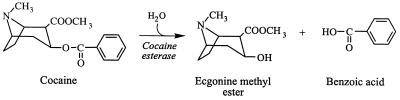
FIG. 1
FIG. 1
Cocaine esterase reaction.
FIG. 2
FIG. 2
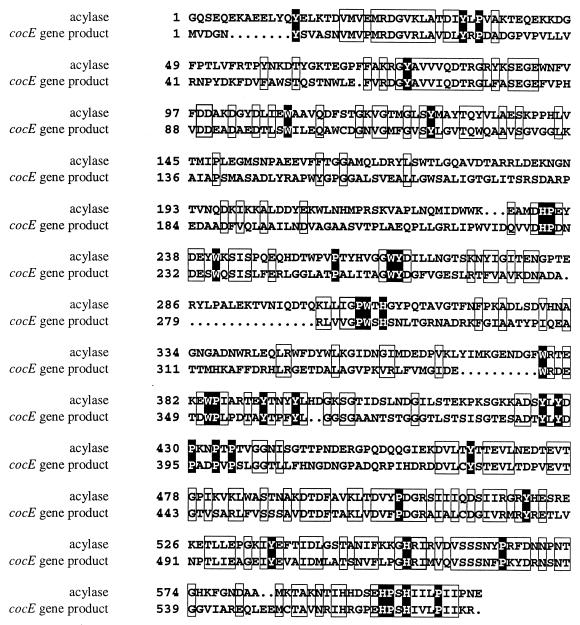
Alignment of protein encoded by cocE with glutaryl 7-aminocephalosporanic acid acylase. The deduced amino acid sequence of the putative cocaine esterase encoded by cocE was aligned with the amino acid sequence of the glutaryl 7-aminocephalosporanic acid acylase from B. laterosporus J1 (3). The alignment was constructed using the software package MACAW (version 2.05; National Center for Biotechnology Information, National Library of Medicine) and the BLOSUM62 matrix. Dots indicate gaps introduced to maximize the alignment. Pairwise scores from 0 to 33% are not shaded, scores from 33 to 67% are boxed, and scores from 67 to 100% are shaded black, where 100% is the maximum score for the BLOSUM62 matrix.
FIG. 3
FIG. 3
Alignment of cocaine esterase with X-prolyl dipeptidyl aminopeptidases from lactic acid bacteria. The amino acid sequence of a region of the cocaine esterase encoded by cocE (cocE) was aligned with the homologous regions of five cloned X-prolyl dipeptidyl aminopeptidases from Lactobacillus and Lactococcus spp. (labeled by accession no.) (6, 18, 19, 23, 27, 29, 30). The alignment was constructed using the software package MACAW (version 2.05; National Center for Biotechnology Information, National Library of Medicine) and the BLOSUM62 matrix. Mean scores from 0 to 33% are not shaded, mean scores from 33 to 67% are boxed, and mean scores from 67 to 100% are shaded black, where 100% is the maximum mean score for the BLOSUM62 matrix. The G-X-S-Y-X-G consensus sequence surrounding the active-site serine (*) in the three known X-prolyl dipeptidyl aminopeptidases (mammalian, yeast, and bacterial) is indicated (X is a nonconserved amino acid).
FIG. 4
FIG. 4
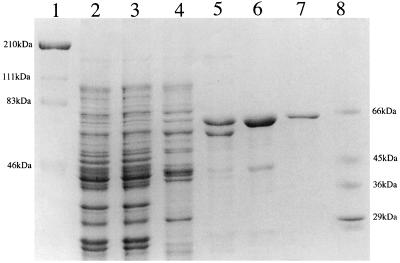
SDS-PAGE analysis of the purification of cocaine esterase from recombinant E. coli. Lanes 1 and 8, high- and low-range molecular mass markers; lane 2, cell extract from E. coli JM109/pCOC2; lane 3, product after ammonium sulfate fractionation; lanes 4 to 6, cocaine esterase activity obtained after hydrophobic-interaction chromatography, anion-exchange chromatography, and hydroxylapatite chromatography, respectively; lane 7, purified cocaine esterase (2 μg).

References

    1. Altschul S F, Gish W, Miller W, Meyers E W, Lipman D J. Basic local alignment search tool. J Mol Biol. 1990;215:403–410. - PubMed
    1. Andersen S J, Quan S, Gowan B, Dabbs E R. Monooxygenase-like sequence of a Rhodococcus equi gene conferring increased resistance to rifampin by inactivating this antibiotic. Antimicrob Agents Chemother. 1997;41:218–221. - PMC - PubMed
    1. Aramori I, Fukagawa M, Tsumura M, Iwami M, Ono H, Kojo H, Kohsaka M, Ueda Y, Imanaka H. Cloning and nucleotide sequencing of a novel 7β-(4-carboxybutanamido)cephalosporanic acid acylase gene of Bacillus laterosporus and its expression in Escherichia coli and Bacillus subtilis. J Bacteriol. 1991;173:7848–7855. - PMC - PubMed
    1. Britt A J, Bruce N C, Lowe C R. Identification of a cocaine esterase in a strain of Pseudomonas maltophilia. J Bacteriol. 1992;174:2087–2094. - PMC - PubMed
    1. Cameron G W W, Jordan K N, Holt P-J, Baker P B, Lowe C R, Bruce N C. Identification of a heroin esterase in Rhodococcus sp. strain H1. Appl Environ Microbiol. 1994;60:3881–3883. - PMC - PubMed

Publication types

MeSH terms

Associated data