. 2000 Mar;66(3):956-65.
doi: 10.1128/AEM.66.3.956-965.2000.

Increase in bacterial community diversity in subsurface aquifers receiving livestock wastewater input

Affiliations

Increase in bacterial community diversity in subsurface aquifers receiving livestock wastewater input

J C Cho et al. Appl Environ Microbiol. 2000 Mar.

Abstract

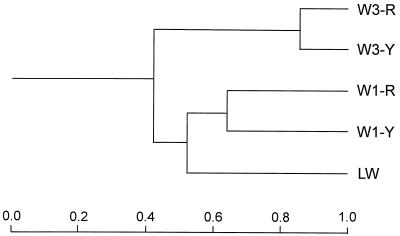
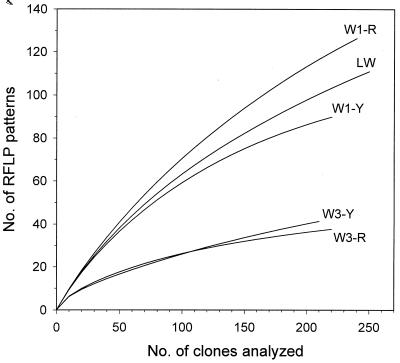
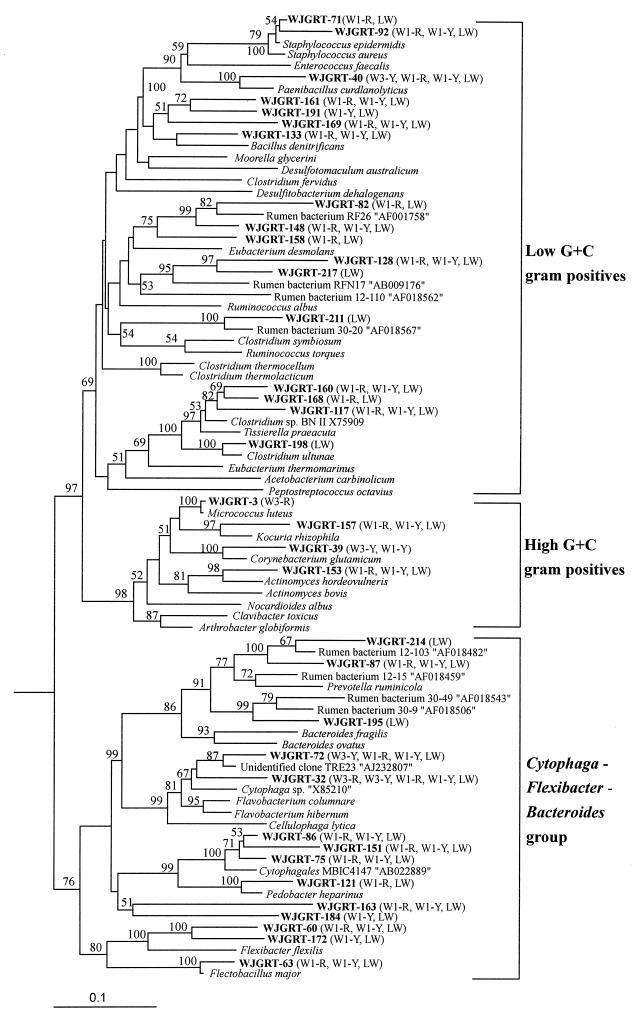
Despite intensive studies of microbial-community diversity, the questions of which kinds of microbial populations are associated with changes in community diversity have not yet been fully solved by molecular approaches. In this study, to investigate the impact of livestock wastewater on changes in the bacterial communities in groundwater, bacterial communities in subsurface aquifers were analyzed by characterizing their 16S rDNA sequences. The similarity coefficients of restriction fragment length polymorphism (RFLP) patterns of the cloned 16S ribosomal DNAs showed that the bacterial communities in livestock wastewater samples were more closely related to those in contaminated aquifer samples. In addition, calculations of community diversity clearly showed that bacterial communities in the livestock wastewater and the contaminated aquifer were much more diverse than those in the uncontaminated aquifer. Thus, the increase in bacterial-community diversity in the contaminated aquifer was assumed to be due to the infiltration of livestock wastewater, containing high concentrations of diverse microbial flora, into the aquifer. Phylogenetic analysis of the sequences from a subset of the RFLP patterns showed that the Cytophaga-Flexibacter-Bacteroides and low-G+C gram-positive groups originating from livestock wastewater were responsible for the change in the bacterial community in groundwater. This was evidenced by the occurrence of rumen-related sequences not only in the livestock wastewater samples but also in the contaminated-groundwater samples. Rumen-related sequences, therefore, can be used as indicator sequences for fecal contamination of groundwater, particularly from livestock.


Figures
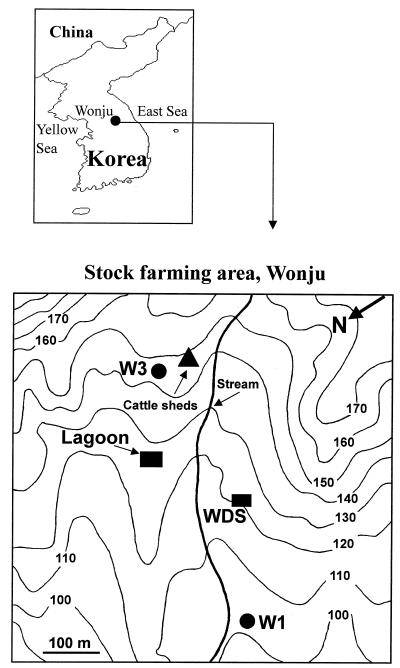
FIG. 1
FIG. 1
Locations of sampling sites and boreholes drilled at a livestock farming area in Wonju, Korea. Numbers on the contours show altitudes above sea level (in meters). W3, used as an uncontaminated control, is a 120-m-deep borehole located adjacent to the cattle sheds. Borehole W1 is located downstream from the lagoon and the livestock waste disposal sites and is contaminated with livestock wastewater. Livestock wastewater samples were taken from a livestock wastewater storage lagoon (Lagoon) and an animal waste dump site (WDS).
FIG. 2
FIG. 2
Dendrogram of 16S rDNA RFLP similarities among five clone libraries calculated on the basis of similarity coefficients with the clustering algorithm of UPGMA. See Materials and Methods for designations.
FIG. 3
FIG. 3
RFLP pattern richness curves of the five clone libraries obtained by 16S rDNA PCR-RFLP patterns. Sampling curves were calculated by rarefaction (28, 34). For designations, see Materials and Methods.
FIG. 4
FIG. 4
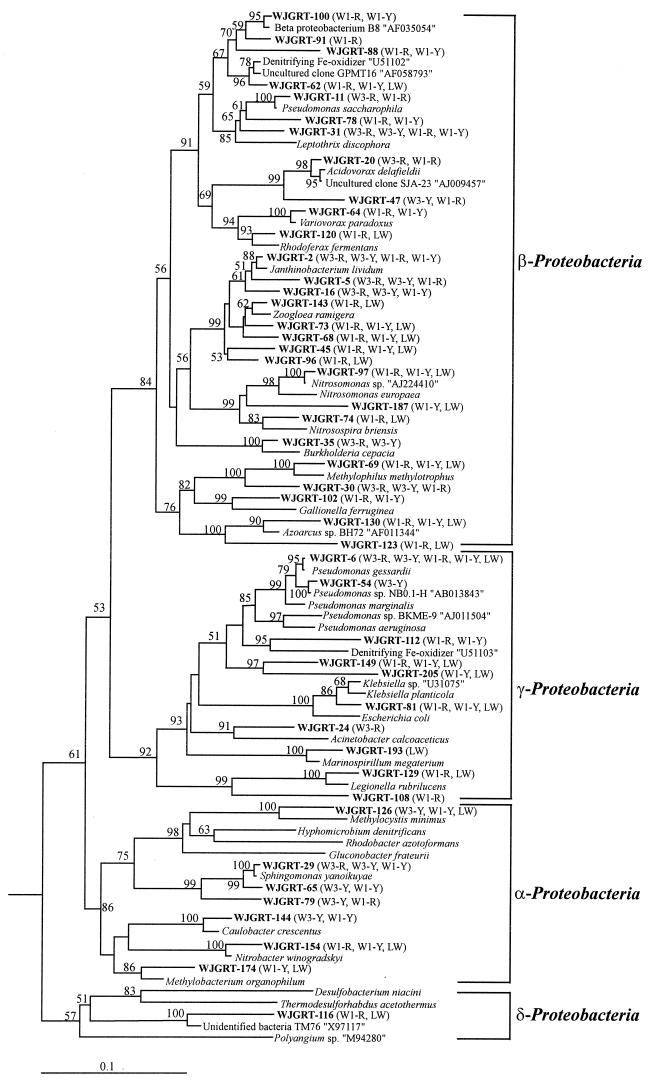
Phylogenetic tree generated by the neighbor-joining method showing the phylogenetic relationships among Wonju groundwater and livestock wastewater clones within the Proteobacteria based on analysis of ca. 400 bases of aligned 16S rDNA sequences. Bootstrap values are shown for each node that had >50% support in a bootstrap analysis of 200 replicates. Sequences obtained from samples are designated in boldface by the prefix WJGRT, followed by replicate numbers (WJGRT-1, WJGRT-2, etc.). The clone libraries from which the individual 16S rDNA clone sequences came are given in parenthesis. GenBank accession numbers of environmental clones or unclassified cultural isolates are given in quotation marks. Actinomyces bovis in the high-G+C gram-positive group served as the outgroup organism. The scale bar indicates 0.1 change per nucleotide.
FIG. 5
FIG. 5
Phylogenetic tree generated by the neighbor-joining method showing the phylogenetic relationships among Wonju groundwater and livestock wastewater clones within the high-G+C gram-positive group, the low-G+C gram-positive group, and the Cytophaga-Flexibacter-Bacteroides group based on analysis of ca. 400 bases of aligned 16S rDNA sequences. For sequence nomenclature, clone libraries in parentheses, accession numbers in quotation marks, and support for branch points, see the legend to Fig. 4. E. coli in the γ-Proteobacteria served as the outgroup organism. The scale bar indicates 0.1 change per nucleotide.
FIG. 6
FIG. 6
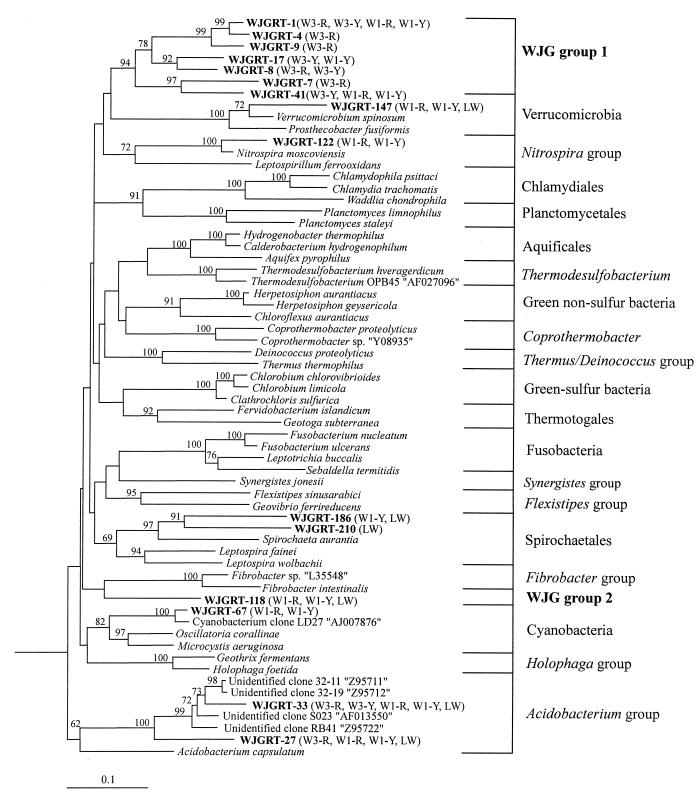
Phylogenetic tree generated by the neighbor-joining method showing the phylogenetic relationships among Wonju groundwater and livestock wastewater clones within the Bacteria based on analysis of ca. 400 bases of aligned 16S rDNA sequences. Only sequences that are not assigned to the Proteobacteria, the high-G+C gram-positive group, the low-G+C gram-positive group, or the Cytophaga-Flexibacter-Bacteroides group are represented in the tree. For sequence nomenclature, clone libraries in parentheses, accession numbers in quotation marks, and support for branch points, see the legend to Fig. 4. Methanobacterium thermoflexum in the Archaea served as the outgroup organism. The scale bar indicates 0.1 change per nucleotide.

References

    1. Altschul S F, Madden T L, Schäffer A A, Zhang J, Zhang Z, Miller W, Lipman D J. Gapped BLAST and PSI-BLAST: a new generation of protein database search programs. Nucleic Acids Res. 1997;25:3389–3402. - PMC - PubMed
    1. Amann R, Snaidr J, Wagner M, Ludwig W, Schleifer K-H. In situ visualization of high genetic diversity in a natural microbial community. J Bacteriol. 1996;178:3496–3500. - PMC - PubMed
    1. Amann R I, Ludwig W, Schleifer K-H. Phylogenetic identification and in situ detection of individual microbial cells without cultivation. Microbiol Rev. 1995;59:143–169. - PMC - PubMed
    1. Atlas R M, Horowitz A, Krichevsky M, Bej A K. Response of microbial populations to environmental disturbance. Microb Ecol. 1991;22:249–256. - PubMed
    1. Barns S M, Takala S L, Kuske C R. Wide distribution and diversity of members of the bacterial kingdom Acidobacterium in the environment. Appl Environ Microbiol. 1999;65:1731–1737. - PMC - PubMed

Publication types

MeSH terms

Associated data

LinkOut - more resources