. 2000 Mar;66(3):1007-19.
doi: 10.1128/AEM.66.3.1007-1019.2000.

Degradation and mineralization of high-molecular-weight polycyclic aromatic hydrocarbons by defined fungal-bacterial cocultures

Affiliations

Degradation and mineralization of high-molecular-weight polycyclic aromatic hydrocarbons by defined fungal-bacterial cocultures

S Boonchan et al. Appl Environ Microbiol. 2000 Mar.

Abstract

This study investigated the biodegradation of high-molecular-weight polycyclic aromatic hydrocarbons (PAHs) in liquid media and soil by bacteria (Stenotrophomonas maltophilia VUN 10,010 and bacterial consortium VUN 10,009) and a fungus (Penicillium janthinellum VUO 10, 201) that were isolated from separate creosote- and manufactured-gas plant-contaminated soils. The bacteria could use pyrene as their sole carbon and energy source in a basal salts medium (BSM) and mineralized significant amounts of benzo[a]pyrene cometabolically when pyrene was also present in BSM. P. janthinellum VUO 10,201 could not utilize any high-molecular-weight PAH as sole carbon and energy source but could partially degrade these if cultured in a nutrient broth. Although small amounts of chrysene, benz[a]anthracene, benzo[a]pyrene, and dibenz[a,h]anthracene were degraded by axenic cultures of these isolates in BSM containing a single PAH, such conditions did not support significant microbial growth or PAH mineralization. However, significant degradation of, and microbial growth on, pyrene, chrysene, benz[a]anthracene, benzo[a]pyrene, and dibenz[a,h]anthracene, each as a single PAH in BSM, occurred when P. janthinellum VUO 10,201 and either bacterial consortium VUN 10,009 or S. maltophilia VUN 10,010 were combined in the one culture, i.e., fungal-bacterial cocultures: 25% of the benzo[a]pyrene was mineralized to CO(2) by these cocultures over 49 days, accompanied by transient accumulation and disappearance of intermediates detected by high-pressure liquid chromatography. Inoculation of fungal-bacterial cocultures into PAH-contaminated soil resulted in significantly improved degradation of high-molecular-weight PAHs, benzo[a]pyrene mineralization (53% of added [(14)C]benzo[a]pyrene was recovered as (14)CO(2) in 100 days), and reduction in the mutagenicity of organic soil extracts, compared with the indigenous microbes and soil amended with only axenic inocula.


Figures
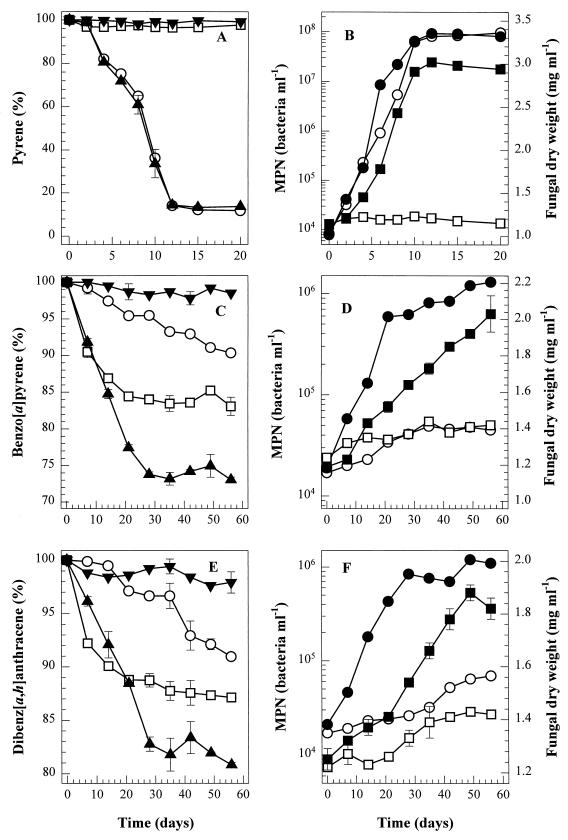
FIG. 1
FIG. 1
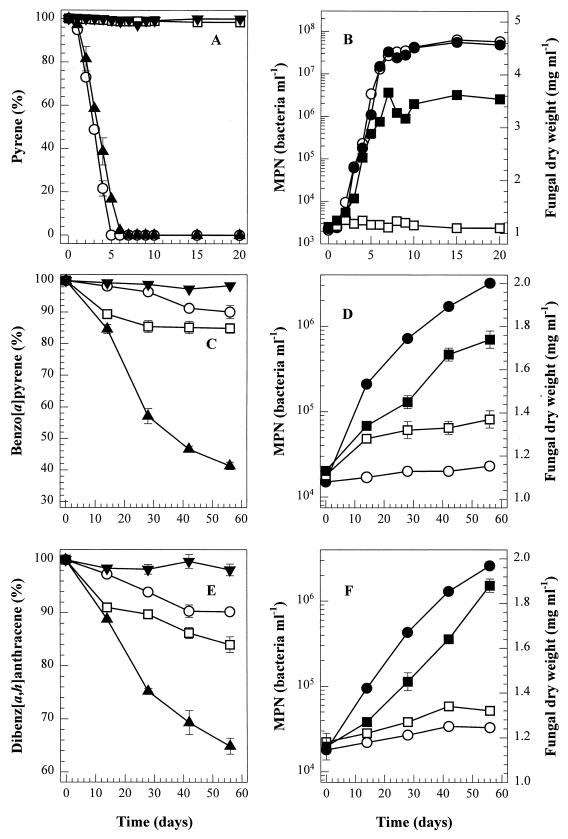
PAH degradation by P. janthinellum VUO 10,201 (□), bacterial consortium VUN 10,009 (○), or coculture A (▴). BSM contained 250 mg of pyrene (A and B), 50 mg of benzo[a]pyrene (C and D), or 50 mg of dibenz[a,h]anthracene (E and F) per liter. Test cultures were sampled in triplicate, and HgCl2-killed coculture A (▾) was sampled in duplicate, for measurement of bacterial numbers (axenic cultures [○] and coculture A [●]) and fungal dry weight (axenic cultures [□] and coculture A [■]).
FIG. 2
FIG. 2
PAH degradation by P. janthinellum VUO 10,201 (□), S. maltophilia VUN 10,010 (○), or coculture B (▴). BSM contained 250 mg of pyrene (A and B), 50 mg of benzo[a]pyrene (C and D), or 50 mg of dibenz[a,h]anthracene (E and F) per liter. Test cultures were sampled in triplicate, and HgCl2-killed coculture B (▾) was sampled in duplicate, for measurement of bacterial numbers (axenic cultures [○] and coculture B [●]) and fungal dry weight (axenic cultures [□] and coculture B [■]).
FIG. 3
FIG. 3
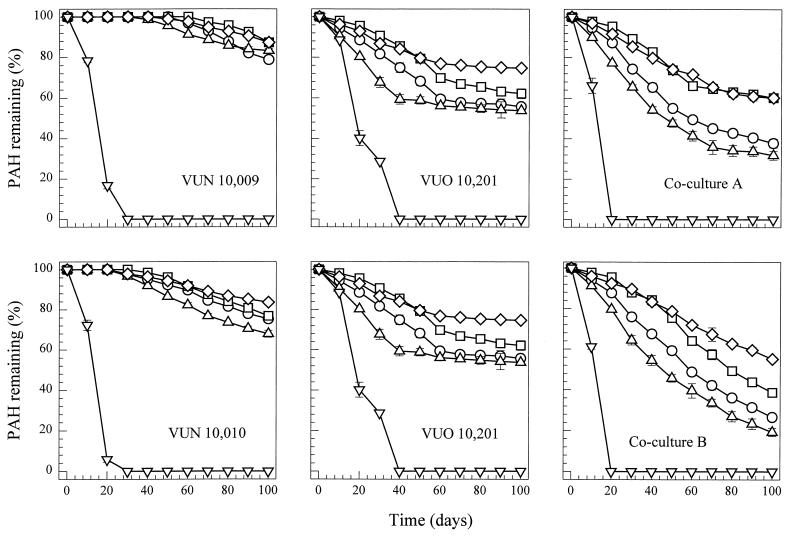
Degradation of pyrene (▿), benz[a]anthracene (□), chrysene (○), benzo[a]pyrene (▵), and dibenz[a,h]anthracene (◊) in PAH-spiked soil inoculated with either coculture A, coculture B, or axenic cultures of bacterial consortium VUN 10,009, S. maltophilia VUN 10,010, or P. janthinellum VUO 10,201. The soil was spiked with the following (milligrams per kilogram): fluorene, 100; phenanthrene and pyrene, 250; and fluoranthene, benz[a]anthracene, chrysene, benzo[a]pyrene, and dibenz[a,h]anthracene, 50. Data presented account for PAH disappearance in the HgCl2-killed controls, and all samples were assayed in triplicate.
FIG. 4
FIG. 4
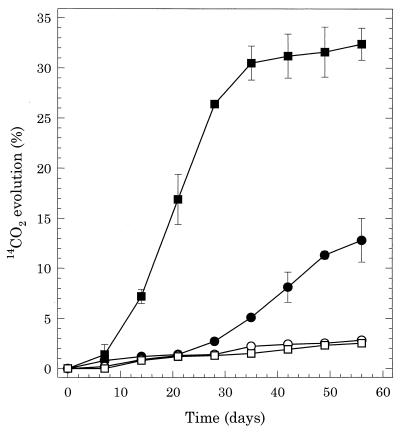
Comineralization of [14C]benzo[a]pyrene in BSM containing pyrene (250 mg liter−1) and benzo[a]pyrene (50 mg liter−1) by either bacterial consortium VUN 10,009 (●) or S. maltophilia VUN 10,010 (■) and their HgCl2-killed controls (VUN 10,009 [○] and VUN 10,010 [□]). The degree of mineralization was calculated as the cumulative percentage of 14CO2 evolved relative to the amount of added label.
FIG. 5
FIG. 5
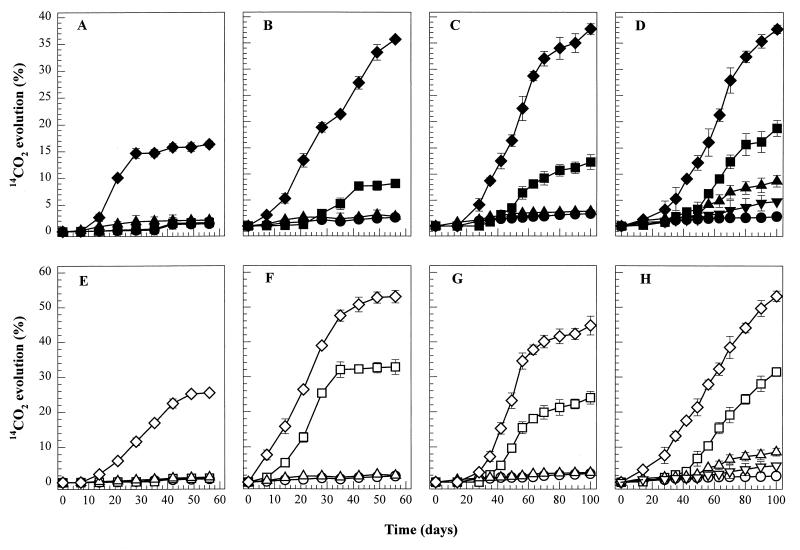
Benzo[a]pyrene mineralization in liquid and soil cultures. [14C]benzo[a]pyrene was added to BSM containing benzo[a]pyrene (50 mg liter−1) (A and E), BSM with a PAH mixture (B and F), PAH-spiked soil (C and G), and PAH-contaminated soil from Sydney (D and H). The upper panels show data for axenic cultures inoculated with either P. janthinellum VUO 10,201 (▴), bacterial consortium VUN 10,009 (■), or coculture A (⧫). The lower panels show data for axenic cultures of either VUO 10,201 (▵) or S. maltophilia VUN 10,010 (□) and coculture B (◊). Cumulative 14CO2 evolution (percentage relative to added label) is also shown for HgCl2-killed controls of cocultures A (●) and B (○) and for uninoculated, PAH-contaminated soil (▾ and ▿), which was presumably due to the indigenous microbial activity.
FIG. 6
FIG. 6
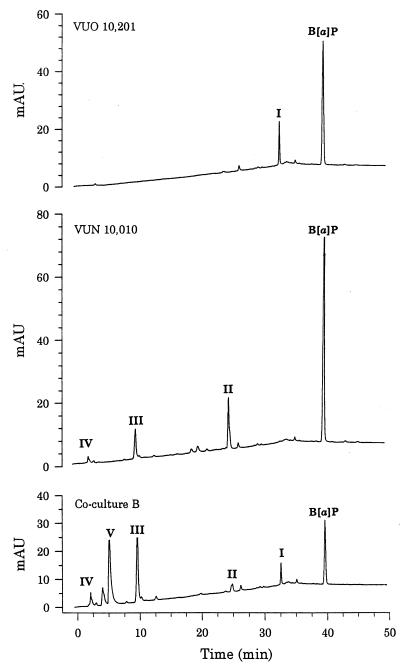
Production of unidentified compounds by axenic cultures of P. janthinellum VUO 10,201 or S. maltophilia VUN 10,010 and by coculture B during incubation in BSM containing benzo[a]pyrene (50 mg liter−1). The HPLC profiles for DCM extracts of 28-day samples are shown, with unidentified compounds arbitrarily named I to V. mAU, milliabsorbance units.
FIG. 7
FIG. 7
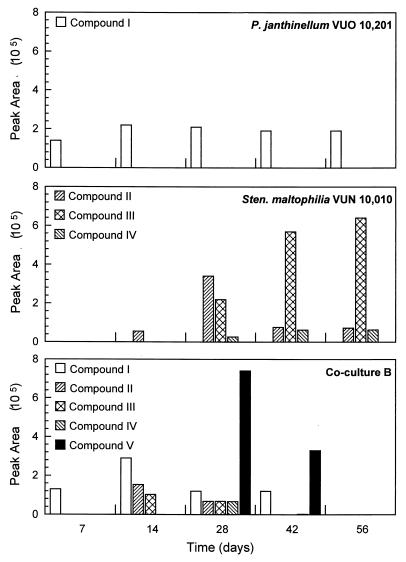
Time course of compounds formed in axenic cultures of P. janthinellum VUO 10,201 or S. maltophilia VUN 10,010 and by coculture B during incubation in BSM containing benzo[a]pyrene (50 mg liter−1). The data represent peak areas of compounds detected by HPLC during degradation of benzo[a]pyrene as sole carbon and energy source, where compounds are numbered as described in the legend to Fig. 6.

References

    1. Anderson B E, Henrysson T. Accumulation and degradation of dead-end metabolites during treatment of soil contaminated with polycyclic aromatic hydrocarbons with five strains of white-rot fungi. Appl Microbiol Biotechnol. 1996;46:647–652.
    1. Barclay C D, Farquhar G F, Legge R L. Biodegradation and sorption of polyaromatic hydrocarbons by Phanerochaete chrysosporium. Appl Microbiol Biotechnol. 1995;42:958–963. - PubMed
    1. Bezalel L, Hadar Y, Fu P P, Freeman J P, Cerniglia C E. Initial oxidation products in the metabolism of pyrene, anthracene, fluorene, and dibenzothiophene by the white rot fungus Pleurotus ostreatus. Appl Environ Microbiol. 1996;62:2554–2559. - PMC - PubMed
    1. Bogan B W, Lamar R T. Polycyclic aromatic hydrocarbon-degrading capabilities of Phanerochaete laevis HHB-1625 and its extracellular ligninolytic enzymes. Appl Environ Microbiol. 1996;62:1597–1603. - PMC - PubMed
    1. Boldrin B, Tiehm A, Fritsche C. Degradation of phenanthrene, fluorene, fluoranthene, and pyrene by a Mycobacterium sp. Appl Environ Microbiol. 1993;59:1927–1930. - PMC - PubMed

Publication types

LinkOut - more resources