


Evaluation of a capacitance method for direct antifungal susceptibility testing of yeasts in positive blood cultures
- PMID: 10698982
- PMCID: PMC86316
- DOI: 10.1128/JCM.38.3.971-976.2000
Evaluation of a capacitance method for direct antifungal susceptibility testing of yeasts in positive blood cultures
Abstract
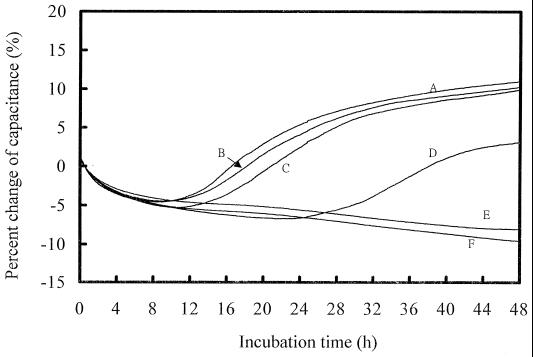
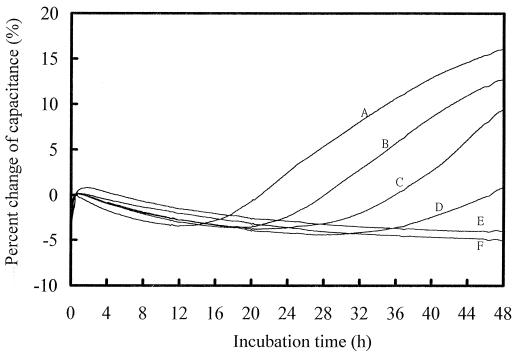
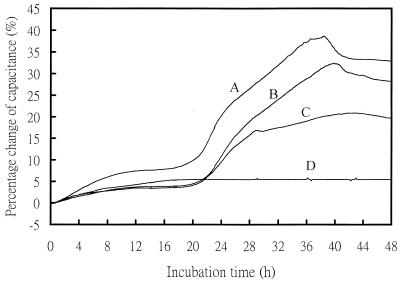
The feasibility of using a capacitance method (CM) for direct antifungal susceptibility testing of yeasts in positive blood cultures was evaluated. The CM used the same test conditions as those recommended by the National Committee for Clinical Laboratory Standards. After direct inoculation of positive culture broths into module wells (Bactometer; bioMérieux, Inc., Hazelwood, Mo.), the end-point determination was made by monitoring the capacitance change in the culture broths with Bactometer. The MIC of amphotericin B was the lowest concentration at which yeast growth was completely inhibited, while the MICs of ketoconazole, flucytosine, and fluconazole were the concentrations at which a >/=80% reduction in capacitance change was observed. The MICs of the four drugs against each blood isolate obtained on subculture plates were also determined by the macrodilution method. For 51 positive blood cultures tested, the percent agreement (+/-2 log(2) dilutions) between the CM and the macrodilution method were as follows: amphotericin B (98%), ketoconazole (92%), flucytosine (84%), and fluconazole (96%). The CM was further used for breakpoint susceptibility testing of fluconazole (8 and 64 microg/ml) and flucytosine (4 and 32 microg/ml) against yeasts in positive blood cultures. After testing of 74 specimens by the CM, flucytosine and fluconazole produced one (1.4%) major error and two (2.8%) minor errors, respectively. All yeasts that displayed resistance to flucytosine or fluconazole were detected within 24 h after direct inoculation of the positive broths into Bactometer. The CM may be useful for the rapid detection of antifungal resistance in positive blood cultures containing yeasts.
Figures
References
-
- Anaissie E J, Bodey G P, Rinaldi M G. Emerging fungal pathogens. Eur J Clin Microbiol Infect Dis. 1989;8:323–330. - PubMed
-
- Banerjee S N, Emori T G, Culver D H, Gaynes R P, Jarvis W R, Horan T, Edwards J R, Tolson J, Henderson T, Martone W J. Secular trends in nosocomial primary bloodstream infections in the United States, 1980–1989. National Nosocomial Infections Surveillance System. Am J Med. 1991;91(Suppl. 3B):86S–89S. - PubMed
-
- Beck-Sague C, Jarvis W R. Secular trends in the epidemiology of nosocomial fungal infections in the United States, 1980–1990. National Nosocomial Infections Surveillance System. J Infect Dis. 1993;167:1247–1251. - PubMed
-
- Chen Y C, Chang S C, Sun C C, Yang L S, Hseih W C, Luh K T. Secular trends in the epidemiology of nosocomial fungal infections at a teaching hospital in Taiwan, 1981 to 1993. Infect Control Hosp Epidemiol. 1997;18:369–375. - PubMed
Publication types
MeSH terms
Substances
LinkOut - more resources
Full Text Sources
