


Expression of nuclear beta-catenin and c-myc is correlated with tumor size but not with proliferative activity of colorectal adenomas
- PMID: 10702403
- PMCID: PMC1876834
- DOI: 10.1016/s0002-9440(10)64955-3
Expression of nuclear beta-catenin and c-myc is correlated with tumor size but not with proliferative activity of colorectal adenomas
Abstract
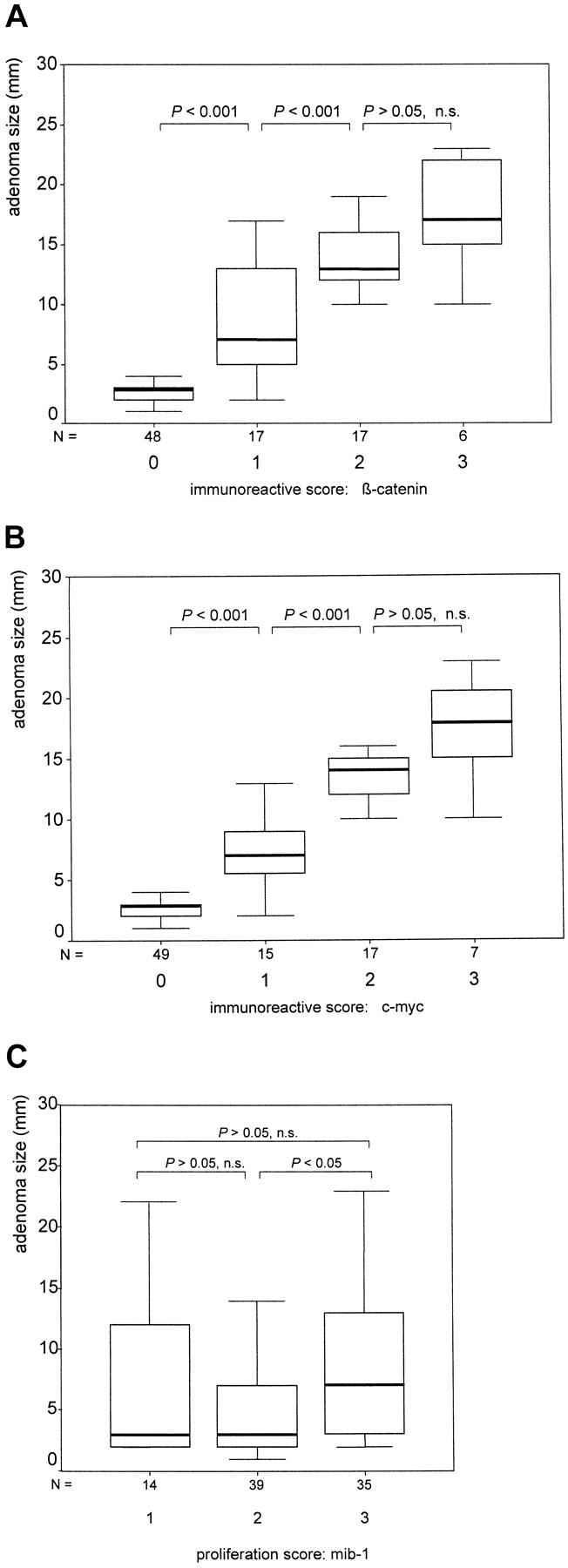
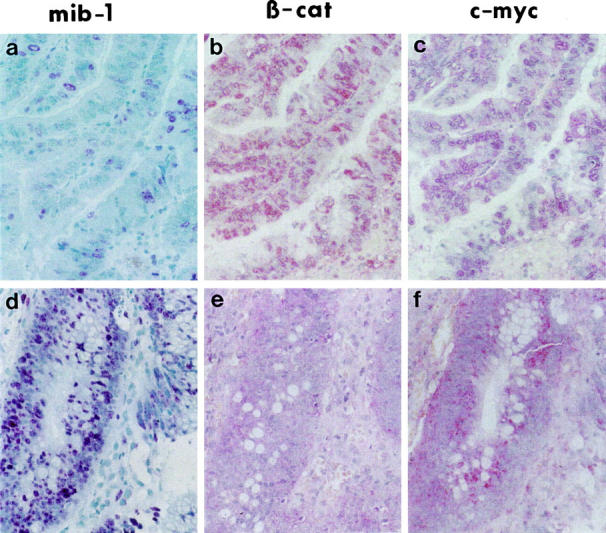
Most colorectal cancers have loss-of-function mutations in the adenomatosis polyposis coli (APC) tumor suppressor gene. This leads to the accumulation of nuclear beta-catenin, which, together with the DNA-binding protein TCF-4, functions as a transcriptional activator. The recently defined target genes c-myc, cyclin D1, and matrilysin are responsible for tumor proliferation or malignant progression and explain the oncogenic potential of nuclear beta-catenin. To investigate its role in early colon carcinogenesis, we analyzed the expression of beta-catenin, its target gene c-myc, and the proliferative activity in 88 colorectal adenomas of varying size and grade of dysplasia. The results revealed i) the most significant correlation of nuclear beta-catenin and c-myc expression was not with the grade of dysplasia but with the size of the colon adenoma; ii) perfect correlation of nuclear beta-catenin and c-myc expression; iii) no significant correlation of adenoma size with the proliferative activity; and iv) no significant correlation of proliferative activity and the nuclear expression of beta-catenin and c-myc. These results imply that APC mutations have additional beta-catenin-independent functions; APC mutations alone are not sufficient for nuclear overexpression of beta-catenin; and nuclear beta-catenin has additional important functions for exceeding a threshold tumor size.
Figures
References
-
- Kinzler KW, Vogelstein B: Lessons from hereditary colorectal cancer. Cell 1996, 87:159-170 - PubMed
-
- Korinek V, Barker N, Morin PJ, van Wichen D, de Weger R, Kinzler KW, Vogelstein B, Clevers H: Constitutive transcriptional activation by a β-catenin-Tcf complex in APC−/− colon carcinoma. Science 1997, 275:1784-1787 - PubMed
-
- Morin PJ, Sparks AB, Korinek V, Barker N, Clevers H, Vogelstein B, Kinzler KW: Activation of β-catenin-Tcf signaling in colon cancer by mutations in β-catenin or APC. Science 1997, 275:1787-1790 - PubMed
-
- He TC, Sparks AB, Rago C, Hermeking H, Zawel L, da Costa LT, Morin PJ, Vogelstein B, Kinzler KW: Identification of c-myc as a target of the APC pathway. Science 1998, 281:1509-1512 - PubMed
-
- Tetsu O, McCormick F: Beta-catenin regulates expression of cyclin D1 in colon carcinoma cells. Nature 1999, 398:422-426 - PubMed
MeSH terms
Substances
LinkOut - more resources
Full Text Sources
Medical
Research Materials
Miscellaneous
