Review
. 2000 Feb;130(3):277-97.
doi: 10.1007/s002210050033.

Afferent diversity and the organization of central vestibular pathways

Affiliations
Review

Afferent diversity and the organization of central vestibular pathways

J M Goldberg. Exp Brain Res. 2000 Feb.

Abstract

This review considers whether the vestibular system includes separate populations of sensory axons innervating individual organs and giving rise to distinct central pathways. There is a variability in the discharge properties of afferents supplying each organ. Discharge regularity provides a marker for this diversity since fibers which differ in this way also differ in many other properties. Postspike recovery of excitability determines the discharge regularity of an afferent and its sensitivity to depolarizing inputs. Sensitivity is small in regularly discharging afferents and large in irregularly discharging afferents. The enhanced sensitivity of irregular fibers explains their larger responses to sensory inputs, to efferent activation, and to externally applied galvanic currents, but not their distinctive response dynamics. Morphophysiological studies show that regular and irregular afferents innervate overlapping regions of the vestibular nuclei. Intracellular recordings of EPSPs reveal that some secondary vestibular neurons receive a restricted input from regular or irregular afferents, but that most such neurons receive a mixed input from both kinds of afferents. Anodal currents delivered to the labyrinth can result in a selective and reversible silencing of irregular afferents. Such a functional ablation can provide estimates of the relative contributions of regular and irregular inputs to a central neuron's discharge. From such estimates it is concluded that secondary neurons need not resemble their afferent inputs in discharge regularity or response dynamics. Several suggestions are made as to the potentially distinctive contributions made by regular and irregular afferents: (1) Reflecting their response dynamics, regular and irregular afferents could compensate for differences in the dynamic loads of various reflexes or of individual reflexes in different parts of their frequency range; (2) The gating of irregular inputs to secondary VOR neurons could modify the operation of reflexes under varying behavioral circumstances; (3) Two-dimensional sensitivity can arise from the convergence onto secondary neurons of otolith inputs differing in their directional properties and response dynamics; (4) Calyx afferents have relatively low gains when compared with irregular dimorphic afferents. This could serve to expand the stimulus range over which the response of calyx afferents remains linear, while at the same time preserving the other features peculiar to irregular afferents. Among those features are phasic response dynamics and large responses to efferent activation; (5) Because of the convergence of several afferents onto each secondary neuron, information transmission to the latter depends on the gain of individual afferents, but not on their discharge regularity.


Figures
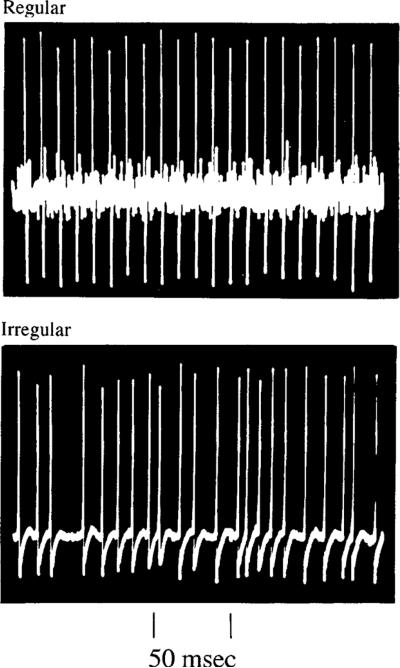
Fig. 1
Fig. 1
Discharge regularity in vestibular-nerve afferents. Spike trains from two afferents, each innervating the superior crista in a squirrel monkey. Both fibers are firing at nearly the same rate, slightly less than 100 spikes/s. The top unit has a regular discharge, the bottom unit an irregular discharge. From Goldberg and Fernández (1971a)
Fig. 2A, B
Fig. 2A, B
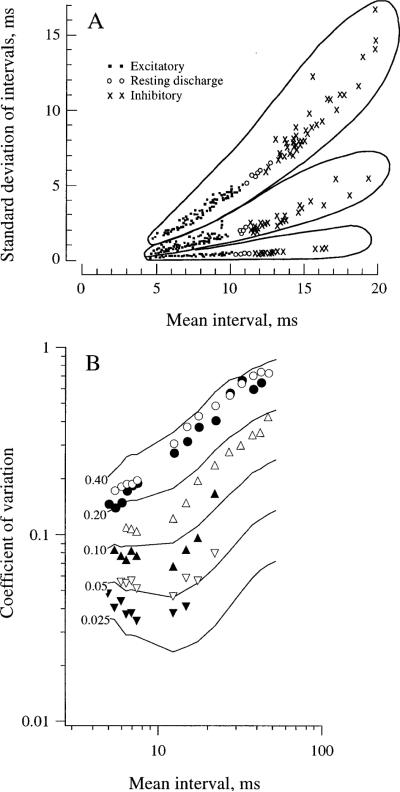
Discharge regularity is characteristic of each afferent. A Standard deviation of intervals versus mean interval for three semicircular-canal afferents in the squirrel monkey. From Goldberg and Fernández (1971b). B Relation between coefficient of variation (cv) and mean interval (t¯) for six semicircular-canal afferents in the squirrel monkey, indicated by different symbols. The points for individual units conform to the empirical curves relating cv and t¯ for different values of cv*, the cv at t¯ ms (see numbers to the left). Based on Goldberg et al. (1984)
Fig. 3A, B
Fig. 3A, B
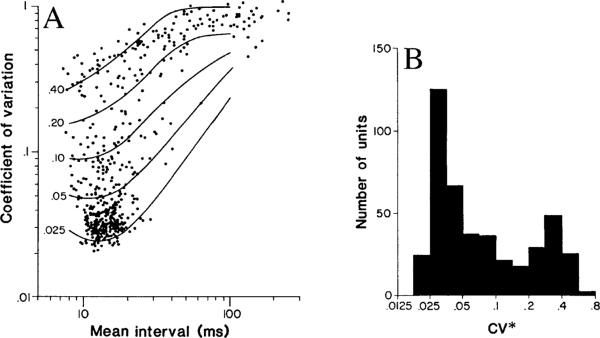
Quantifying discharge regularity. A The curves are empirical functions, based on the relation between the coefficient of variation (cv) and the mean interval t¯ for individual chinchilla otolith afferents, whose discharge rates were changed by static tilts. Each curve is for a particular normalized cv*, the cv at t¯=15 ms (see numbers to left). Each point shows cv versus t¯ at the resting discharge for an individual chinchilla semicircular-canal unit. B cv*'s for a population of chinchilla semicircular-canal units. From Baird et al. (1988)
Fig. 4A, B
Fig. 4A, B
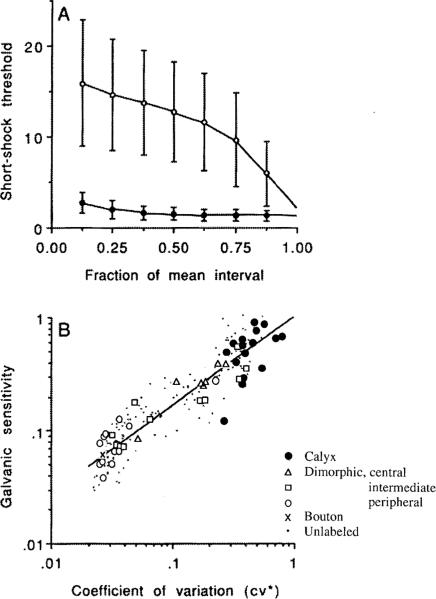
Responses of vestibular-nerve afferents to electrical stimulation delivered by an electrode in the perilymphatic space of the vestibule. A Thresholds for 0.1-ms shocks presented at stated times after the occurrence of a naturally occurring action potential at t=0. Squirrel-monkey afferents. Time is expressed as a fraction (f) of the mean interval; threshold is normalized in each animal to a value of unity at f=1 in the most sensitive afferents. Points are means and bars are standard deviations for populations of regular (◯) and irregular (◯) afferents. Recovery in irregular units is fast; that in regular units is delayed. From Goldberg et al. (1990c), based on Goldberg et al. (1984). B Sensitivity determined from the response to the last 2.5 s of a 5-s, 50-μA current is plotted against the normalized coefficient of variation (cv*) for chinchilla semicircular-canal afferents. For each animal, sensitivity is normalized to unity for cv*=1 by an analysis of covariance that estimates sensitivity differences across preparations; such differences are likely to reflect electrode placement or other technical factors. Key, symbols representing labeled and unlabeled fibers; straight-line, best fitting power-law relation. The more irregular the afferent, the more sensitive it is to galvanic currents. From Goldberg et al. (1990c), based on Baird et al. (1988)
Fig. 5A, B
Fig. 5A, B
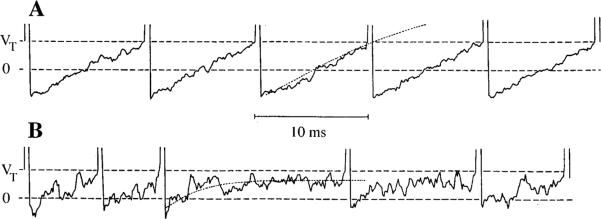
A stochastic version of an afterhyperpolarization (AHP) model of repetitive discharge. 0 Resting potential, VT spike-threshold potential. Two model units are shown with their mean interspike trajectories (dotted lines). A The unit at the top has a regular discharge because of its deep and slow AHP and relatively small miniature EPSPs. B The bottom unit is irregular as its AHP is shallow and fast and its miniature EPSPs somewhat larger than those in A. Note that a regular discharge is associated with the mean trajectory crossing VT. For the irregular discharge, the mean trajectory does not cross VT. As a result, the timing of spikes in the regular unit is largely determined by the mean trajectory, whereas that for the irregular unit is largely determined by synaptic noise. From Smith and Goldberg (1986)
Fig. 6A–H
Fig. 6A–H
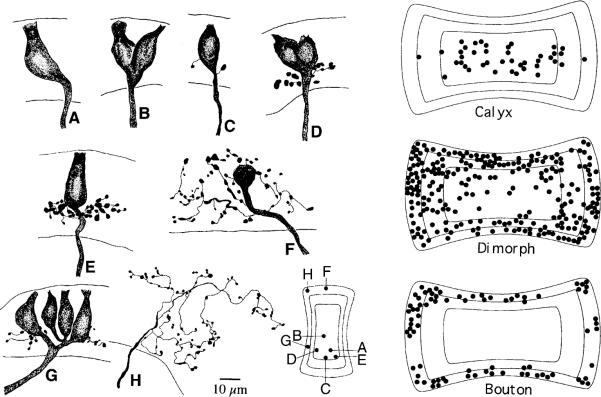
Innervation patterns in the chinchilla crista, as revealed by extracellular horseradish-peroxidase (HRP) labeling of individual afferents. A, B Calyx fibers innervating one or two hair cells. C–G Dimorphic fibers include both calyx and bouton endings. H Bouton fiber. Inset Locations of individual afferents are placed on a standard map of the cristae. Right Three standard maps of the cristae divided into concentrically arranged central, intermediate, and peripheral zones of equal areas. Shown are the locations of calyx, dimorphic, and bouton fibers with each symbol (●) representing a single dye-filled fiber. Dimorphic units make up 70% of the population, bouton units 20%, and calyx units 10%. From Fernández et al. (1988)
Fig. 7A–D
Fig. 7A–D
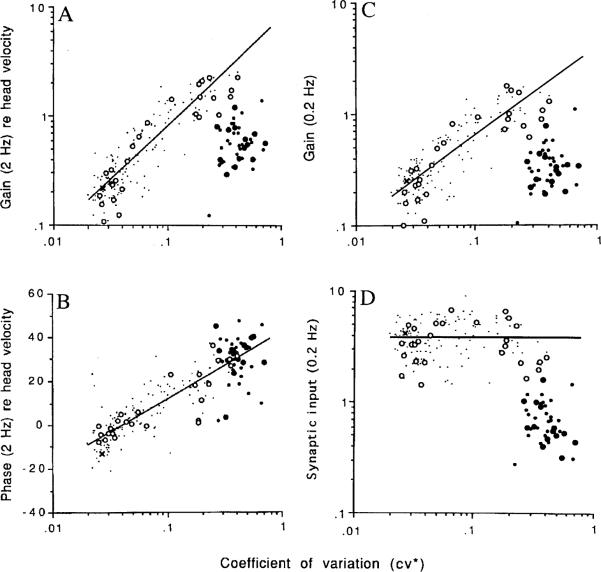
Responses of semicircular-canal afferents in the chinchilla to sinusoidal head rotations. Each point represents an individual unit. Labeled afferents include calyx (●), dimorphic (◯), and bouton (×) fibers; smaller dots represent unlabeled fibers. A Rotational gain re head velocity (spikes·s−1/°s−1) versus normalized coefficient of variation (cv*). Straight-line, best fitting power-law relation between gain and cv* for dimorphic and bouton fibers. Data are for 2-Hz sinusoidal rotations. B Rotational phase re head velocity (degrees) for the same sinusoidal head rotations versus cv*. Straight-line, best fitting semilogarithmic relation between phase and cv* for all fibers. When compared with irregular dimorphic units with similar cv*s, calyx units have considerably lower gains, but similar phases. C Based on an empirical transfer function, gains at 0.2 Hz have been calculated from the 2-Hz gains in A. The power-law relation for dimorphic and bouton units in C is less steep than the relation in A and is virtually identical with the power-law relation between normalized galvanic sensitivity (ß*) and cv* (Fig. 4B). D As a result of the similarity in power-law relations, synaptic input, the ratio between the rotational gain of each unit at 0.2 Hz and normalized galvanic sensitivity, is nearly constant for dimorphic and bouton units regardless of their discharge regularity. Calyx units are distinctive in having a much lower synaptic input than other units. From Goldberg et al. (1990c), based on Baird et al. (1988)
Fig. 8A, B
Fig. 8A, B
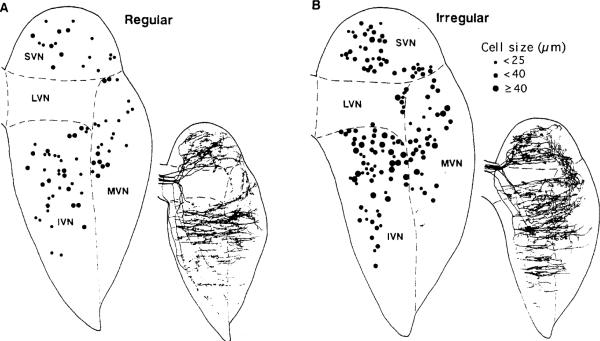
Innervation by HRP-labeled horizontal-canal afferents of the vestibular nuclei of the cat. Standard horizontal sections of the four main nuclei: superior (SVN), lateral (LVN), inferior or descending (IVN), and medial (MVN) vestibular nuclei. Afferents were characterized as regular (A) or irregular (B). In each subpanel, the drawing to the left indicates size of cell bodies receiving boutons (key to right), whereas the smaller drawing to the right depicts branching patterns for several afferents. From Sato and Sasaki (1993)
Fig. 9A–D
Fig. 9A–D
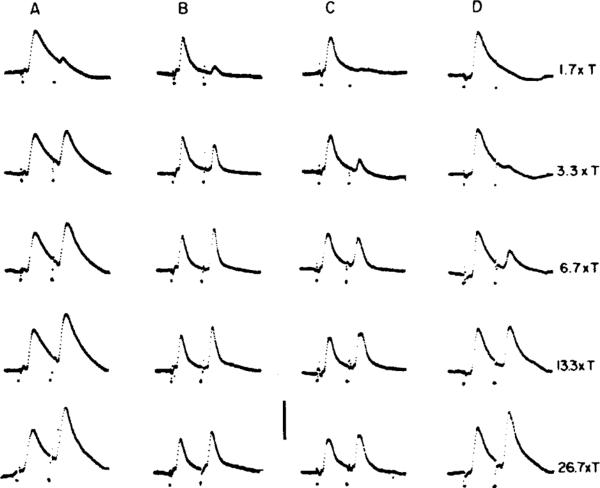
An intracellular paradigm can deduce the profile of regular and irregular inputs received by individual secondary neurons. EPSPs were recorded from four cells (A–D) located in the superior vestibular nucleus of one squirrel monkey. Each record includes the response to a supramaximal shock intended to synchronize the activity of the vestibular nerve. This is followed 4 ms later by a second shock ranging in amplitude from 1.7 to 26.7xT, where T is the threshold shock strength needed to evoke a field potential in the vestibular nuclei. A This cell receives a predominantly irregular vestibular-nerve input because the second EPSP reaches near-maximal size at low shock strengths. D In this case, the vestibular-nerve input is predominantly regular, as the second EPSP is activated only at high shock strengths. B, C These two cells receive mixed irregular and regular inputs. The second EPSP has a low threshold, but continues to grow as shock strength increases. Calibration: 10 mV (A, B) and 5 mV (C, D). From Goldberg et al. (1987)
Fig. 10A–J
Fig. 10A–J
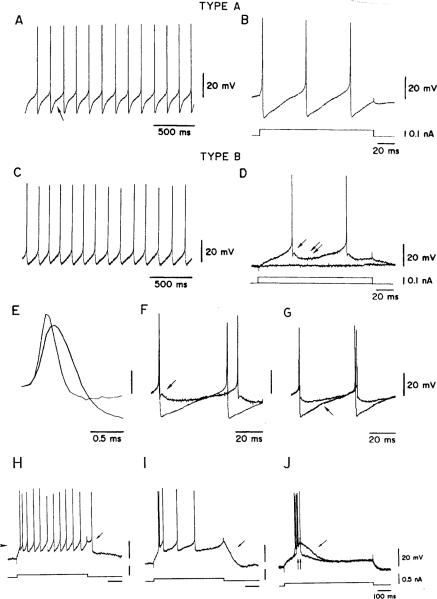
Properties of “A” and “B” neurons recorded from slices through the medial vestibular nucleus in the guinea pig. A Spontaneous activity in an “A” neuron. The slowing of the afterhyperpolarization (AHP) trajectory (see arrow) suggests the presence of an A-like current. B The same “A” neuron is seen responding to depolarizing currents at a higher speed to show the single AHP following each spike. C Spontaneous activity in a “B” neuron. D Response of the “B” neuron to depolarizing currents is seen at higher speed. The AHP shows a fast component (arrow), followed by a slow component (double arrow). No additional slowing of the AHP is seen as the neuron depolarizes towards firing threshold. E Spikes recorded in “A” and “B” neurons. Action potentials are wider in “A” neurons. F, G AHPs are superimposed for an “A” neuron (G, lower arrow) and a “B” neuron (F, upper arrow). These potentials are larger in “A” neurons. H–J Response to depolarizing currents of a “B” neuron. Tonic firing in H is replaced by plateau potentials (I–J, single arrows) and by low-threshold Ca2+ spikes (J, double arrows) as the cell is depolarized from progressively more hyperpolarized levels. From Serafin et al. (1991a)
Fig. 11A–D
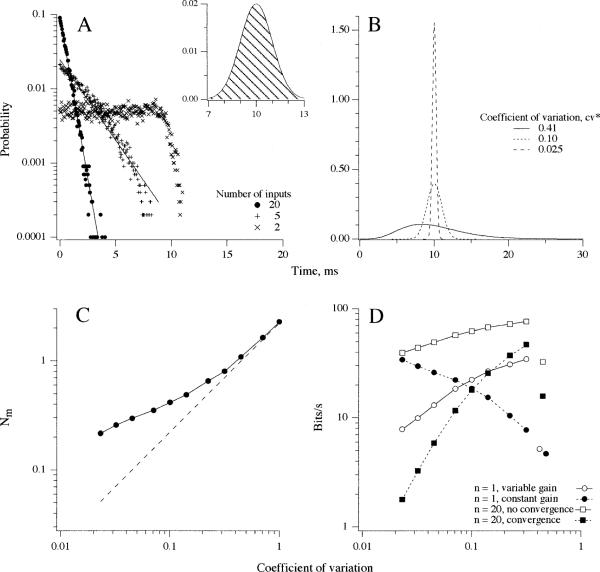
Fig. 11A–D
Theoretical considerations in information transmission between vestibular-nerve afferents and secondary neurons. A Simulated interval distributions obtained by the superposition of several unsynchronized afferents (see key), each having an intermediate regularity (see inset). Even two inputs result in an irregular discharge. The interval distribution approaches an exponential distribution, appropriate to a Poisson process, when the number of inputs reaches five. B Eq. 2 was used to calculate interval distributions with mean intervals of 10 ms and varying coefficients of variation (cv) (see key). C Simulations were used to determine N¯m(ΔT), the standard deviation in the number of events as a function of the coefficient of variation for a single input. Actual values of N¯m(ΔT) (solid line) are compared with the linear approximation, N¯m(ΔT)=(Δtμ)12 (dashed line), which holds for long sampling intervals (Cox 1962). In the particular case considered, the sampling interval, Δt=50 ms, and the mean interval, Δ=10 ms. For each cv, the appropriate gamma distribution was chosen and its equilibrium and waiting-time distributions used in a Monte-Carlo simulation of the events occurring in 100 separate, 50-ms samples. The number of events in the several samples was used to calculate N¯m(ΔT). D It), the information transmitted in bits/s during Δt=50 ms is calculated from eq. 1, with N¯m(ΔT) obtained from C. Curves are for theoretical dimorphic (and bouton) units, whose cv's vary from 0.0231 to 0.316. Points to the right are for a theoretical calyx unit with a cv=0.447. Calculations were done for single afferents (n=1) and for n=20 afferents kept separate or converging on a single secondary neuron. For n=1, constant gain, Smt), =0.674. For all other curves, Smt)=k·cv is assumed to be linearly related to cv. The proportionality constant, k=8 spikes, was set so that the highest value is Smt)=2.5 spikes at cv=0.316, compared with a background of λDt=5 spikes. This value of Sm minimizes inhibitory silencing for even the most sensitive unit. Afferent gains, g, for dimorphic units are linearly related to cv with a proportionlity constant, k =8 spikes·s−1/degrees s−1 (Fig. 7A). The rms stimulus amplitude corresponding to k=8 spikes is Sx=k/k1Δt=20 degrees/s. From human data (Grossman et al. 1988), this value of Sx matches head velocities during walking, is slightly smaller than those during running, and considerably smaller than those during maximal voluntary head shakes. Single points to the right are for the calyx unit with Smt)=0.72, five times smaller than predicted from the linear relation between Smt) and cv for dimorphic units

References

    1. Aitkin LM, Irvine DRF, Webster WR. Central neural mechanisms of hearing. In: Darian-Smith I, editor. Handbook of physiology. Section I. The nervous system. Volume III. Sensory processes, Part 2. Williams & Wilkins; Baltimore: 1984. pp. 675–737.
    1. Angelaki DE, Perachio AA. Contribution of irregular semicircular canal afferents to the horizontal vestibuloocular response during constant velocity rotation. J Neurophysiol. 1993;69:996–999. - PubMed
    1. Angelaki DE, Perachio AA, Mustari MJ, Strunk CL. Role of irregular otolith afferents in the steady-state nystagmus during off-vertical axis rotation. J Neurophysiol. 1992;68:1895–1900. - PubMed
    1. Angelaki DE, Bush GA, Perachio AA. Two-dimensional spatiotemporal coding of linear acceleration in vestibular nuclei neurons. J Neurosci. 1993;13:1403–1417. - PMC - PubMed
    1. Angelaki DE, McHenry MQ, Perachio AA, Dickman JD. Irregular otolith afferent inputs to the translational vestibuloocular reflex. Soc Neurosci Abstr. 1998;24:1411.

Publication types

LinkOut - more resources