


Dishabituation of the Tritonia escape swim
- PMID: 10706601
- PMCID: PMC311319
- DOI: 10.1101/lm.7.1.43
Dishabituation of the Tritonia escape swim
Abstract
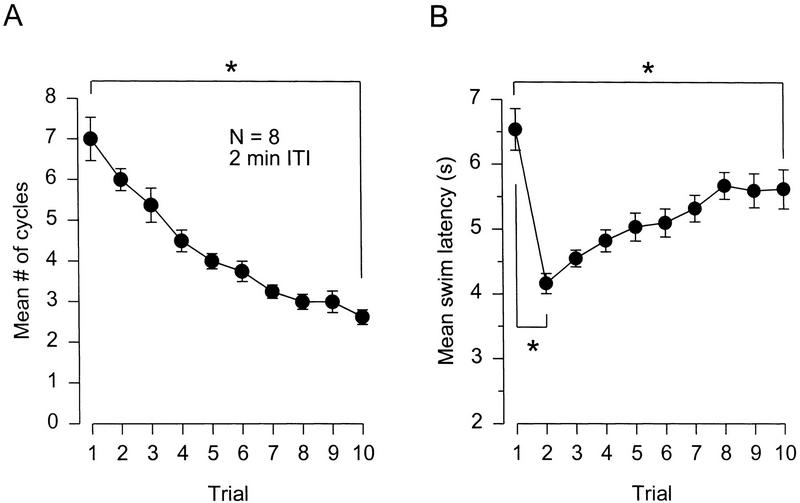
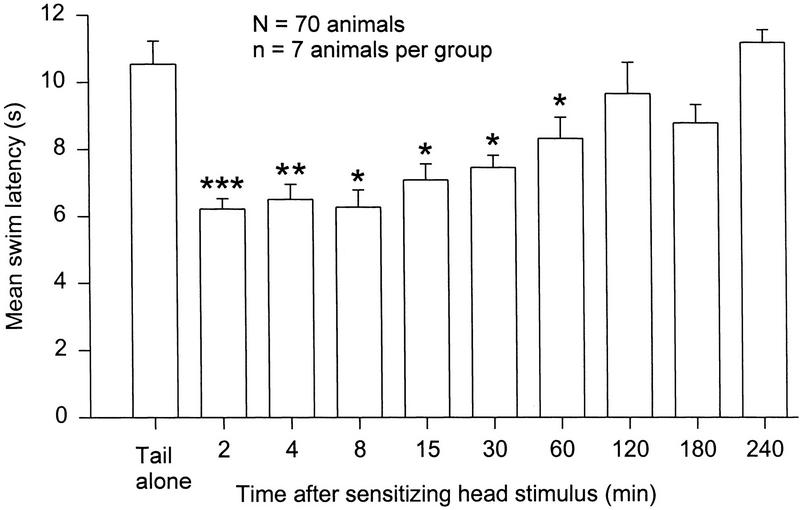
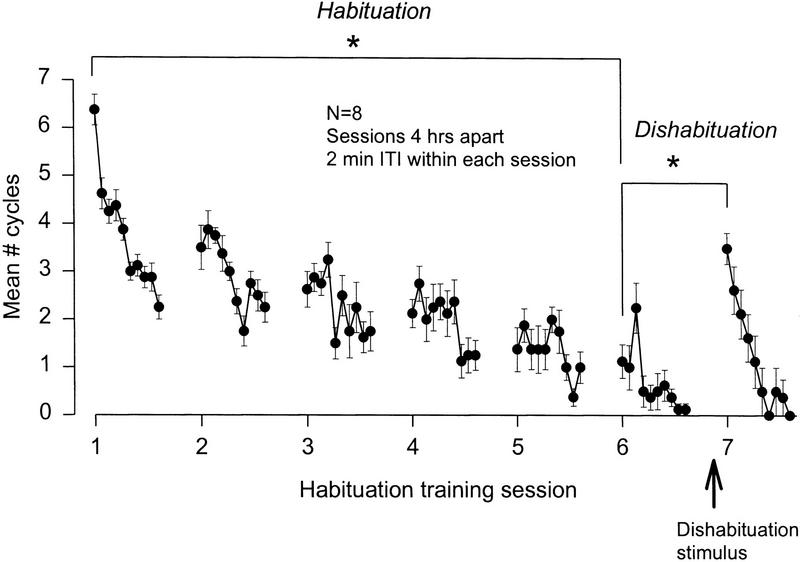
When repeatedly elicited, the oscillatory escape swim of the marine mollusc Tritonia diomedea undergoes habituation of the number of cycles per swim. Although similar in most respects to habituation observed in vertebrates and other invertebrates, one key feature, dishabituation, has been surprisingly difficult to demonstrate. Here we evaluate the hypothesis that this is due to interference from short-term sensitization, which is manifested as a reduction in swim onset latency, that occurs simultaneously during habituation training. Robust dishabituation was obtained using a multisession habituation protocol designed to allow this sensitization to dissipate before the dishabituatory stimulus was applied. These results extend the similarity of habituation in Tritonia to that described in other species, strengthening the usefulness of this preparation as a model system for studies of the cellular basis of habituation.
Figures
References
-
- Abraham FD, Willows AOD. Plasticity of a fixed action pattern in the sea slug Tritonia diomedia. Comm Behav Biol. 1971;6:271–280.
-
- Brown GD. Nonassociative learning processes affecting swimming probability in the seaslug Tritonia diomedea: Habituation, sensitization and inhibition. Behav Brain Res. 1998;95:151–165. - PubMed
-
- Brown GD, Frost WN, Getting PA. Habituation and iterative enhancement of multiple components of the Tritonia swim response. Behav Neurosci. 1996;110:478–485. - PubMed
-
- Erlich JS, Boulis NM, Karrer T, Sahley CL. Differential effects of serotonin depletion on sensitization and dishabituation in the leech, Hirudo medicinalis. J Neurobiol. 1992;23:270–279. - PubMed
Publication types
MeSH terms
Substances
Grants and funding
LinkOut - more resources
Full Text Sources