. 2000 Mar 14;97(6):2652-5.
doi: 10.1073/pnas.050558597.

Genetic analysis of speciation by means of introgression into Drosophila melanogaster

Affiliations

Genetic analysis of speciation by means of introgression into Drosophila melanogaster

K Sawamura et al. Proc Natl Acad Sci U S A. .

Abstract

In the last decade, the genetic basis of reproductive isolation has been shown to be surprisingly polygenic, and yet even the most efficient system currently in use could lend itself to molecular analysis only in highly selected cases. By extending the recent discovery of fertility rescue between Drosophila melanogaster and Drosophila simulans, we show that this hybridization can permit systematic and precise delineation of the genetic and molecular basis of speciation. In a region of 5% of the D. simulans genome introgressed into D. melanogaster, we discover at least six genes of hybrid male sterility and none for female sterility by deficiency mapping. A single case of hybrid inviability has been tracked down to a 3-Kb element that was inserted into the Cyclin E locus during species hybridization. The extent of interspecific genetic divergence underlying hybrid male sterility, especially in contrast with the low degree of inviability and female sterility, is far greater than expected from previous studies.


Figures
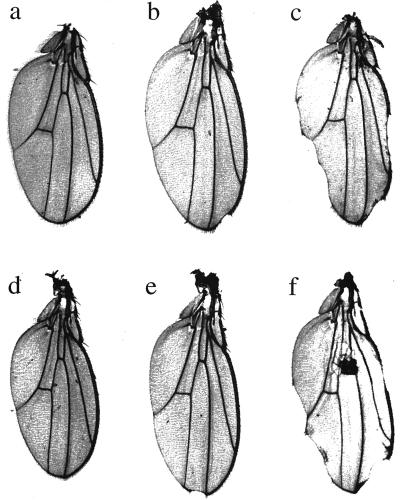
Figure 1
Figure 1
Wing morphology associated with introgressions and F1 hybrids. Wings were taken from males of: (a) D. melanogaster Oregon-R; (b) introgression heterozygotes; (c) introgression homozygotes; (d) D. simulans C167.4; (e and f) F1 hybrids rescued by the lethal hybrid rescue mutations, Lhr and Hmr (13, 14), respectively.
Figure 2
Figure 2
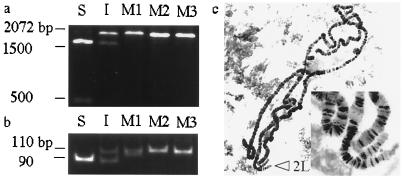
Physical evidence for D. simulans introgressions on 2L. (a) The PstI-digested PCR products at the Adh locus at the cytological position 35B2: Lane S, the C167.4 strain of D. simulans; lane I, an introgression subline (Int(2L)D+S/CyO); lanes M1-M3, D. melanogaster lines used in the crosses (M1, CyO/bwVDe2; M2, Oregon-R; M3, C(1)M4, y2/In(1)AB, f). Lane I clearly exhibits the heterospecific pattern. All other five introgression sublines show a pattern identical with that of lane I. (b) The PCR products at the ex locus at the tip of 2L (21C3–4). DNA sources for each lane are identical with a. In total, four sublines carry this distal introgression. (c) Polytene chromosomes of the Oregon-R/Int(2L)D+S heterozygote. Note the asynapsis at the tip of 2L, which is always associated with heterospecific chromatids between D. melanogaster and D. simulans (35).
Figure 3
Figure 3
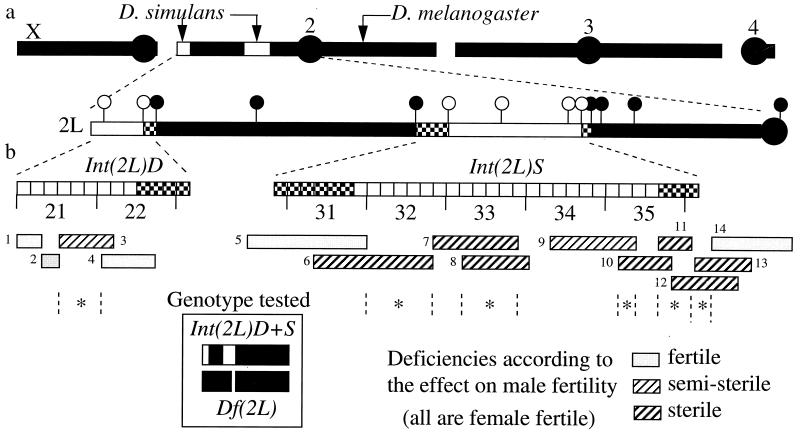
(a) Mapping of D. simulans introgressions, Int(2L)D+S, by molecular markers. Dark and light bars denote D. melanogaster and D. simulans chromatids, respectively. Checkered bars denote regions of uncertain species origin. The markers used [and their cytological locations (18)] are, from Left to Right: [ex (21C3–4), aop (22D1–2)], Pgk (23A1–2), Acp26Aa (26A1–5), bib (30F1–6), [da (31E1–7), prd (33C1), Adh (35B2), CycE (35D7)], grp (36A10–14), dl (36C2), Ddc (37C1), Rsp (h39), where [ ] corresponds to the boundaries of introgressions. (b) Mapping genes of reproductive isolation by deficiencies. Each deficiency is tested over Int(2L)D+S as shown in Inset, where blank regions indicate introgressions, and the gap denotes a deletion. The numbers below the chromosome indicate the cytological intervals; further divisions of each interval into six letter regions (A–F) are also given. Fourteen deficiencies were used, and the fertility of the tested genotype is indicated. Loci of hybrid male sterility are indicated by stars; no female sterility is observed over any of these deficiencies. Deficiencies no. 10 and no. 11 result in inviability over the introgressions in the one subline that is homozygote inviable.

References

    1. Dobzhansky T. Genetics and the Origin of Species. New York: Columbia Univ. Press; 1937.
    1. Mayr E. Systematics and the Origin of Species. New York: Columbia Univ. Press; 1942.
    1. Sturtevant A H. Genetics. 1920;5:488–500. - PMC - PubMed
    1. David J, Lemeunier F, Tsacas L, Bocquet C. Ann Genet. 1974;17:235–241. - PubMed
    1. Lachaise D, David J R, Lemeunier F, Tsacas L, Ashburner M. Evolution. 1986;40:262–271. - PubMed

Publication types

Substances

LinkOut - more resources