. 2000 Apr;74(7):3253-63.
doi: 10.1128/jvi.74.7.3253-3263.2000.

cis- and trans-acting elements in flavivirus RNA replication

Affiliations

cis- and trans-acting elements in flavivirus RNA replication

A A Khromykh et al. J Virol. 2000 Apr.

Abstract

Most of the seven flavivirus nonstructural proteins (NS1 to NS5) encoded in the distal two-thirds of the RNA positive-sense genome are believed to be essential components of RNA replication complexes. To explore the functional relationships of these components in RNA replication, we used trans-complementation analysis of full-length infectious RNAs of Kunjin (KUN) virus with a range of lethal in-frame deletions in the nonstructural coding region, using as helper a repBHK cell line stably producing functional replication complexes from KUN replicon RNA. Recently we showed that replication of KUN RNAs with large carboxy-terminal deletions including the entire RNA polymerase region in the NS5 gene, representing 34 to 75% of the NS5 coding content, could be complemented after transfection into repBHK cells. In this study we have demonstrated that KUN RNAs with deletions of 84 to 97% of the NS1 gene, or of 13 to 63% of the NS3 gene including the entire helicase region, were also complemented in repBHK cells with variable efficiencies. In contrast, KUN RNAs with deletions in any of the other four nonstructural genes NS2A, NS2B, NS4A, and NS4B were not complemented. We have also demonstrated successful trans complementation of KUN RNAs containing either combined double deletions in the NS1 and NS5 genes or triple deletions in the NS1, NS3, and NS5 genes comprising as much as 38% of the entire nonstructural coding content. Based on these and our previous complementation results, we have generated a map of cis- and trans-acting elements in RNA replication for the nonstructural coding region of the flavivirus genome. These results are discussed in the context of our model on formation and composition of the flavivirus replication complex, and we suggest molecular mechanisms by which functions of some defective components of the replication complex can be complemented by their wild-type counterparts expressed from another (helper) RNA molecule.


Figures
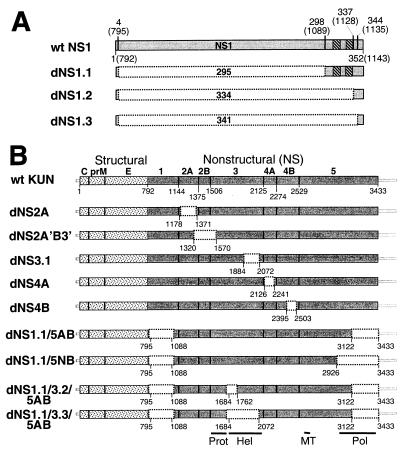
FIG. 1
FIG. 1
Schematic representation of deletion constructs. (A) Deletions in the NS1 protein. Filled boxes represent KUN NS1 protein, with numbers indicating NS1 amino acid positions. Numbers in brackets show corresponding amino acid positions in the KUN polyprotein (11). Open boxes with dotted borders show in-frame deletions, with the numbers in them indicating the total number of deleted amino acids. Striped boxes represent two amino acid sequences (KUN polyprotein amino acids 1103 to 1113 and 1119 to 1128 [11]) conserved among flaviviruses. wt, wild type. (B) Single, double, and triple deletions in the KUN nonstructural proteins. Dotted boxes and filled boxes represent KUN structural and nonstructural regions, respectively, with the name of the proteins shown above. Thick lines show KUN 5′ and 3′ untranslated regions. Numbers below the boxes in construct wt KUN indicate the first amino acid of the following protein in the KUN polyprotein (11). Open boxes with dotted borders show in-frame deletions with the positions of deleted amino acids indicated below. Apostrophes in dNS2A'B3' construct indicate that only very small proportions of the genes (NS2A and NS3) were deleted, in contrast to the deletion of an entire NS2B gene (indicated as B without apostrophe). Bars under the bottom construct indicate the position of domains for protease (Prot), helicase (Hel), methyltransferase (MT), and RNA polymerase (Pol).
FIG. 2
FIG. 2
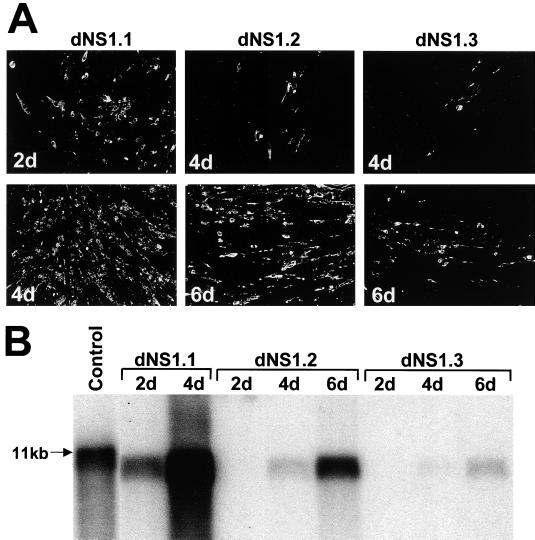
Complementation of KUN RNAs with large deletions in the NS1 gene. dNS1.1, dNS1.2, and dNS1.3 RNAs contain deletions of 295, 334, and 341 NS1 codons, respectively, out of a total 352 codons (Fig. 1A). (A) Selected fields of repBHK cells transfected with deleted RNAs and stained with anti-E antibodies at 2, 4, and 6 days (2d, 4d, and 6d) after transfection. (B) Northern blot analysis with a radioactive prM-E cDNA probe of ∼5 μg of total RNA isolated from repBHK cells transfected with deleted RNAs. The arrow in panel B indicates the position in the gel of RNA of about 11 kb, determined relative to migration in the same gel of an ethidium bromide stained 1 Kb Plus DNA Ladder (GibcoBRL); the control lane contains ∼10 ng of in vitro-transcribed full-length KUN RNA.
FIG. 3
FIG. 3
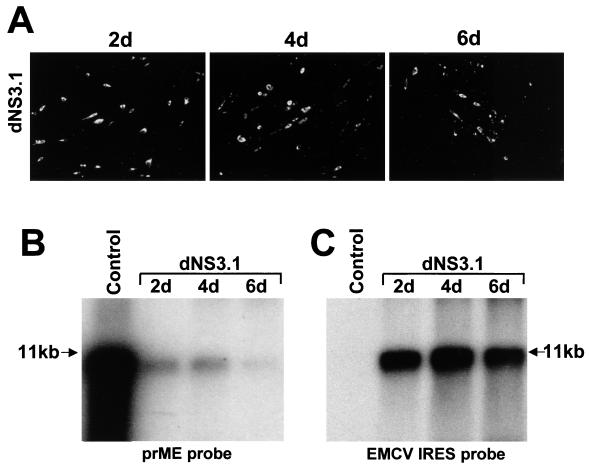
Complementation of KUN RNA with a single deletion in the NS3 gene. dNS3.1 RNA has a deletion of 189 codons in the C-terminal region of the helicase region in the NS3 gene (KUN polyprotein amino acids 1884 to 2072 inclusive [Fig. 1B]). (A) Selected fields of repBHK cells transfected with dNS3.1 RNA and stained with KUN anti-E antibodies at days 2, 4, and 6 (2d, 4d, and 6d) after transfection. (B and C) Northern blot analysis with radioactive prM-E (B) and EMCV IRES (C) cDNA probes of the same blot containing samples of total RNA (∼5 μg) isolated from repBHK cells transfected with dNS3.1 RNA. Northern blot hybridization was performed first with the prME probe and then rehybridized with the EMCV IRES probe as described in Materials and Methods. The arrows in panels B and C indicate the position in the gel of RNA of about 11 kb, determined as in Fig. 1B. Control lanes in panels B and C contain ∼10 ng of in vitro-transcribed full-length KUN RNA. The gels were exposed to X-ray film for 2.5 days (B) and for 16 h (C).
FIG. 4
FIG. 4
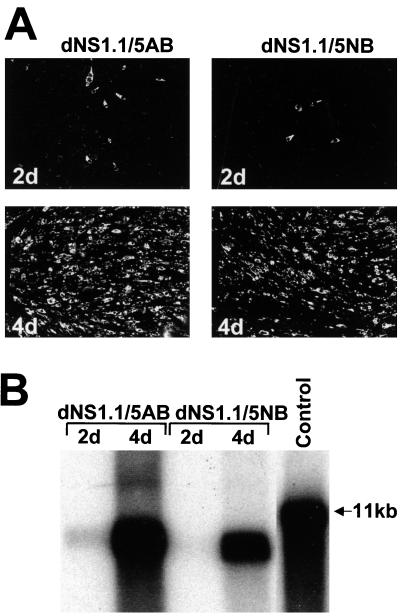
Complementation of KUN RNAs with double deletions in the NS1 and NS5 genes. Both dNS1.1/5AB and dNS1.1/5NB RNAs have a deletion of 295 codons in the NS1 gene and a C-terminal deletion of either 313 or 506 codons in the NS5 gene (KUN polyprotein amino acids 3122 to 3433 and 2926 to 3433, respectively [Fig. 1B]). (A) Selected fields of repBHK cells transfected with deleted RNAs and stained with anti-E antibodies at 2 and 4 days (2d and 4d) after transfection. (B) Northern blot analysis with a radioactive prM-E cDNA probe of the total RNA isolated from repBHK cells transfected with deleted RNAs. The arrowhead in panel B indicates the position in the gel of RNA of about 11 kb, determined as in Fig. 1B; the control lane contains ∼10 ng of in vitro-transcribed full-length KUN RNA.
FIG. 5
FIG. 5
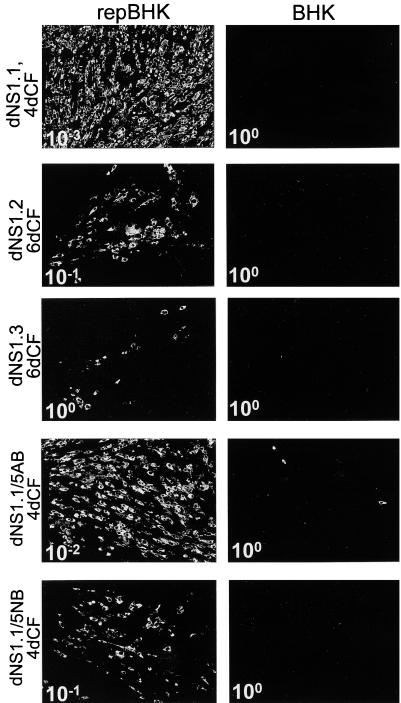
Characterization of secreted complemented viruses by IF analysis. Panels show selected fields of repBHK and BHK cells infected with diluted (10−1, 10−2, or 10−3) or undiluted (100) CF collected at 4 or 6 days (4dCF and 6dCF) after transfection of repBHK cells with corresponding RNAs (as shown on the left) and stained with anti-E antibodies at 2 days after infection.
FIG. 6
FIG. 6
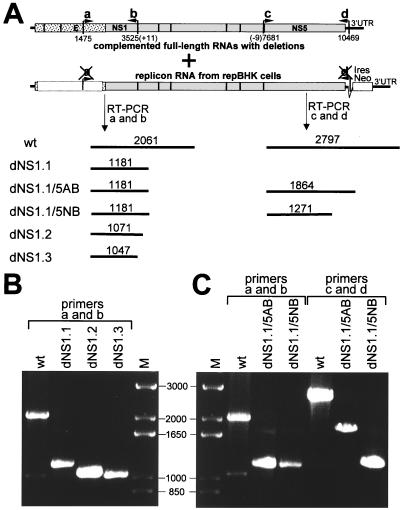
Characterization of secreted complemented viruses by RT-PCR analysis. (A) Schematic representation of the KUN full-length (wild-type [wt]) and replicon genomes and predicted sizes of the RT-PCR products. The numbers represent nucleotide positions in the KUN RNA sequence (11, 21) plus additional nucleotides (numbers shown in parentheses) incorporated into the RT-PCR primers a and b (see below). These numbers were used to calculate the size of RT-PCR fragments shown above the lines. Primers a and b used in RT-PCRs for the E-NS1 region were 5′-CCCCCGCGGCACCCTCTTACACTCTTAAGCT-3′ (nucleotides 1475 to 1505 of the KUN sequence) and 5′-gctggatcctaGGCATTCACCTGTGA-3′ (minus sense, complementary to nucleotides 3511 to 3525 of the KUN sequence), respectively, with nucleotides in lowercase representing 11 nucleotides not present in the KUN sequence. Primer c (which included an additional nine nucleotides) and primer d for RT-PCR of the region containing NS5 deletions were described previously (23). Note that primers a and d cannot bind to the helper replicon RNA because they represent the sequences in the structural region and in the 3′UTR, respectively, of the KUN genome which are deleted in the replicon construct C20DXrepNeo used for generation of repBHK cells (21, 22). (B) RT-PCR analysis of recovered defective viral RNAs. KUN virus particles secreted from cells after complementation of the defective RNAs were treated with RNase A and DNase and immunoprecipitated with anti-E antibodies; the virion RNA was extracted and used in RT-PCR analysis using the SuperScript One-Step RT-PCR system (GibcoBRL) and primer pairs a-b and c-d as described above. Lanes shown as wt in panels B and C represent RT-PCRs with ∼10 ng of KUN virion RNA purified as described previously (20); M lanes show 1 Kb Plus DNA Ladder (GibcoBRL).
FIG. 7
FIG. 7
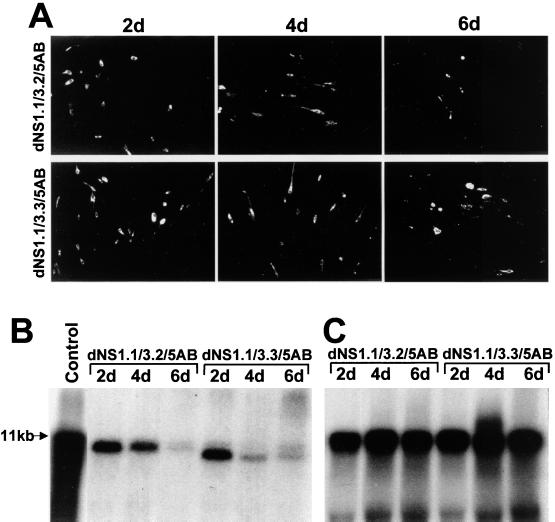
Complementation of KUN RNAs with triple deletions in the NS1, NS3, and NS5 genes. Both dNS1.1/3.2/5AB and dNS1.1/3.3/5AB RNAs contain deletions of most of the NS1 gene (295 codons) and most of the RNA polymerase region in the NS5 gene (C terminal 313 codons), as well as a small deletion in the N-terminal region of the helicase domain (79 codons, polyprotein amino acids 1684 to 1762) and deletion of the entire helicase domain (389 codons, polyprotein amino acids 1684 to 2072) in the NS3 gene, respectively (Fig. 1B and 8). (A) Selected fields of repBHK cells transfected with the deleted RNAs (as shown) and stained with anti-E antibodies at 2, 4, and 6 days (2d, 4d, and 6d) after transfection. (B and C) Northern blot analysis with a radioactive prM-E probe (B) and EMCV IRES (C) probe of the same blot containing samples of total RNA (∼10 μg) isolated from repBHK cells transfected with deleted RNAs. Northern blot hybridization was performed first with the prME probe, and the blot was then rehybridized with the EMCV IRES probe as described in Materials and Methods. The arrow in panel B indicates the position in the gel of RNA of about 11 kb, determined as in Fig. 1B; the control lane contains ∼10 ng of in vitro-transcribed full-length KUN RNA. The part of the gel with the control lane was exposed to X-ray film for 3 h, while the rest of the gel was exposed for 2.5 days. The gel in panel C was exposed for 16 h.
FIG. 8
FIG. 8
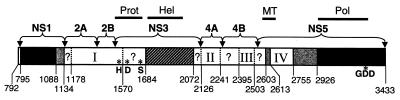
Map of cis- and trans-acting elements in the nonstructural region of KUN virus RNA. Numbers represent amino acid positions in the KUN polyprotein (11) and show boundaries of introduced deletions. Prot, Hel, MT, and Pol indicate corresponding functional domains (as in Fig. 1B). H, D, and S with asterisks show locations of the amino acids of the catalytic triad of the serine protease, and GDD with an asterisk shows the location of the characteristic RNA polymerase motif. Black boxes show trans-acting sequences efficiently complemented singly in NS1 (84% of NS1; yield, 6 × 10⁶ IU/ml at day 4), in NS5 (C-terminal 56% of NS5 including entire polymerase region; yield, 3 × 10⁵ to 5 × 10⁵ IU/ml at day 4), or in RNA deleted in both NS1 and NS5 (yield, 8 × 10⁴ IU/ml at day 4). Gray boxes show trans-acting sequences complemented inefficiently in NS1 (97% of NS1; yield, 3 × 10² IU/ml at day 6), in MT of NS5 (11 amino acids; yield, 2 × 10⁴ IU/ml at day 7), and in NS5 (C-terminal 75% of NS5; yield, 102 IU/ml at day 6). Striped box shows the trans-acting sequence in NS3 (63% of NS3 including entire helicase region) complemented very inefficiently, and no secreted complemented virus was recovered by day 6. Numbered open boxes represent cis-acting sequences apparently not complemented in trans for any deletions, e.g., within box I (NS2A, NS2B, or N terminus of NS3), box II (NS4A), box III (C-terminal half of NS4B), or box IV (region between MT and Pol motifs at the N terminus of NS5). Question marks denote regions that have not been analyzed in complementation assays and represent only 18% of the entire nonstructural coding sequence. Boundaries of the boxes were determined from the complementation data summarized in Table 1.

References

    1. Amberg S M, Rice C M. Mutagenesis of the NS2B-NS3-mediated cleavage site in the flavivirus capsid protein demonstrates a requirement for coordinated processing. J Virol. 1999;73:8083–8094. - PMC - PubMed
    1. Arias C F, Preugschat F, Strauss J H. Dengue 2 virus NS2B and NS3 form a stable complex that can cleave NS3 within the helicase domain. Virology. 1993;193:888–899. - PubMed
    1. Brinkworth R I, Fairlie D P, Leung D, Young P R. Homology model of the dengue 2 virus NS3 protease: putative interactions with both substrate and NS2B cofactor. J Gen Virol. 1999;80:1167–1177. - PubMed
    1. Chambers T J, Grakoui A, Rice C M. Processing of the yellow fever virus nonstructural polyprotein: a catalytically active NS3 proteinase domain and NS2B are required for cleavages at dibasic sites. J Virol. 1991;65:6042–6050. - PMC - PubMed
    1. Chambers T J, Nestorowicz A, Amberg S M, Rice C M. Mutagenesis of the yellow fever virus NS2B protein: effects on polyprotein processing, NS2B-NS3 complex formation, and viral replication. J Virol. 1993;67:6797–6807. - PMC - PubMed

Publication types