


No contractile effect for 5-HT1D and 5-HT1F receptor agonists in human and bovine cerebral arteries: similarity with human coronary artery
- PMID: 10711348
- PMCID: PMC1571865
- DOI: 10.1038/sj.bjp.0703081
No contractile effect for 5-HT1D and 5-HT1F receptor agonists in human and bovine cerebral arteries: similarity with human coronary artery
Abstract
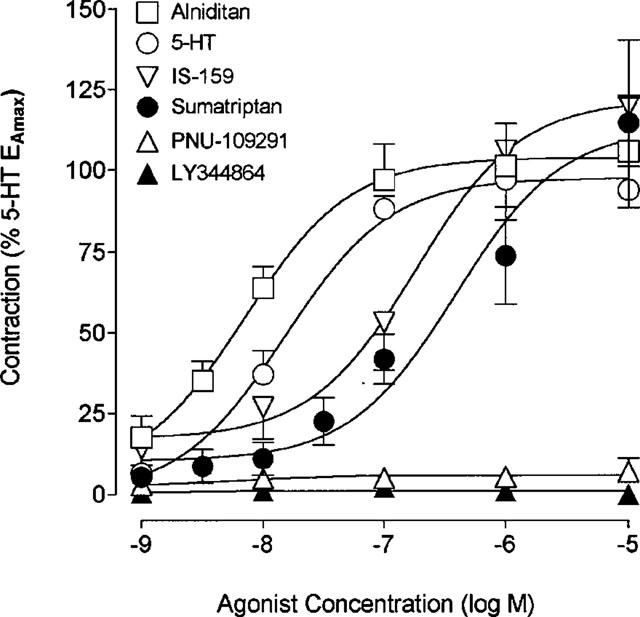
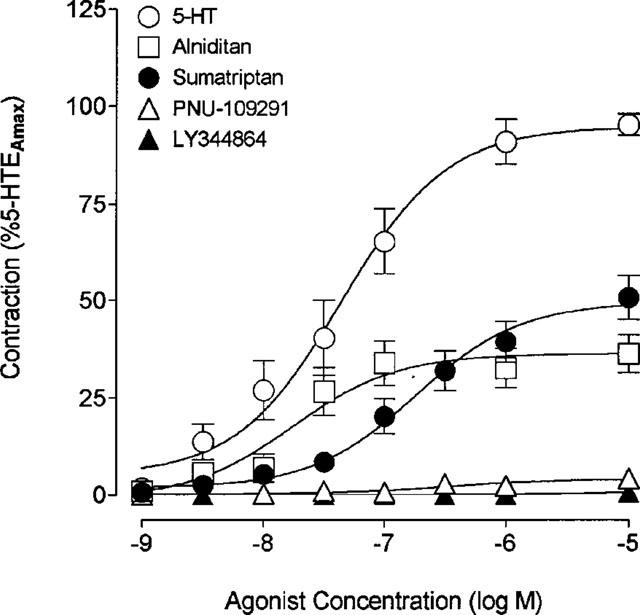
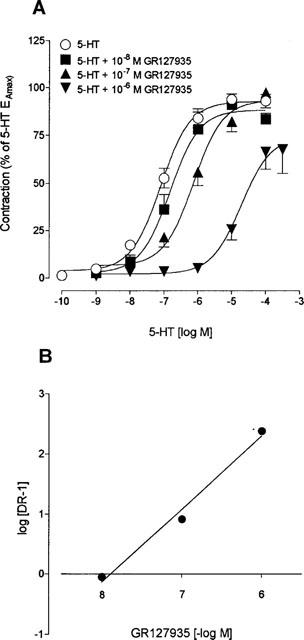
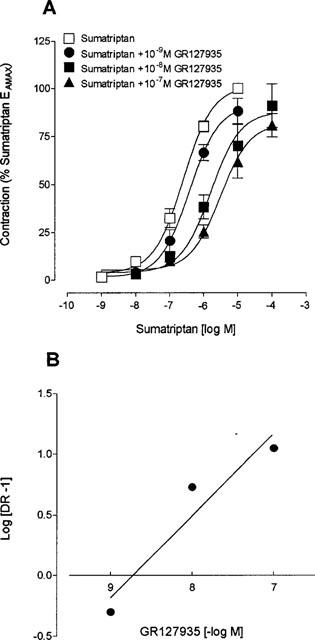
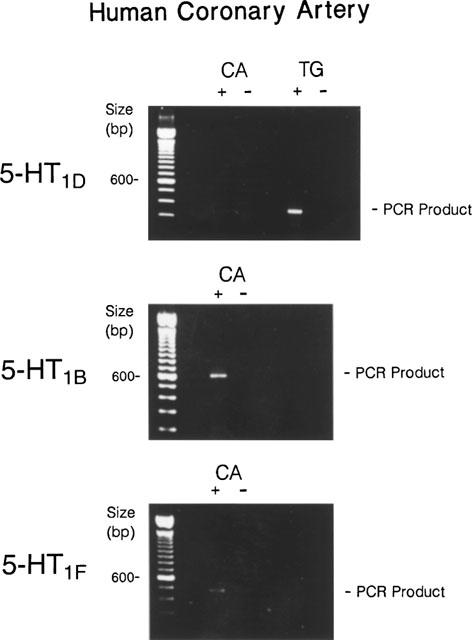
1. Using subtype-selective 5-HT1 receptor agonists and/or the 5-HT1 receptor antagonist GR127935, we characterized in vitro the 5-HT receptor that mediates the contraction of human and bovine cerebral arteries. Further, we investigated which sumatriptan-sensitive receptors are present in human coronary artery by reverse-transcriptase polymerase chain reaction (RT-PCR). 2. Agonists with affinity at the 5-HT1B receptor, such as sumatriptan, alniditan and/or IS-159, elicited dose-dependent contraction in both human and bovine cerebral arteries. They behaved as full agonists at the sumatriptan-sensitive 5-HT1 receptors in both species. In contrast, PNU-109291 and LY344864, selective agonists at 5-HT1D and 5-HT1F receptors, respectively, were devoid of any significant vasocontractile activity in cerebral arteries, or did not affect the sumatriptan-induced vasocontraction. The rank order of agonist potency was similar in both species and could be summarized as 5-HT = alniditan > sumatriptan = IS-159 >>> PNU-109291 = LY344864. 3. In bovine cerebral arteries, the 5-HT1 receptor antagonist GR127935 dose-dependently inhibited the vasoconstrictions elicited by both 5-HT and sumatriptan, with respective pA2 values of 8.0 and 8.6. 4. RT-PCR studies in human coronary arteries showed a strong signal for the 5-HT1B receptor while message for the 5-HT1F receptor was weak and less frequently detected. Expression of 5-HT1D receptor mRNA was not detected in any sample. 5. The present results demonstrate that the triptan-induced contraction in brain vessels is mediated exclusively by the 5-HT1B receptor, which is also present in a majority of human coronary arteries. These results suggest that selective 5-HT1D and 5-HT1F receptor agonists might represent new antimigraine drugs devoid of cerebro- and cardiovascular effects.
Figures
References
-
- ADHAM N., KAO H.-T., SCHECHTER L.E., BARD J.A., OLSEN M., URQUHART D., DURKIN M., HARTIG P.R., WEINSHANK R.L., BRANCHEK T.A. Cloning of another human serotonin receptor (5-HT1F): A fifth 5-HT1 receptor coupled to the inhibition of adenylate cyclase. Proc. Natl. Acad. Sci. U.S.A. 1993;90:408–412. - PMC - PubMed
-
- BEATTIE D.T., CONNOR H.E. The pre- and postjunctional activity of CP-122,288, a conformationally restricted analogue of sumatriptan. Eur. J. Pharmacol. 1995;276:271–276. - PubMed
-
- BONAVENTURE P., VOORN P., LUYTEN W.H., LEYSEN J.E. 5-HT1B and 5-HT1D receptor mRNA differential co-localization with peptide mRNA in the guinea pig trigeminal ganglion. Neuroreport. 1998;9:641–645. - PubMed
-
- BOUCHELET I., CASE B., HAMEL E. Expression of mRNA for serotonin (5-HT) receptors in human coronary arteries. Soc. Neurosci. Abst. 1996a;22 Part 2:1578.
Publication types
MeSH terms
Substances
LinkOut - more resources
Full Text Sources
