. 2000 Apr;182(7):1969-77.
doi: 10.1128/JB.182.7.1969-1977.2000.

Regulation of rRNA transcription is remarkably robust: FIS compensates for altered nucleoside triphosphate sensing by mutant RNA polymerases at Escherichia coli rrn P1 promoters

Affiliations

Regulation of rRNA transcription is remarkably robust: FIS compensates for altered nucleoside triphosphate sensing by mutant RNA polymerases at Escherichia coli rrn P1 promoters

M S Bartlett et al. J Bacteriol. 2000 Apr.

Abstract

We recently identified Escherichia coli RNA polymerase (RNAP) mutants (RNAP beta' Delta215-220 and beta RH454) that form extremely unstable complexes with rRNA P1 (rrn P1) core promoters. The mutant RNAPs reduce transcription and alter growth rate-dependent regulation of rrn P1 core promoters, because the mutant RNAPs require higher concentrations of the initiating nucleoside triphosphate (NTP) for efficient transcription from these promoters than are present in vivo. Nevertheless, the mutants grow almost as well as wild-type cells, suggesting that rRNA synthesis is not greatly perturbed. We report here that the rrn transcription factor FIS activates the mutant RNAPs more strongly than wild-type RNAP, thereby compensating for the altered properties of the mutant RNAPs. FIS activates the mutant RNAPs, at least in part, by reducing the apparent K(ATP) for the initiating NTP. This and other results suggest that FIS affects a step in transcription initiation after closed-complex formation in addition to its stimulatory effect on initial RNAP binding. FIS and NTP levels increase with growth rate, suggesting that changing FIS concentrations, in conjunction with changing NTP concentrations, are responsible for growth rate-dependent regulation of rrn P1 transcription in the mutant strains. These results provide a dramatic demonstration of the interplay between regulatory mechanisms in rRNA transcription.


Figures
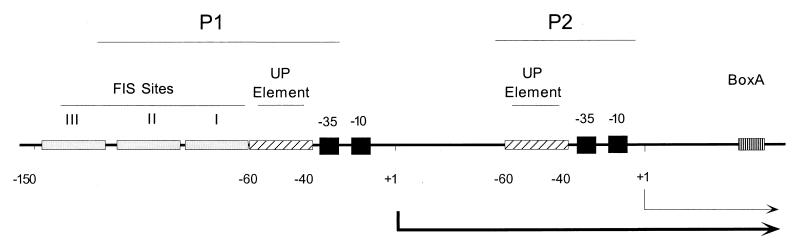
FIG. 1
FIG. 1
The rrnB regulatory region, including the P1 and P2 promoters. FIS binding sites, UP elements, −10 and −35 elements, transcription start sites (+1), and the Nus factor binding site (BoxA) are indicated.
FIG. 2
FIG. 2
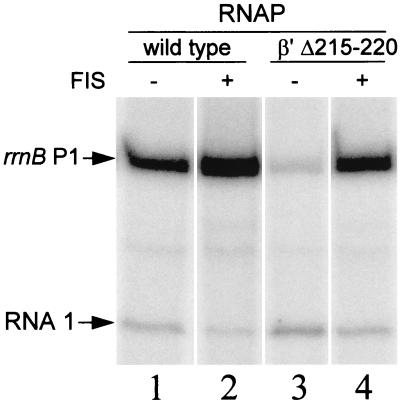
Activation of rrnB P1 transcription by FIS in vitro. The supercoiled template contained rrnB P1 positions −154 to +50. The reaction mixtures contained 200 μM ATP and wild-type RNAP (lanes 1 and 2) or β′ Δ215–220 RNAP (lanes 3 and 4) in the absence (lanes 1 and 3) or presence (lanes 2 and 4) of FIS. The transcripts derived from the rrnB P1 promoter and from the vector-encoded RNA I promoter are indicated. Since the reaction conditions were identical in each lane and the wild-type and mutant RNAPs had similar activities on a non-FIS-activated promoter (see Materials and Methods), activation by FIS was calculated directly from the relative amounts of rrnB P1 transcripts. Only one gel is shown, but the experiment was performed multiple times with similar results.
FIG. 3
FIG. 3
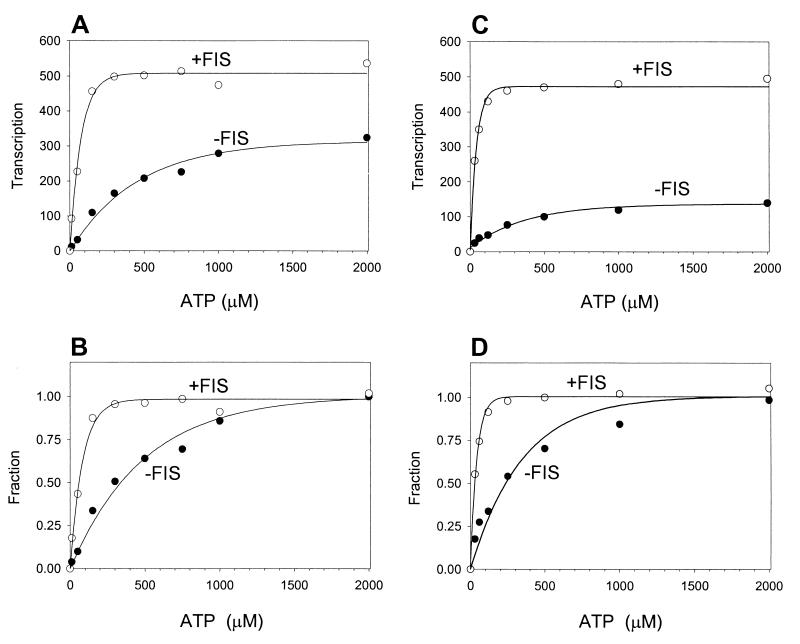
Effect of FIS on initiating NTP levels required for rrnB P1 transcription. (A) Transcription by the β′ Δ215–220 mutant RNAP at different ATP concentrations. In vitro transcription was performed as described in Materials and Methods with 100 mM NaCl, using supercoiled plasmid templates containing the rrnB P1 (−154 to +50) promoter in the absence or presence of FIS. (B) Results from panel A normalized to those obtained with 2 mM ATP. The graphed data represent averages from two experiments. The apparent KATPs in the absence and presence of FIS are about 330 and 60 μM, respectively. (C) Transcription by the wild-type RNAP at different ATP concentrations. In vitro transcription was performed as described in Materials and Methods with 130 mM NaCl, using supercoiled plasmid templates containing the rrnB P1 (−154 to +50) promoter in the absence or presence of FIS. (D) Results from panel A normalized to those obtained with 2 mM ATP. The graphed data represent averages from two experiments. The apparent KATPs in the absence and presence of FIS are about 240 and 30 μM, respectively.
FIG. 4
FIG. 4
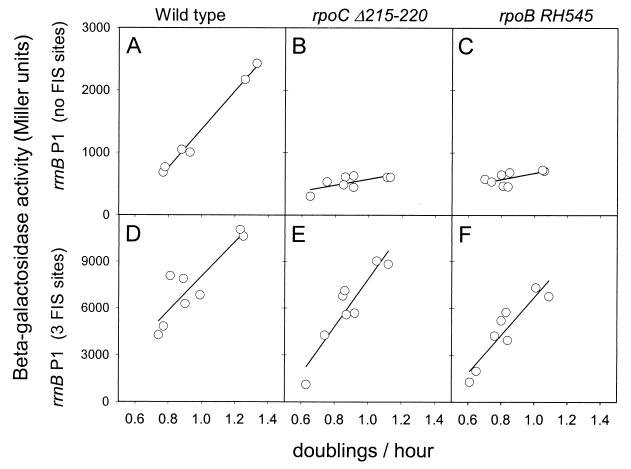
Effect of FIS on growth rate-dependent regulation of rrnB P1 transcription in wild-type (A and D), rpoCΔ215–220 (B and E), and rpoBRH454 (C and F) strains. (A to C) Transcription from the rrnB P1 promoter without FIS sites (−61 to +50). (D to F) Transcription from the rrnB P1 promoter containing three FIS sites (−154 to +50). Promoter activities were determined from β-galactosidase activities of promoter-lacZ fusions. Growth rates of cultures were varied as described previously (7).
FIG. 5
FIG. 5
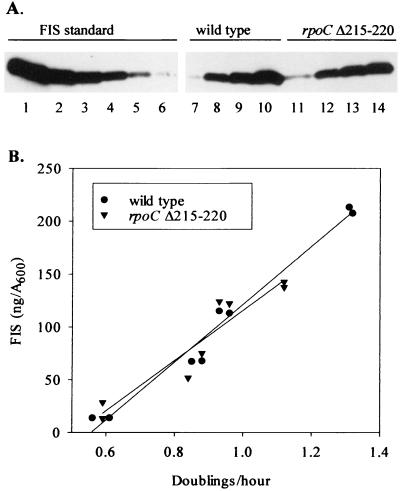
Growth rate-dependent variation in FIS levels in wild-type and rpoCΔ215–220 strains. (A) Western blot with anti-FIS antibody. Lanes 1 to 6, 40, 20, 10, 5, 2.5, and 1.25 ng of purified FIS protein, respectively. Lanes 7 to 10, protein extracts from the wild-type strain grown at 0.56, 0.85, 0.93, and 1.32 doublings/h, respectively. Lanes 11 to 14, protein extracts from the rpoCΔ215–220 strain grown at 0.59, 0.88, 0.96, and 1.12 doublings/h, respectively. Aliquots of lysates representing equivalent numbers of cells (as determined from the optical density) were loaded in each lane. (B) Amounts of FIS as a function of growth rate. Quantitation is illustrated for two independent experiments, including the one pictured in panel A, lanes 7 to 14, using the purified standards of FIS protein in lanes 1 to 6 for calibration.

References

    1. Afflerbach H, Schroder O, Wagner R. Effects of the Escherichia coli DNA-binding protein H-NS on rRNA synthesis in vivo. Mol Microbiol. 1998;28:641–653. - PubMed
    1. Afflerbach H, Schroder O, Wagner R. Conformational changes of the upstream DNA mediated by H-NS and FIS regulate E. coli rrnB P1 promoter activity. J Mol Biol. 1999;286:339–353. - PubMed
    1. Appleman J A, Ross W, Salomon J, Gourse R L. Activation of Escherichia coli rRNA transcription by FIS during a growth cycle. J Bacteriol. 1998;180:1525–1532. - PMC - PubMed
    1. Bachmann B J. Derivatives and genotypes of some mutant derivatives of Escherichia coli K-12. In: Neidhardt F C, et al., editors. Escherichia coli and Salmonella typhimurium: cellular and molecular biology. Vol. 2. Washington, D.C.: American Society for Microbiology; 1987. pp. 1190–1219.
    1. Ball C A, Osuna R, Ferguson K C, Johnson R C. Dramatic changes in Fis levels upon nutrient upshift in Escherichia coli. J Bacteriol. 1992;174:8043–8056. - PMC - PubMed

Publication types

MeSH terms

Substances

LinkOut - more resources