


Right and left hemisphere cooperation for drawing predictive and coherence inferences during normal story comprehension
- PMID: 10716864
- PMCID: PMC4364278
- DOI: 10.1006/brln.1999.2268
Right and left hemisphere cooperation for drawing predictive and coherence inferences during normal story comprehension
Abstract
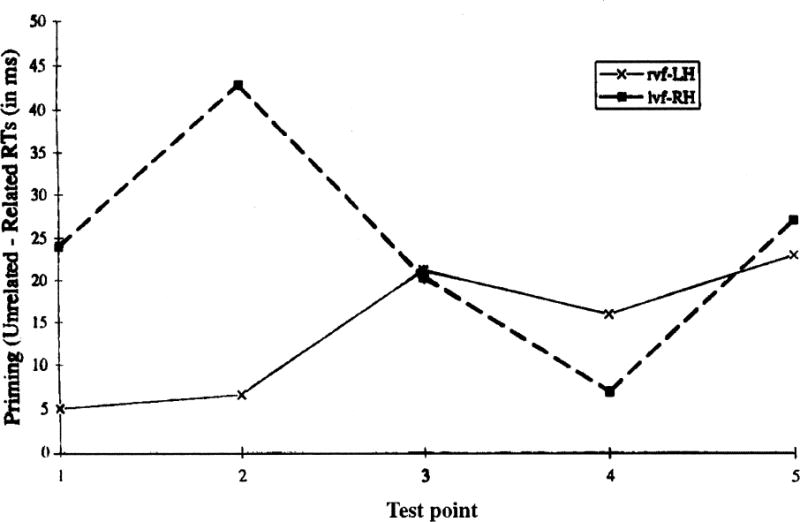
In three experiments, healthy young participants listened to stories promoting inferences and named inference-related test words presented to the right visual field-Left Hemisphere (rvf-LH) or to the left visual field-Right Hemisphere (lvf-RH). Participants showed priming for predictive inferences only for target words presented to the lvf-RH; in contrast, they showed priming for coherence inferences only for target words presented to the rvf-LH. These results, plus the fact that patients with RH brain damage have difficulty drawing coherence inferences and do not show inference-related priming, suggest that information capable of supporting predictive inferences is more likely to be initially activated in the RH than the LH, but following coherence breaks these concepts (now coherence inferences) are completed in the LH. These results are consistent with the theory that the RH engages in relatively coarse semantic coding, which aids full comprehension of discourse.
Copyright 2000 Academic Press.
Figures
References
-
- Abdullaev YG, Posner MI. Time course of activating brain areas in generating verbal associations. Psychological Science. 1997;8:56–59.
-
- Allport A. Selection for action: Some behavioral and neurophysiological considerations of attention and action. In: Heuer H, Sanders AF, editors. Perspectives on perception and action. Hillsdale, NJ: Erlbaum; 1987. pp. 395–415.
-
- Baggett P. Memory for explicit and implicit information in picture stories. Journal of Verbal Learning and Verbal Behavior. 1975;14:538–548.
-
- Banich MT, Karol DL. The sum of the parts does not equal the whole: Evidence from bihemispheric processing. Journal of Experimental Psychology: Human Perception and Performance. 1992;18:562–577. - PubMed
-
- Banich MT, Nicholas CD. Integration of processing between the hemispheres in word recognition. In: Beeman M, Chiarello C, editors. Getting it right: The cognitive neuroscience of right hemisphere language comprehension. Mahwah, NJ: Erlbaum; 1998. pp. 51–78.
Publication types
MeSH terms
Grants and funding
LinkOut - more resources
Full Text Sources
Other Literature Sources
