. 2000 Apr;44(4):867-72.
doi: 10.1128/AAC.44.4.867-872.2000.

Pefloxacin-induced achilles tendon toxicity in rodents: biochemical changes in proteoglycan synthesis and oxidative damage to collagen

Affiliations

Pefloxacin-induced achilles tendon toxicity in rodents: biochemical changes in proteoglycan synthesis and oxidative damage to collagen

M A Simonin et al. Antimicrob Agents Chemother. 2000 Apr.

Abstract

Despite a relatively low incidence of serious side effects, fluoroquinolones and the fluoroquinolone pefloxacin have been reported to occasionally promote tendinopathy that might result in the complication of spontaneous rupture of tendons. In the present study, we investigated in rodents the intrinsic deleterious effect of pefloxacin (400 mg/kg of body weight) on Achilles tendon proteoglycans and collagen. Proteoglycan synthesis was determined by measurement of in vivo and ex vivo radiosulfate incorporation in mice. Collagen oxidative modifications were measured by carbonyl derivative detection by Western blotting. An experimental model of tendinous ischemia (2 h) and reperfusion (3 days) was achieved in rats. Biphasic changes in proteoglycan synthesis were observed after a single administration of pefloxacin, consisting of an early inhibition followed by a repair-like phase. The depletion phase was accompanied by a marked decrease in the endogenous serum sulfate level and a concomitant increase in the level of sulfate excretion in urine. Studies of ex vivo proteoglycan synthesis confirmed the in vivo results that were obtained. The decrease in proteoglycan anabolism seemed to be a direct effect of pefloxacin on tissue metabolism rather than a consequence of the low concentration of sulfate. Pefloxacin treatment for several days induced oxidative damage of type I collagen, with the alterations being identical to those observed in the experimental tendinous ischemia and reperfusion model. Oxidative damage was prevented by coadministration of N-acetylcysteine (150 mg/kg) to the mice. These results provide the first experimental evidence of a pefloxacin-induced oxidative stress in the Achilles tendon that altered proteoglycan anabolism and oxidized collagen.


Figures
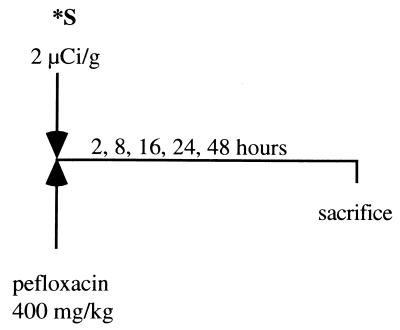
FIG. 1
FIG. 1
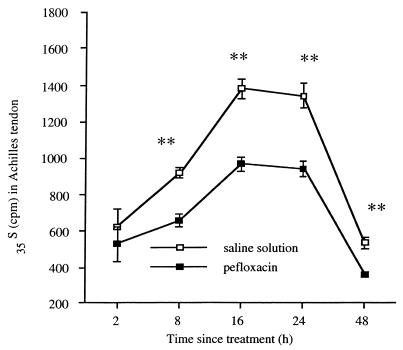
Kinetics of incorporation of 35S in blood and Achilles tendons in vivo in mice: effect of pefloxacin administration during the first phase (early effects of pefloxacin). ∗S, Na235SO4.
FIG. 2
FIG. 2
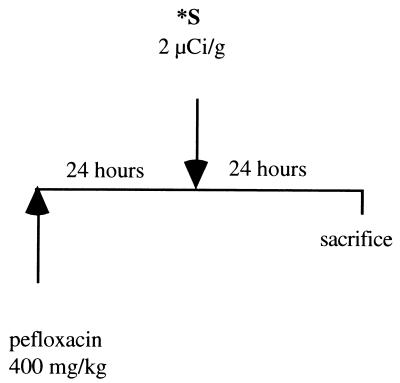
Kinetics of incorporation of 35S in blood and Achilles tendon in vivo in mice: effect of pefloxacin administration during the second phase (24 to 48 h). ∗S, Na235SO4.
FIG. 3
FIG. 3
Effect in mice of a single oral dose (400 mg/kg) of pefloxacin on the in vivo incorporation of simultaneously administered 35S into the Achilles tendon. Control animals were given saline solution instead of pefloxacin. Values for 35S are means ± SEMs (n = 4 experiments). ∗, P < 0.05, and ∗∗, P < 0.01, versus controls (Student's t test).
FIG. 4
FIG. 4
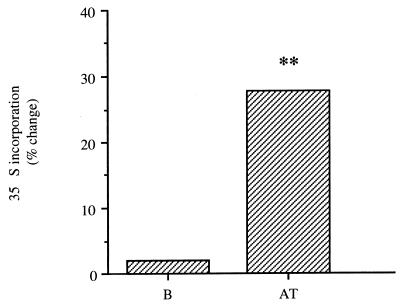
In vivo effects in mice of a single oral dose (400 mg/kg) of pefloxacin on proteoglycan synthesis as indicated by changes in 35S incorporation 48 h after pefloxacin administration and 24 h after intraperitoneal administration of 35S (2 μCi/g). Control animals received saline only. Values are percent differences in 35S incorporation in treated mice and controls (n = 2 experiments each with five mice). B, blood; AT, Achilles tendon. ∗, P < 0.05, and ∗∗, P < 0.01, versus controls (Student's t test).
FIG. 5
FIG. 5
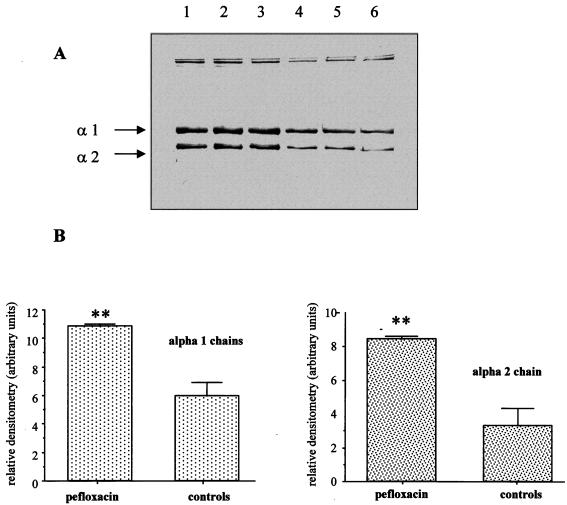
Immunochemical detection of carbonyl groups in Achilles tendon collagen of mice after pefloxacin administration. A total of 10 μg of DNPH-derivatized protein was loaded onto each lane. (A) Lanes 1 to 3, Achilles tendon collagen of mice treated with pefloxacin (400 mg/kg/day) for 7 days; lanes 4 to 6, Achilles tendon collagen of control mice. (B) Densitometric analysis of the immunoblots in panel A. Values are means ± standard deviations. ∗, P < 0.05, and ∗∗, P < 0.01, versus controls (Student's t test).
FIG. 6
FIG. 6
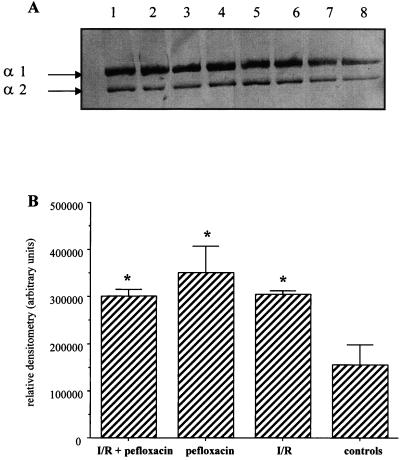
Immunochemical detection of carbonyl groups in Achilles tendon collagen of rats after pefloxacin administration and ischemia (2 h) and reperfusion (3 days). A total of 15 μg of DNPH-derivatized protein was loaded onto each lane. (A) Lanes 1 and 2, Achilles tendon collagen of rats treated with pefloxacin (400 mg/kg/day) for 7 days; for this group I-R and sham surgery were done on the 4th day of pefloxacin treatment (duplicate loads); lanes 3 and 4, Achilles tendon collagen of rats that underwent sham surgery and that were treated with pefloxacin (400 mg/kg/day) for 7 days (duplicate loads); lanes 5 and 6, Achilles tendon collagen of rats submitted to a tendinous I-R (duplicated loads); lanes 7 and 8, Achilles tendon collagen of rats that underwent sham surgery and that received saline solution for 7 days. (B) Densitometric analysis of the immunoblots in panel A. Values are means ± standard deviations. ∗, P < 0.05, and ∗∗, P < 0.01, versus controls (Student's t test).
FIG. 7
FIG. 7
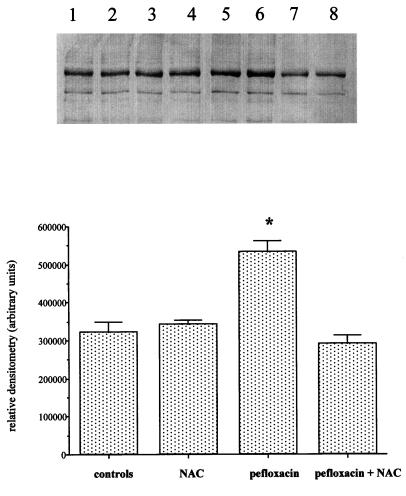
Immunochemical detection of carbonyl groups in Achilles tendon collagen of mice after coadministration of pefloxacin (400 mg/kg/day) and N-acetylcysteine (NAC; 150 mg/kg/day) for 10 days. A total of 10 μg of DNPH-derivatized protein was loaded onto each lane. (A) Lanes 1 and 2, Achilles tendon collagen of controls receiving saline solution for 10 days (duplicate loads); lanes 3 and 4, Achilles tendon collagen of mice receiving N-acetylcysteine (150 mg/kg/day) for 10 days (duplicate loads); lanes 5 and 6, Achilles tendon collagen of mice receiving pefloxacin (400 mg/kg/day) for 10 days (duplicate loads); lanes 7 and 8, Achilles tendon collagen of mice receiving pefloxacin (400 mg/kg/day) and, simultaneously, N-acetylcysteine (150 mg/kg/day) for 10 days (duplicate loads). (B) Densitometric analysis of the immunoblots in panel A. Values are means ± standard deviations. ∗, P < 0.05 versus controls (Student's t test).

References

    1. Birch H L, Rutter G A, Goodship A E. Oxidative energy metabolism in equine tendon cells. Res Vet Sci. 1997;62:93–97. - PubMed
    1. Brenneisen P, Briviba K, Wlaschek M, Wenk J, Scharffetter-Kochanek K. Hydrogen peroxide (H2O2) increases the steady-state mRNA levels of collagenase/MMP-1 in human dermal fibroblasts. Free Radical Biol Med. 1997;22:515–524. - PubMed
    1. Burkhardt J E, Hill M A, Carlton W W, Kesterson J W. Histologic and histochemical changes in articular cartilages of immature beagle dogs dosed with difloxacin, a fluoroquinolone. Vet Pathol. 1990;27:162–170. - PubMed
    1. Christ W, Lehnert T, Ullbrich B. Specific toxicologic aspects of the quinolones. Rev Infect Dis. 1988;10(Suppl.):S144–S146. - PubMed
    1. Desbordes J M, Bouquet S, Breux J, Chapelle G, Bataille B, Becq Giraudon B, Fusciardi J. Comparative penetration of 3 fluoroquinolones into human cranial bone tissue after administration of a single intravenous dose. Drugs. 1993;45(Suppl. 3):448–449.

Publication types

MeSH terms

LinkOut - more resources