


In vivo characterization of the pharmacodynamics of flucytosine in a neutropenic murine disseminated candidiasis model
- PMID: 10722494
- PMCID: PMC89795
- DOI: 10.1128/AAC.44.4.938-942.2000
In vivo characterization of the pharmacodynamics of flucytosine in a neutropenic murine disseminated candidiasis model
Abstract
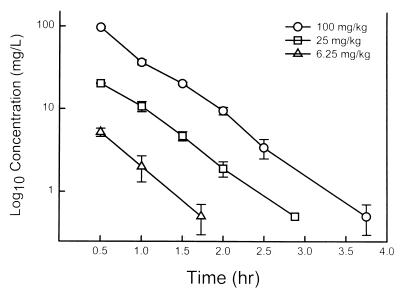
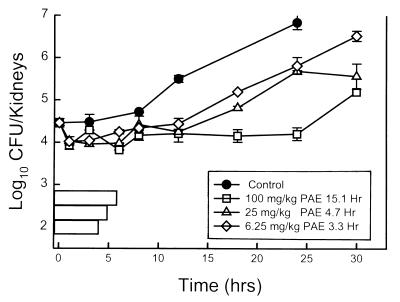
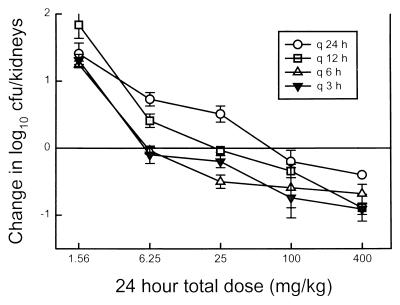
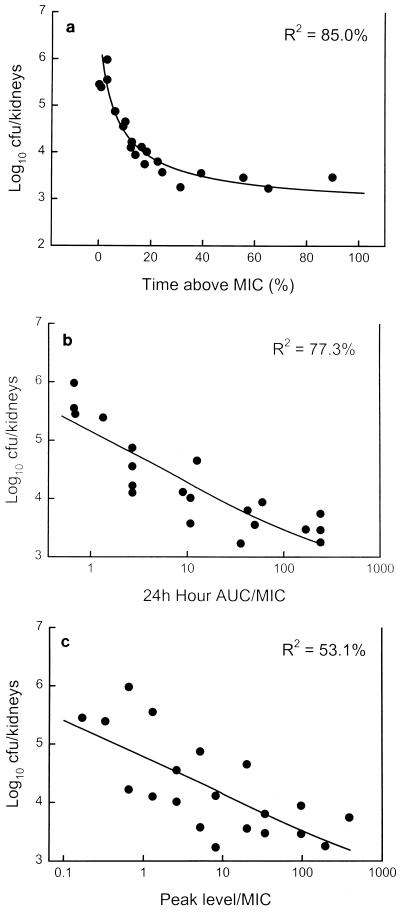
In vivo pharmacodynamic parameters have been characterized for a variety of antibacterial agents. These parameters have been studied in correlation with in vivo outcomes in order to determine (i) which dosing parameter is predictive of outcome and (ii) the magnitude of that parameter associated with efficacy. Very little is known of the pharmacodynamics of antifungal agents. We used a neutropenic murine model of disseminated candidiasis to correlate the pharmacodynamic parameters (percentage of time above the MIC, area under the concentration-time curve [AUC]/MIC and peak level/MIC) for flucytosine (5-FC) in vivo with efficacy as measured by organism number in homogenized kidney cultures after 24 h of therapy. The pharmacokinetics of 5-FC in infected mice were linear. Serum half-lives ranged from 0.36 to 0.43 h. Infection was achieved by intravenous inoculation of 10(6) CFU of yeast cells per ml via the lateral tail vein of neutropenic mice. Groups of mice were treated with fourfold escalating total doses of 5-FC ranging from 1.56 to 400 mg/kg of body weight/day divided into one, two, four, or eight doses over 24 h. Increasing doses produced minimal concentration-dependent killing ranging from 0 to 0.9 log(10) CFU/kidneys. 5-FC did, however, produce a dose-dependent suppression of growth after levels in serum had fallen below the MIC. The fungistatic dose increased from 6 to 8 mg/kg with dosing every 3 and 6 h to 70 mg/kg at with dosing every 24 h. Nonlinear regression analysis was used to determine which pharmacodynamic parameter best correlated with efficacy. Time above the MIC was the parameter best predictive of outcome, while AUC/MIC was only slightly less predictive (time above MIC, R(2) = 85%; AUC/MIC, R(2) = 77%; peak level/MIC, R(2) = 53%). Maximal efficacy was observed when levels exceeded the MIC for only 20 to 25% of the dosing interval. If one considers drug kinetics in humans, these results suggest reevaluation of current dosing regimens.
Figures
References
-
- Anaissie E J, Karyotakis N C, Hachem R, Dignani M C, Rex J H, Paetznick V. Correlation between in vitro and in vivo activity of antifungal agents against Candida species. J Infect Dis. 1994;170:384–389. - PubMed
-
- Atkinson B A, Bouthet C, Bocanegra R, Correa A, Luther M F, Graybill J R. Comparison of fluconazole, amphotericin B and flucytosine in treatment of a murine model of disseminated infection with Candida glabrata in immunocompromised mice. J Antimicrob Chemother. 1995;35:631–640. - PubMed
-
- Banerjee S N, Emori T G, Culver D H, Gaynes R P, Jarvis W R, Horan T, Edwards J R, Tolson J S, Henderson T, Martone W J. Secular trends in nosocomial primary blood stream infections in the United States, 1980–1989. Am J Med. 1991;91(Suppl. 3B):86–89. - PubMed
-
- Bennett J E, Dismukes W E, Duma R J, Medoff G, Sande M A, Gallis H, Leonard J, Fields B T, Bradshaw M, Haywood H, McGee Z A, Cate T R, Cobs C G, Warner J F, Alling D W. A comparison of amphotericin B alone and combined with flucytosine in the treatment of cryptococcal meningitis. N Engl J Med. 1979;301:126–131. - PubMed
MeSH terms
Substances
LinkOut - more resources
Full Text Sources
Other Literature Sources
Medical
