. 2000 Apr;68(4):1787-95.
doi: 10.1128/IAI.68.4.1787-1795.2000.

Cable-piliated Burkholderia cepacia binds to cytokeratin 13 of epithelial cells

Affiliations

Cable-piliated Burkholderia cepacia binds to cytokeratin 13 of epithelial cells

U S Sajjan et al. Infect Immun. 2000 Apr.

Abstract

Although the Burkholderia cepacia complex consists of several genomovars, one highly transmissible strain of B. cepacia has been isolated from the sputa of cystic fibrosis (CF) patients throughout the United Kingdom and Canada. This strain expresses surface cable (Cbl) pili and is thought to be the major strain associated with the fatal "cepacia syndrome." In the present report we characterize the specific 55-kDa buccal epithelial cell (BEC) protein that binds cable pilus-positive B. cepacia. N-terminal sequences of CNBr-generated internal peptides identified the protein as cytokeratin 13 (CK13). Western blots of BEC extracts probed with a specific monoclonal antibody to CK13 confirmed the identification. Mixed epidermal cytokeratins (which contain CK13), cytokeratin extract from BEC (which consists essentially of CK13 and CK4), and a polyclonal antibody to mixed cytokeratins inhibited B. cepacia binding to CK13 blots and to normal human bronchial epithelial (NHBE) cells. Preabsorption of the antikeratin antibody with the BEC cytokeratin fraction reversed the inhibitory effect of the antibody. A cytokeratin mixture lacking CK13 was ineffective as an inhibitor of binding. Colocalization of CK13 and B. cepacia by confocal microscopy demonstrated that intact nonpermeabilized NHBE cells express small amounts of surface CK13 and bind Cbl-positive B. cepacia in the same location. Binding to intact NHBE cells was dependent on bacterial concentration and was saturable, whereas a Cbl-negative isolate exhibited negligible binding. These findings raise the possibility that surface-accessible CK13 in respiratory epithelia may be a biologically relevant target for the binding of cable piliated B. cepacia.


Figures
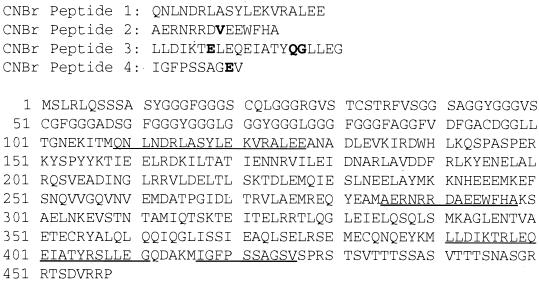
FIG. 1
FIG. 1
N-terminal amino acid sequences of four CNBr fragments obtained from the 55-kDa B. cepacia receptor of BEC, and their alignment (underlined) with the published sequence of human CK13 (39). Dissimilar residues are shown in boldface.
FIG. 2
FIG. 2
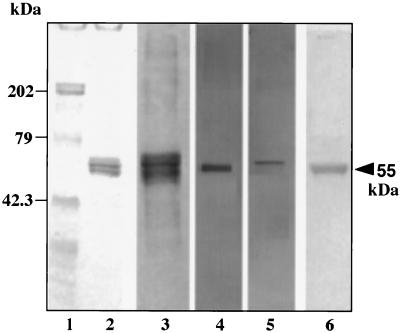
Immunoreactivity of the cytoskeleton-rich (CS) fraction of BEC and binding of B. cepacia. The CS fraction extracted from 104 BEC was separated by SDS-PAGE and Western blotted onto nitrocellulose. Lane 1, molecular mass standards in kilodaltons; lane 2, Coomassie blue staining; lane 3, reactivity with a polyclonal antibody (1:500 dilution) to mixed epidermal cytokeratins; lanes 4 and 5, reactivity with MAbs (0.04 μg of Fab fragments/ml) to CK13 and CK4, respectively; lane 6, overlay with 35S-labeled isolate BC7 (108 CFU/ml) for 1.5 h at 37°C and detection by autoradiography.
FIG. 3
FIG. 3
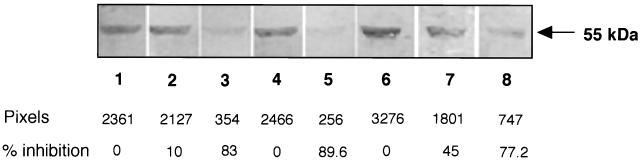
Inhibition of isolate BC7 binding to the 55-kDa receptor of BEC. The cytoskeleton-rich (CS) fraction of BEC was separated by SDS-PAGE and blotted onto nitrocellulose. 35S-labeled isolate BC7 (10 ml of 108 CFU/ml) was added to the blots, and binding was detected by autoradiography. Lane 1, no inhibitor added; lanes 2 and 3, preincubation of bacteria with keratin solubilization buffer alone (lane 2) or with buffer plus mixed epidermal cytokeratins (200 μg) (lane 3); lanes 4 and 5, preincubation of blots with nonimmune serum (lane 4) or antiserum (1:40 dilution) to mixed epidermal cytokeratins (lane 5); lanes 6 to 8, preincubation of bacteria with keratin solubilization buffer (lane 6) or with buffer plus the BEC CS fraction containing 0.3 μg (lane 7) or 1.6 μg (lane 8) of CK13. Density (pixels) was measured on digitized images using NIH Image software. Inhibition of binding was calculated as a percentage of controls (set to 0% inhibition in each set of comparisons).
FIG. 4
FIG. 4
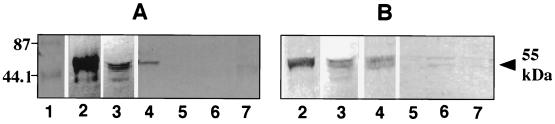
CS fractions from different cell types. Immunoreactivity with MAb to CK13 and BC7 binding. CS fractions from BEC and other epithelial cells were subjected to SDS-PAGE, and proteins were transferred to nitrocellulose membranes. One blot (A) was incubated with the MAb to CK13 (0.04 μg of Fab fragments/ml), and a separate identical blot (B) was incubated with 35S-BC7 (7 × 10⁸ CFU/ml). CK13 was detected by using a second antibody conjugated to alkaline phosphatase. Bound bacteria were detected by autoradiography. Lane 1, prestained molecular mass standards (in kilodaltons); lanes 2 to 7 represent CS fractions from BEC (0.5 × 10⁴), NHBE (1.1 × 10⁵), A-431 (0.56 × 10⁵), A-549 (5 × 10⁵), NCI-H520 (5 × 10⁵), and HEp-2 (5 × 10⁵) cells, respectively.
FIG. 5
FIG. 5
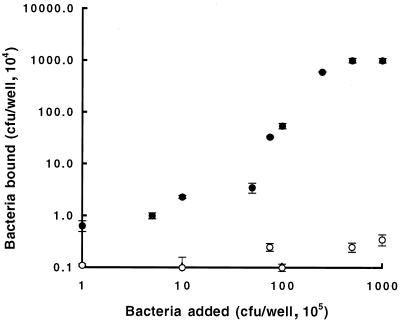
Binding of B. cepacia to NHBE cells. NHBE cells were grown in 96-well plates until they were 80 to 90% confluent. The wells were blocked with 3% BSA for 1 h at 37°C, washed with PBS, and then incubated with 0.1 ml of B. cepacia (105 to 108 CFU/ml) for 1 h. The wells were washed five times with PBS to remove nonbound bacteria, and the bound bacteria were quantitated by enzyme-linked immunosorbent assay by using an antibody specific for B. cepacia. ●, Cbl-positive isolate BC7; ○, Cbl-negative isolate BC45. The mean ± the standard error of the mean of quadruplicate assays for each bacterial concentration is given.
FIG. 6
FIG. 6
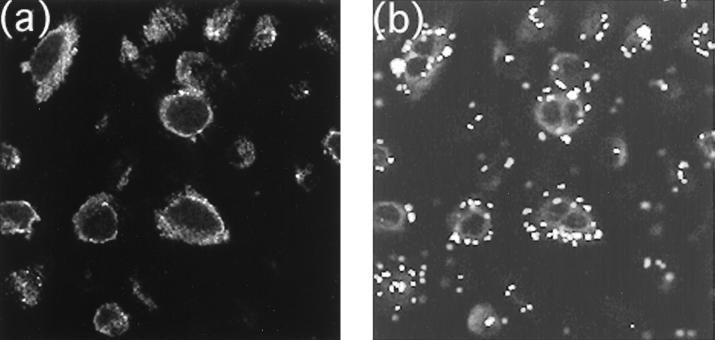
Colocalization of bound B. cepacia and CK13 on NHBE cells. NHBE cells were incubated with the mouse MAb to CK13 and FITC-labeled B. cepacia BC7 as described in Materials and Methods, washed, and then incubated with antimouse antibody conjugated with the fluorophore LRSC. Cells were counterstained with Mayer's hematoxylin. Panels a and b represent CK13 localization and B. cepacia binding, respectively. Magnification bar, 10 μm.
FIG. 7
FIG. 7
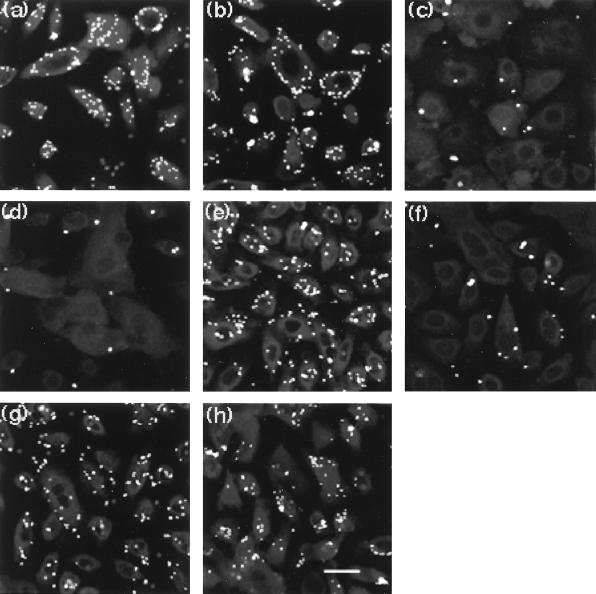
Inhibition of BC7 binding to NHBE cells by BEC CS fraction, mixed epidermal cytokeratins, and polyclonal antibody to mixed epidermal cytokeratins. FITC-labeled BC7 (107 CFU/ml) were incubated with NHBE cells for 1 h and washed, and bound bacteria were detected by confocal microscopy. (a) No inhibitor added. (b to d) Preincubation of bacteria with keratin solubilization buffer (control) (b), buffer plus mixed epidermal cytokeratins (20 μg/ml) (c), and buffer plus BEC CS fraction (containing approximately 8.3 μg of CK13 per ml) (d). (e to h) Preincubation of cells with nonimmune serum control (e), antiserum to mixed epidermal cytokeratins (f), nonimmune serum preadsorbed on BEC CS fraction (g), and antibody to mixed epidermal cytokeratins preabsorbed on BEC CS fraction (h). Magnification bar, 10 μm.

References

    1. Blobel G A, Moll R, Franke W W, Vogt-Moykopf I. Cytokeratins in normal lung and lung carcinomas. Virchows Arch B Cell Pathol. 1984;45:407–429. - PubMed
    1. Broers J L, Carney D N, Klein Rot M, Schaart G, Lane E B, Vooijs G P, Ramaekers F C. Intermediate filament proteins in classic and variant types of small cell lung carcinoma cell lines: a biochemical and immunochemical analysis using a panel of monoclonal and polyclonal antibodies. J Cell Sci. 1986;83:37–60. - PubMed
    1. Burns J L, Wardsworth C D, Barry J J, Goodall C P. Nucleotide sequence analysis of a gene from Burkholderia cepacia encoding an outer membrane lipoprotein involved in multiple antibiotic resistance. Antimicrob Agents Chemother. 1996;40:307–313. - PMC - PubMed
    1. Darling P, Chan M, Cox A D, Sokol P A. Siderophore production by cystic fibrosis isolates of Burkholderia cepacia. Infect Immun. 1998;66:874–877. - PMC - PubMed
    1. Diaz L A, Sampaio S A P, Martins C R, Rivitti E A, Macca M L, Roscoe J T, Takahashi Y, Labib R S, Patel H P, Mutasim D F, Kugan E M, Anhalt G J. An autoantibody in pemphigus serum, specific for the 59 KD keratin, selectively binds the surface of keratinocytes: evidence for an extracellular keratin domain. J Investig Dermatol. 1987;89:287–295. - PubMed

MeSH terms