


Linkage of exogenous T-cell epitopes to the 19-kilodalton region of Plasmodium yoelii merozoite surface protein 1 (MSP1(19)) can enhance protective immunity against malaria and modulate the immunoglobulin subclass response to MSP1(19)
- PMID: 10722607
- PMCID: PMC97391
- DOI: 10.1128/IAI.68.4.2102-2109.2000
Linkage of exogenous T-cell epitopes to the 19-kilodalton region of Plasmodium yoelii merozoite surface protein 1 (MSP1(19)) can enhance protective immunity against malaria and modulate the immunoglobulin subclass response to MSP1(19)
Abstract
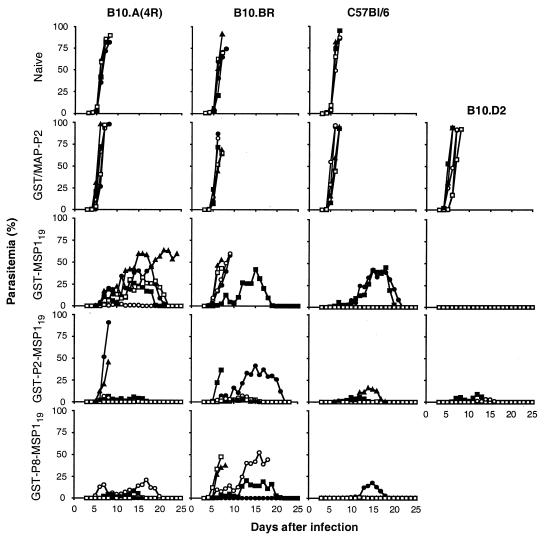
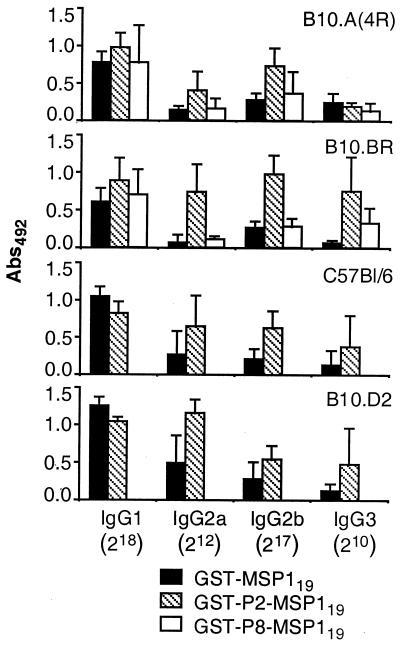
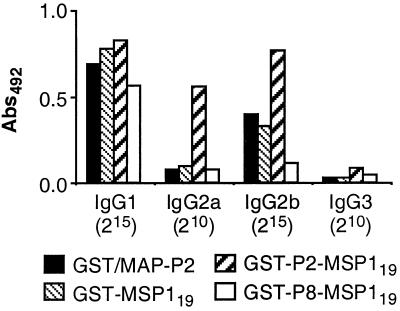
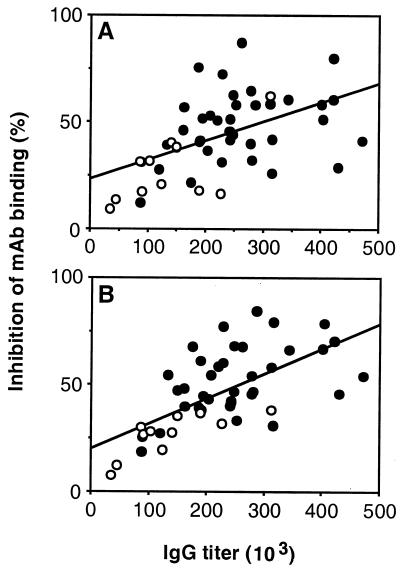
The degree of protection against Plasmodium yoelii asexual blood stages induced by immunization of mice with the 19-kDa region of merozoite surface protein 1 (MSP1(19)) is H-2 dependent. As a strategy to improve the protection, mouse strains with disparate H-2 haplotypes were immunized with glutathione S-transferase (GST)-MSP1(19) proteins including either a universal T-cell epitope from tetanus toxin (P2) or an I-A(k)-restricted T-cell epitope (P8) from Plasmodium falciparum Pf332. In H-2(k) mice which are poorly protected following immunization with GST-MSP1(19), GST-P2-MSP1(19) significantly improved the protection. In mice partially (H-2(k/b)) or well protected by GST-MSP1(19) (H-2(d) and H-2(b)), P2 did not further increase the protection. However, the protection of H-2(k/b) mice and to some extent H-2(k) mice was improved by immunization with GST-P8-MSP1(19). The magnitudes of immunoglobulin G1 (IgG1) and IgG2a responses in mice immunized with the GST-MSP1(19) variants correlated with low peak parasitemia, indicating a protective capacity of these IgG subclasses. In H-2(k) mice immunized with GST-P2-MSP1(19), both IgG1 and IgG2a responses were significantly enhanced. The epitope P2 appeared to have a general ability to modulate the IgG subclass response since all four mouse strains displayed elevated IgG2a and/or IgG2b levels after immunization with GST-P2-MSP1(19). In contrast, GST-P8-MSP1(19) induced a slight enhancement of IgG responses in H-2(k/b) and H-2(k) mice without any major shift in IgG subclass patterns. The ability to improve the protective immunity elicited by P. yoelii MSP1(19) may have implications for improvement of human vaccines based on P. falciparum MSP1(19).
Figures
References
-
- Ahlborg N. Synthesis of a diepitope MAP containing two malaria antigen sequences using Fmoc chemistry. J Immunol Methods. 1995;179:269–275. - PubMed
-
- Ahlborg N, Paulie S, Braesch-Andersen S. Generation of antibodies to human IL-12 and amphiregulin by immunization of Balb/c mice with diepitope multiple antigen peptides. J Immunol Methods. 1997;204:23–32. - PubMed
-
- Ahlborg N, Sterky F, Haddad D, Perlmann P, Nygren P-Å, Andersson R, Berzins K. Predominance of H-2d and H-2k-restricted T-cell epitopes in the highly repetitive Plasmodium falciparum antigen Pf332. Mol Immunol. 1997;34:379–389. - PubMed
-
- Amante F, Good M. Prolonged Th1-like response generated by a Plasmodium yoelii-specific T cell clone allows complete clearance of infection in reconstituted mice. Parasite Immunol. 1997;19:111–126. - PubMed
-
- Blackman M, Dennis E, Hirst E, Kocken C, Scott-Finnigan T, Thomas A. Plasmodium knowlesi: secondary processing of the malaria merozoite surface protein-1. Exp Parasitol. 1996;83:229–239. - PubMed
Publication types
MeSH terms
Substances
Grants and funding
LinkOut - more resources
Full Text Sources
Medical
Research Materials
