. 2000 Mar 28;97(7):3438-43.
doi: 10.1073/pnas.97.7.3438.

Induction of basal cell carcinomas and trichoepitheliomas in mice overexpressing GLI-1

Affiliations

Induction of basal cell carcinomas and trichoepitheliomas in mice overexpressing GLI-1

M Nilsson et al. Proc Natl Acad Sci U S A. .

Abstract

Basal cell carcinoma is the most prevalent cancer in the western world, showing a rapid increase in incidence. Activation of the Sonic hedgehog/Patched (PTCH) signaling pathway because of PTCH1 inactivation is a key event in sporadic and familial basal cell carcinoma development in humans and is associated with transcriptional activation of specific target genes, including PTCH1 itself. These changes are analogous to the situation in Drosophila where hedgehog activates the zinc-finger transcription factor Cubitus interruptus, leading to increased transcription of target genes. In the present study, we show that mice ectopically expressing the human Cubitus interruptus homolog GLI-1 in the skin develop tumors closely resembling human BCCs as well as other hair follicle-derived neoplasias, such as trichoepitheliomas, cylindromas, and trichoblastomas. Furthermore, examination of the tumors revealed wild-type p53 and Ha ras genes. These findings firmly establish that increased GLI-1 expression is central and probably sufficient for tumor development and suggest that GLI-1-induced tumor development does not depend on additional p53 or Ha ras mutations.


Figures
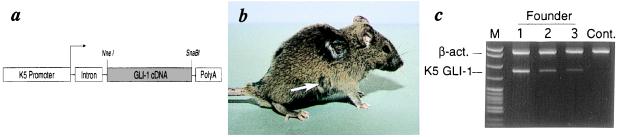
Figure 1
Figure 1
Generation of transgenic mice. (a) Schematic drawing of the K5 GLI-1 transgene. The transgene contains the bovine K5 promoter, the rabbit β-globin intron, the human GLI-1 cDNA, and the SV40 poly(A) signal. (b) GLI-1 transgenic founder (founder 2) showing a tumor ulceration and the nodule (arrow) on the back. (c) RT-PCR analysis of K5 GLI-1 and β-actin mRNA in dorsal skin of the transgenic founders 1 to 3 (–3). Sizes of the specific PCR products are 553 bp for β-actin and 370 bp for K5 GLI-1. Lane M pBR322-MspI ladder (New England Biolabs).
Figure 2
Figure 2
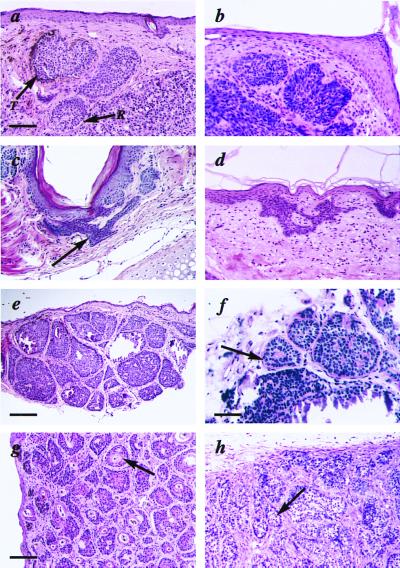
Histological features of the K5 GLI-1 transgenic skin. (a) Nodular BCC from founder 2 with palisading basaloid cells forming tumor nests (T) and retraction space of stroma from tumor islands (R). (b) Human nodular BCC. (c) Superficial BCC from founder 2 with buds and irregular proliferations of tumor tissue attached to the undersurface of the epidermis (arrow). (d) Human superficial BCC. (e) Cylindroma from founder 2 with tumor islands forming a jigsaw puzzle. (f) The periodic acid/Schiff reagent-positive hyalin membrane surrounding the cylindroma tumor islands (arrow). (g) TE from founder 1 with keratinized centers (arrow) surrounded by basophilic tumor cells. (h) Trichoblastoma from founder 3 illustrating tumor islands consisting mostly of germinative cells (arrow). Bar = 135 μm (e), 54 μm (a–d and g, h), and 33 μm (f).
Figure 3
Figure 3
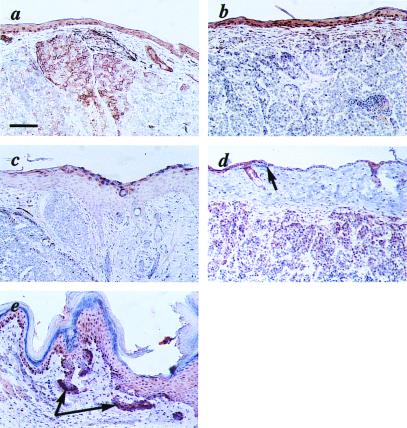
Expression of marker proteins in the K5 GLI-1 mouse skin. (a) Positive immunoreactivity for K5 both in the epidermis and in the tumor cells. (b) K1 is expressed in the suprabasal layers of the epidermis but not in the tumor cells. (c) The granular layer of the epidermis shows positive immunoreactivity with the loricrin antibody, but the closely located tumor cells are negative. (d) Strong expression of K6 in the tumor cells and the overlying hyperproliferative epidermis, whereas the histologically normal epidermis (arrow) is negative. (e) A strong immunoreactivity with phosphohistone 3 (H3) antibodies is seen in the tumor cells (arrows) with a weaker signal in the hyperplastic epidermis. Bar = 54 μm (a–e).
Figure 4
Figure 4
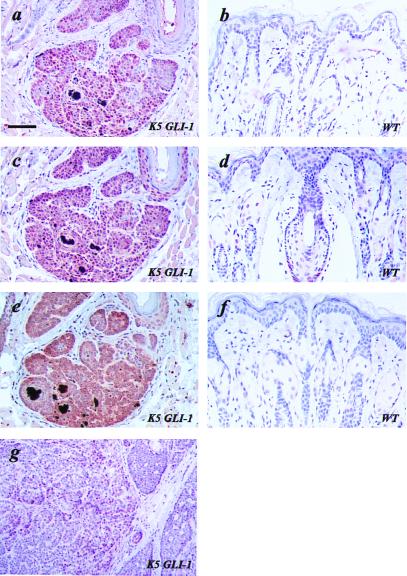
Expression of GLI-1 target genes in K5 GLI-1 transgenic skin and tumors (K5 GLI-1) (a, c, e, and g) and in wild-type skin (WT) (b, d, and f). High expression of Gli-1 is seen in a transgenic BCC and adjacent epidermis (a), but no signal was detected in wild-type skin (b). Ptch1 (c and d) and Bcl-2 (e and f) are both overexpressed in transgenic epidermis and tumor cells compared with wild-type skin. However, single cells in the lower parts of the hair follicle in wild-type skin show positive immunostaining for Ptch1 (d). (g) Sections of a BCC showing scattered tumor cells with immunoreactivity for p53 (brown precipitate). Bar = 92 μm (a–f), 54 μm (g).

References

    1. Johnson R L, Rothman A L, Xie J, Goodrich L V, Bare J W, Bonifas J M, Quinn A G, Myers R M, Cox D R, Epstein E H, Jr, Scott M P. Science. 1996;272:1668–1671. - PubMed
    1. Hahn H, Wicking C, Zaphiropoulous P G, Gailani M R, Shanley S, Chidambaram A, Vorechovsky I, Holmberg E, Undèn A B, Gillies S, et al. Cell. 1996;85:841–851. - PubMed
    1. Aszterbaum M, Rothman A, Johnson R L, Fisher M, Xie J, Bonifas J M, Zhang X, Scott M P, Epstein E H., Jr J Inv Dermatol. 1998;110:885–888. - PubMed
    1. Gailani M R, Stahle-Backdahl M, Leffell D J, Glynn M, Zaphiropoulos P G, Pressman C, Undèn A B, Dean M, Brash D E, Bale A E, et al. Nat Genet. 1996;14:78–81. - PubMed
    1. Vorechovsky I, Undèn A B, Sandstedt B, Toftgård R, Stahle-Backdahl M. Cancer Res. 1997;57:4677–4681. - PubMed

Publication types