. 2000 Mar;105(6):731-40.
doi: 10.1172/JCI5656.

Transgenic mice overexpressing insulin-like growth factor-II in beta cells develop type 2 diabetes

Affiliations

Transgenic mice overexpressing insulin-like growth factor-II in beta cells develop type 2 diabetes

J C Devedjian et al. J Clin Invest. 2000 Mar.

Abstract

During embryonic development, insulin-like growth factor-II (IGF-II) participates in the regulation of islet growth and differentiation. We generated transgenic mice (C57BL6/SJL) expressing IGF-II in beta cells under control of the rat Insulin I promoter in order to study the role of islet hyperplasia and hyperinsulinemia in the development of type 2 diabetes. In contrast to islets from control mice, islets from transgenic mice displayed high levels of IGF-II mRNA and protein. Pancreases from transgenic mice showed an increase in beta-cell mass (about 3-fold) and in insulin mRNA levels. However, the organization of cells within transgenic islets was disrupted, with glucagon-producing cells randomly distributed throughout the core. We also observed enhanced glucose-stimulated insulin secretion and glucose utilization in islets from transgenic mice. These mice displayed hyperinsulinemia, mild hyperglycemia, and altered glucose and insulin tolerance tests, and about 30% of these animals developed overt diabetes when fed a high-fat diet. Furthermore, transgenic mice obtained from the N1 backcross to C57KsJ mice showed high islet hyperplasia and insulin resistance, but they also developed fatty liver and obesity. These results indicate that local overexpression of IGF-II in islets might lead to type 2 diabetes and that islet hyperplasia and hypersecretion of insulin might occur early in the pathogenesis of this disease.


Figures
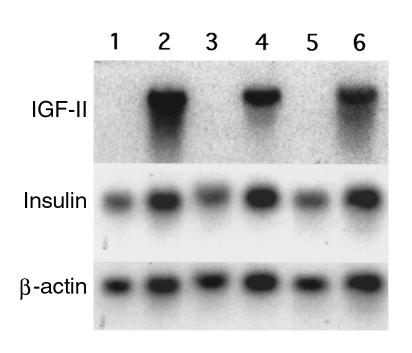
Figure 1
Figure 1
Expression of IGF-II in the pancreas. Total cellular RNA was obtained from control mice and 3 lines of transgenic mice (1, 2, and 3), as indicated in Methods. After transfer, membranes were tested for IGF-II and insulin. Lanes 1, 3, and 5: control mice. Lanes 2, 4, and 6: transgenic mice from lines 1, 2, and 3, respectively.
Figure 2
Figure 2
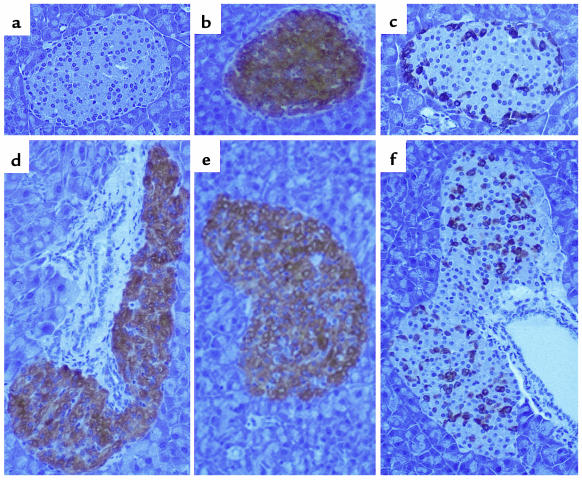
Representative sections of pancreas from 4-month-old control (ac) and transgenic mice (df) showing staining of IGF-II (a and d), insulin (b and e), and glucagon (c and f). ×400.
Figure 3
Figure 3
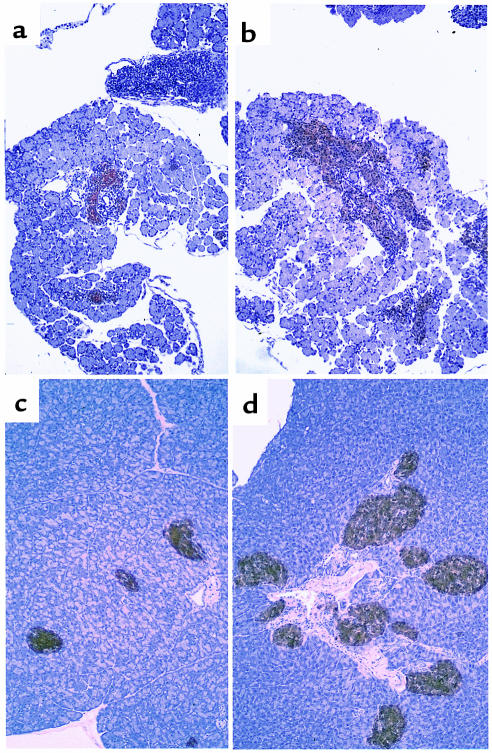
Immunohistochemical analysis of insulin expression in islets from 3-day-old (a and b) and 4-month-old (c and d) control and transgenic mice. Pancreas from control mice (a and c), and pancreas from transgenic mice (b and d), stained for insulin (a and b), (×400); and (c and d), (×200). Note that transgenic mice appear to have an increased number of enlarged islets.
Figure 4
Figure 4
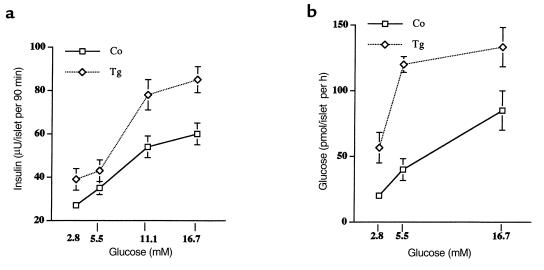
(a) Glucose-induced insulin secretion by isolated islets. Insulin secretion at 2.8 mM, 5.5 mM, 11.1 mM and 16.7 mM glucose was determined as indicated in Methods, in islets isolated from control and transgenic mice. Results are the mean ± SEM of 8 animals in each group. (b) Glucose utilization by pancreatic β cells. Islets were incubated in the presence of different glucose concentrations and the utilization of the sugar was determined by measuring the formation of [3H]2O from D-[5-3H]glucose. Results are the mean ± SEM of 3 independent experiments performed in triplicate. Co, control mice; Tg, transgenic mice.
Figure 5
Figure 5
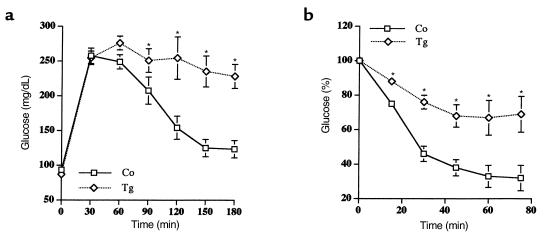
Intraperitoneal glucose and insulin tolerance tests. (a) Glucose tolerance test. Overnight-starved mice were given an intraperitoneal injection of glucose (1 mg/g body wt). Blood samples were taken at the times indicated from the tail vein of the same animals. Glucose was measured as indicated in Methods. Results are mean ± SEM of 12 transgenic and 12 control mice. (b) Insulin tolerance test. Awake fed control and transgenic mice were injected intraperitoneally with 0.75 IU of a soluble insulin. Blood samples were taken from the tail vein of the same animals at the times indicated, and glucose concentration was determined as indicated in Methods. Results are mean ± SEM of 8 transgenic and 8 control mice. *P < 0.05 vs. control.
Figure 6
Figure 6
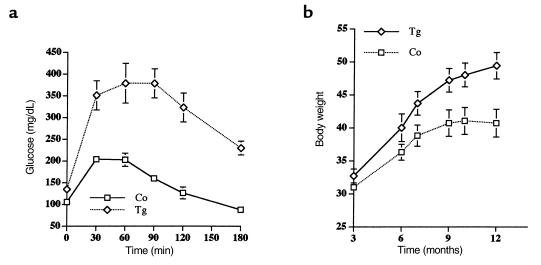
Intraperitoneal glucose tolerance test and body weight in N1 C57KsJ transgenic mice. (a) Glucose tolerance test. Six-month-old mice starved for 24 hours were given an intraperitoneal injection of glucose (1 mg/g body wt). Blood samples were taken at the times indicated from the tail vein of the same animals. Glucose was measured as indicated in Methods. Results are mean ± SEM of 10 transgenic and 10 control mice. (b) Changes in body weight of control mice and transgenic mice. Data are mean ± SEM of 12 mice in each group.
Figure 7
Figure 7
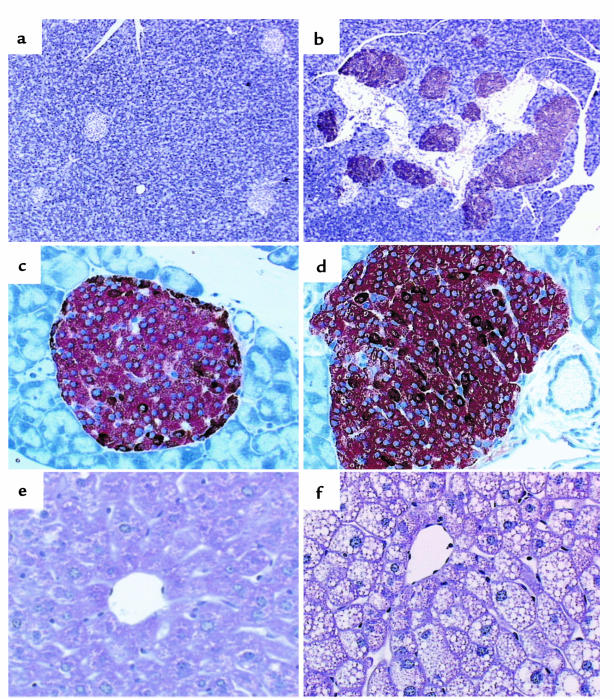
(ad) Immunohistochemical analysis of IGF-II (a and b), insulin (red), and glucagon (brown) (c and d) expression in islets from 12-month-old N1 C57KsJ mice. Control mice are shown in a and c; transgenic mice are shown in b and d. (e and f) PAS staining of the liver from control (e) and transgenic (f) mice aged 12 months. a and b, ×100; cf, ×200.

References

    1. LeRoith, D. 1991. Insulin-like growth factors: molecular and cellular aspects. CRC Press. Boca Raton, FL. 88–110.
    1. Schofield, P.N. 1992. The insulin-like growth factors: structure and biological function. Oxford University Press. Oxford, United Kingdom. 12–44.
    1. Le Roith D. Insulin-like growth factors. N Engl J Med. 1997;336:633–640. - PubMed
    1. Han VK, Lund PK, Lee DC, D’Ercole AJ. Expression of somatomedin/insulin-like growth factor messenger ribonucleic acids in the human fetus: identification, characterization, and tissue distribution. J Clin Endocrinol Metab. 1988;66:422–429. - PubMed
    1. Hogg J, Han VKM, Clemmons DR, Hill DJ. Interactions of nutrients, insulin-like growth factors (IGFs) and IGF-binding proteins in the regulation of DNA synthesis by isolated fetal rat islets of Langerhans. J Endocrinol. 1993;138:401–412. - PubMed

Publication types

MeSH terms