


Patterns of genomic sequence diversity among their simian immunodeficiency viruses suggest that L'Hoest monkeys (Cercopithecus lhoesti) are a natural lentivirus reservoir
- PMID: 10729165
- PMCID: PMC111899
- DOI: 10.1128/jvi.74.8.3892-3898.2000
Patterns of genomic sequence diversity among their simian immunodeficiency viruses suggest that L'Hoest monkeys (Cercopithecus lhoesti) are a natural lentivirus reservoir
Abstract
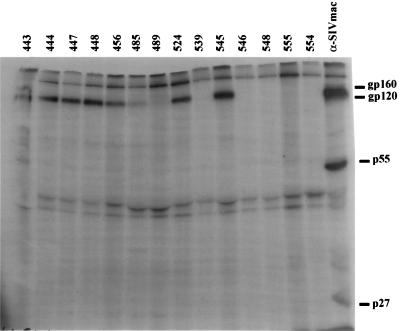
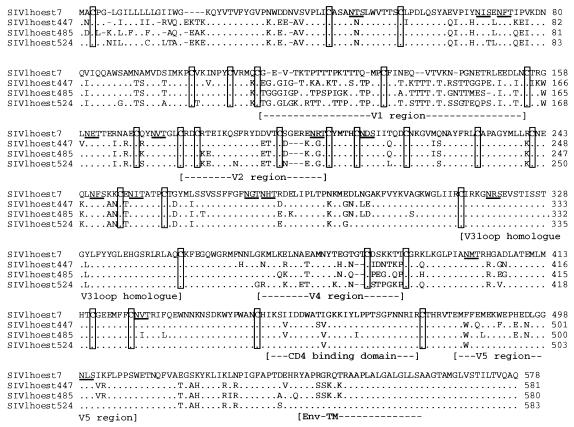
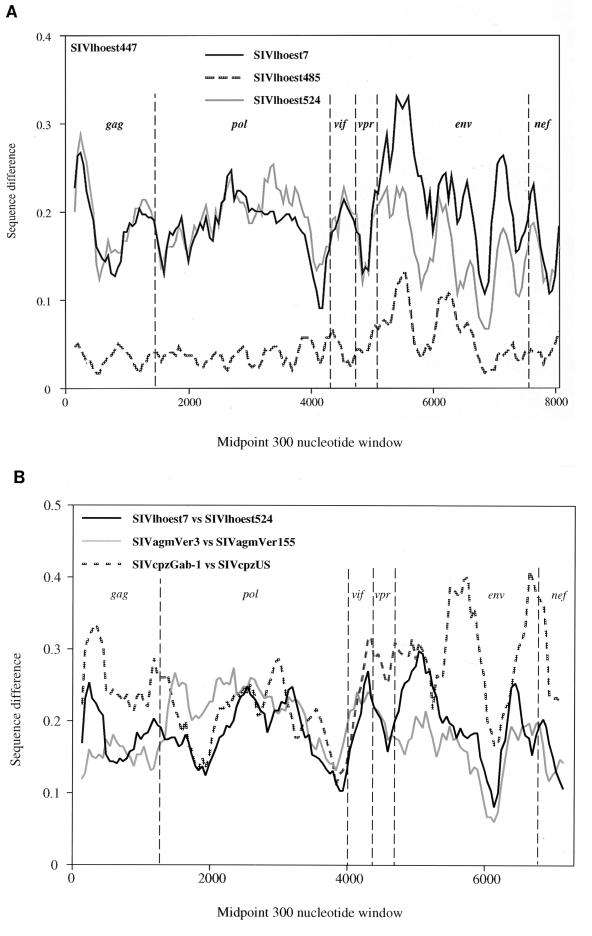
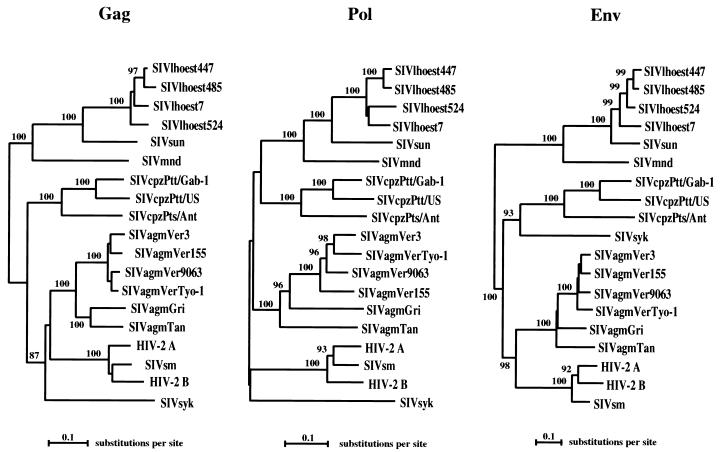
Recently, we described a novel simian immunodeficiency virus (SIVlhoest) from a wild-caught L'Hoest monkey (Cercopithecus lhoesti) from a North American zoo. To investigate whether L'Hoest monkeys are the natural host for these viruses, we have screened blood samples from 14 wild animals from the Democratic Republic of Congo. Eight (57%) were found to be seropositive for SIV. Nearly full-length genome sequences were obtained for SIV isolates from three of these monkeys and compared to the original isolate and to other SIVs. The four samples of SIVlhoest formed a distinct cluster in phylogenetic trees. Two of these isolates differed on average at only about 5% of nucleotides, suggesting that they were epidemiologically linked; otherwise, the SIVlhoest isolates differed on average by 18%. Both the level of diversity and the pattern of its variation along the genome were very similar to those seen among isolates of SIVagm from vervet monkeys, pointing to similarities in the nature of, and constraints on, SIV evolution in these two species. Discordant phylogenetic relationships among the SIVlhoest isolates for different genomic regions indicated that mosaic viruses have been generated by recombination, implying that individual monkeys have been coinfected by more than one strain of SIV. Taken together, these observations provide strong evidence that L'Hoest monkeys constitute a natural reservoir for SIV.
Figures
References
-
- Baier M, Werner A, Cichutek K, Garber C, Mueller C, Kraus G, Ferdinand F J, Hartung S, Papas T S, Kurth R. Molecularly cloned simian immunodeficiency virus SIVagm3 is highly divergent from other SIVagm isolates and is biologically active in vitro and in vivo. J Virol. 1989;63:5119–5123. - PMC - PubMed
-
- Beer B E, Bailes E, Goeken R, Dapolito G, Coulibaly C, Norley S G, Kurth R, Gautier J P, Gautier-Hion A, Vallet D, Sharp P M, Hirsch V M. Simian immunodeficiency virus (SIV) from sun-tailed monkeys (Cercopithecus solatus): evidence for host-dependent evolution of SIV within the C. lhoesti superspecies. J Virol. 1999;73:7734–7744. - PMC - PubMed
-
- Bibollet-Ruche F, Galat-Luong A, Cuny G, Sarni-Manchado P, Galat G, Durand J P, Pourrut X, Veas F. Simian immunodeficiency virus infection in a patas monkey (Erythrocebus patas): evidence for cross-species transmission from African green monkeys (Cercopithecus aethiops sabaeus) in the wild. J Gen Virol. 1996;77:773–781. - PubMed
-
- Chen Z, Luckay A, Sodora D L, Telfer P, Reed P, Gettie A, Kanu J M, Sadek R F, Yee J, Ho D D, Zhang L, Marx P A. Human immunodeficiency virus type 2 (HIV-2) seroprevalence and characterization of a distinct HIV-2 genetic subtype from the natural range of simian immunodeficiency virus-infected sooty mangabeys. J Virol. 1997;71:3953–3960. - PMC - PubMed
MeSH terms
Substances
Associated data
- Actions
- Actions
- Actions
LinkOut - more resources
Full Text Sources
Molecular Biology Databases
