


doi: 10.1128/jvi.74.8.3905-3908.2000.
Control of Sindbis virus infection by antibody in interferon-deficient mice
Affiliations
- PMID: 10729167
- PMCID: PMC111901
- DOI: 10.1128/jvi.74.8.3905-3908.2000
Item in Clipboard
Control of Sindbis virus infection by antibody in interferon-deficient mice
J Virol.
2000 Apr.
Abstract
Antibodies clear Sindbis virus from infected animals through an unknown mechanism. To determine whether interferon-induced pathways are required for this clearance, we examined mice which are unable to respond to alpha/beta interferon or gamma interferon. Although extremely susceptible to infection, such mice survived and completely cleared virus if antibodies against Sindbis virus were given.
Figures
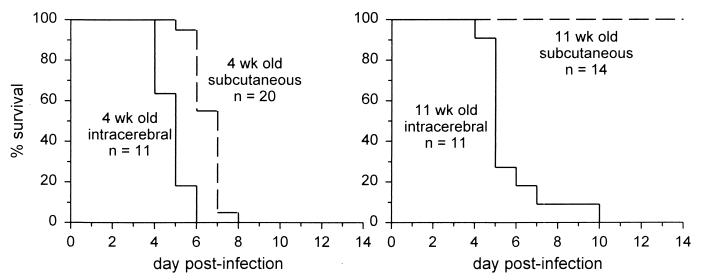
Differences in percentages of survival of young and old A129 mice. A129 mice lack the receptor for IFN-α/β. Mice were injected s.c. or i.c. with 1,000 PFU of Toto 1101 in 30 μl of Hanks' balanced salt solution. Survival was assessed daily. For 4-week-old mice, there was a significant difference between the survival curves following s.c. and i.c. infection (P < 0.05, log rank test). When 11-week-old mice were injected s.c. with virus, all mice survived, and this was significantly different from the result with 11-week-old mice injected i.c. as well as with 4-week-old mice injected s.c. (P < 0.05).
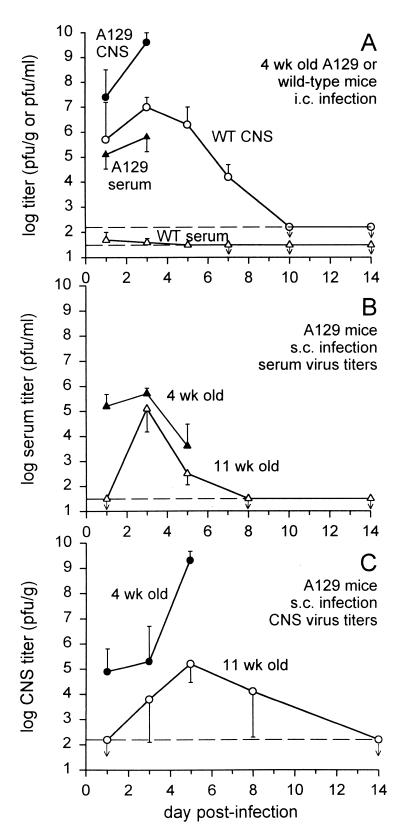
Viral titers in the serum or CNS. (A) Four-week-old A129 or wild-type 129/SvEv mice were infected i.c., and viral titers were assessed by plaque assay on BHK cells (three to four mice per time point; geometric means ± standard deviations). Mice were perfused with phosphate-buffered saline to remove blood-borne virus before brains were harvested. While wild-type (WT) mice cleared virus completely and showed no clinical signs of infection, A129 mice had very high titers of virus and died around day 4 or 5. Horizontal dashed lines indicate the limit of sensitivity of the assay (30 PFU/ml for serum and 170 PFU/g for the CNS), and arrows indicate values below the detection limit. (B and C) Following s.c. injection of virus, replication was slower and less extensive in older mice and virus was eventually cleared. Younger mice developed extremely high titers in their CNSs and died around day 6 or 7. Wild-type mice did not have any detectable virus in their sera or CNSs after s.c. infection (not shown).

Treatment of i.c. infected A129 mice with antiviral antibody lowers viral titers. Mice (4 weeks old) were injected i.c. with virus, and one group was simultaneously given 200 μg of G5 intraperitoneally. Antibody lowered viral titers in the serum by more than 3 orders of magnitude (P < 0.0001, two-way analysis of variance) but had less of an effect on viral replication in the CNS (P = 0.0502).

Antibody protects s.c. infected STAT1-deficient mice. STAT1-deficient mice do not respond to either IFN-α/β or IFN-γ. Four-week-old mice were infected with 1,000 PFU of Toto 1101 by s.c. injection. Some mice were also injected intraperitoneally with 200 μg of G5. Survival curves for both groups of G5-injected mice were significantly different from the survival curve after injection with virus alone (P < 0.05, log rank test).
References
-
- Coppenhaver D H, Singh I P, Sarzotti M, Levy H B, Baron S. Treatment of intracranial alphavirus infections in mice by a combination of specific antibodies and an interferon inducer. Am J Trop Med Hyg. 1995;52:34–40. - PubMed
-
- Durbin J E, Hackenmiller R, Simon M C, Levy D E. Targeted disruption of the mouse Stat1 gene results in compromised innate immunity to viral disease. Cell. 1996;84:443–450. - PubMed
-
- Grieder F B, Vogel S N. Role of interferon and interferon regulatory factors in early protection against Venezuelan equine encephalitis virus infection. Virology. 1999;257:106–118. - PubMed
-
- Griffin D, Levine B, Tyor W, Ubol S, Desprès P. The role of antibody in recovery from alphavirus encephalitis. Immunol Rev. 1997;159:155–161. - PubMed
Publication types
MeSH terms
Substances
Grants and funding
LinkOut - more resources
Full Text Sources
