. 2000 Mar-Apr;7(2):152-63.
doi: 10.1136/jamia.2000.0070152.

Temporal expressiveness in querying a time-stamp--based clinical database

Affiliations

Temporal expressiveness in querying a time-stamp--based clinical database

D J Nigrin et al. J Am Med Inform Assoc. 2000 Mar-Apr.

Abstract

Most health care databases include time-stamped instant data as the only temporal representation of patient information. Many previous efforts have attempted to provide frameworks in which medical databases could be queried in relation to time. These, however, have required either a sophisticated database representation of time, including time intervals, or a time-stamp-based database coupled with a nonstandard temporal query language. In this work, the authors demonstrate how their previously described data retrieval application, DXtractor, can be used as a database querying application with expressive power close to that of temporal databases and temporal query languages, using only standard SQL and existing time-stamp-based repositories. DXtractor provides the ability to compose temporal queries through an interface that is understood by nonprogramming medical personnel. Not all temporal constructs are easily implemented using this framework; nonetheless, DXtractor's temporal capabilities provide a significant improvement in the temporal expressivity accessible to clinicians using standard time-stamped clinical databases.


Figures
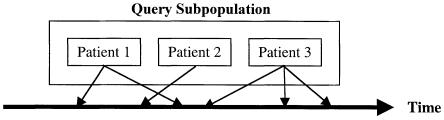
Figure 1
Figure 1
Diagram of a patient subpopulation generated from a Dxtractor query. Each patient may have one or more event dates, which represent the time stamps of the queried-for events.
Figure 2
Figure 2
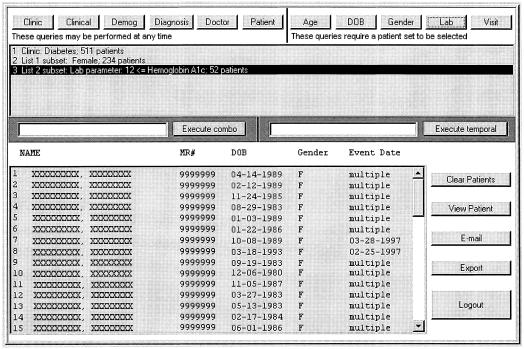
The Dxtractor main screen. Population queries are performed by selecting one of the buttons that appear across the top of the screen. The buttons have self-explanatory names like “Doctor,” “Clinical,” “Diagnosis,” and “Lab,” which select a group of patients based on, respectively, which doctor cares for them, a specific clinical finding on physical examination, a diagnosis, or a specific laboratory finding. The results of several queries are visible in the list of sets. Set 3 represents girls in the diabetes clinic who had a history of elevated glycohemoglobin (HbA1c) values—that is, values greater than or equal to 12 percent. (Names and medical record numbers have been masked to preserve confidentiality.) The Event Date column shows that many patients have had multiple occurrences of the elevated value.
Figure 3
Figure 3
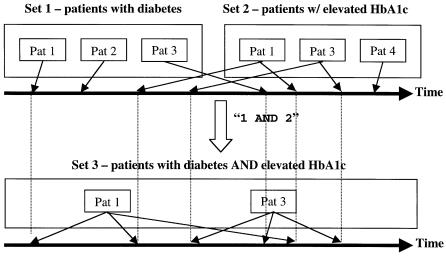
Diagram of a Boolean combination of two retrieved patient subpopulations. Only patients present in both sets are present in the AND combination of the two. All time stamps for patients in both sets are passed to the output set, Set 3. After they are combined, these “event” time stamps may, however, no longer have a meaningful interpretation. HbA1c indicates glycohemoglobin, or hemoglobin A1c.
Figure 4
Figure 4
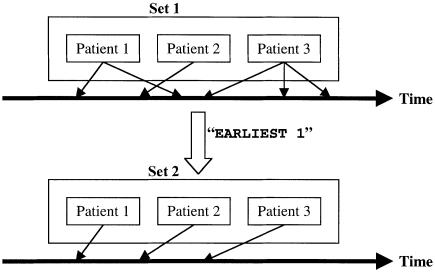
Diagram of the temporal set operation “EARLIEST 1.” Only the earliest time stamp for each patient is passed to the output set. If a patient has only one associated time stamp in the original set, then that time stamp is passed to the output set.
Figure 5
Figure 5
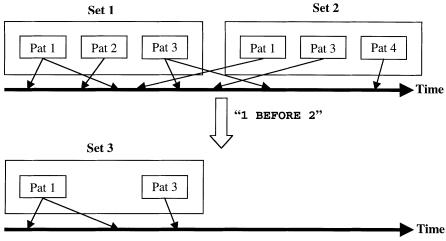
Diagram of the temporal set operation “1 BEFORE 2.” Only patients in both sets are in the result set. For these patients, only the event dates that satisfy the temporal condition are passed to the result set.

References

    1. Combi C, Pinciroli F, Cavallaro M, Cucchi G. Querying temporal clinical databases with different time granularities: the GCH-OSQL language. Proc Annu Symp Comput Appl Med Care. 1995: 326-30. - PMC - PubMed
    1. Das AK, Musen MA. A temporal query system for protocol-directed decision support. Methods Inf Med. 1994;33(4): 358-70. - PubMed
    1. Rucker DW, Maron DJ, Shortliffe EH. Temporal representation of clinical algorithms using expert-system and data-base tools. Comput Biomed Res. 1990;23(3): 222-39. - PubMed
    1. Kohane IS. Temporal reasoning in medical expert systems. In: Salomon R, Blum B, Jørgensen M (eds). Medinfo. 1986: 170-4.
    1. Haimowitz IJ, Kohane IS. Managing temporal worlds for medical trend diagnosis. Artif Intell Med. 1996;8(3): 299-321. - PubMed

Publication types

MeSH terms