. 2000 Apr;20(8):2783-93.
doi: 10.1128/MCB.20.8.2783-2793.2000.

Multiple ras downstream pathways mediate functional repression of the homeobox gene product TTF-1

Affiliations

Multiple ras downstream pathways mediate functional repression of the homeobox gene product TTF-1

C Missero et al. Mol Cell Biol. 2000 Apr.

Abstract

Expression of oncogenic Ras in thyroid cells results in loss of expression of several thyroid-specific genes and inactivation of TTF-1, a homeodomain-containing transcription factor required for normal development of the thyroid gland. In an effort to understand how signal transduction pathways downstream of Ras may be involved in suppression of the differentiated phenotype, we have tested mutants of the Ras effector region for their ability to affect TTF-1 transcriptional activity in a transient-transfection assay. We find that V12S35 Ras, a mutant known to interact specifically with Raf but not with RalGDS or phosphatidylinositol 3-kinase (PI3 kinase) inhibits TTF-1 activity. Expression of an activated form of Raf (Raf-BXB) also inhibits TTF-1 function to a similar extent, while the MEK inhibitors U0126 and PD98059 partially relieve Ras-mediated inactivation of TTF-1, suggesting that the extracellular signal-regulated kinase (ERK) pathway is involved in this process. Indeed, ERK directly phosphorylates TTF-1 at three serine residues, and concomitant mutation of these serines to alanines completely abolishes ERK-mediated phosphorylation both in vitro and in vivo. Since activation of the Raf/MEK/ERK pathway accounts for only part of the activity elicited by oncogenic Ras on TTF-1, other downstream pathways are likely to be involved in this process. We find that activation of PI3 kinase, Rho, Rac, and RalGDS has no effect on TTF-1 transcriptional activity. However, a poorly characterized Ras mutant, V12N38 Ras, can partially repress TTF-1 transcriptional activity through an ERK-independent pathway. Importantly, concomitant expression of constitutive activated Raf and V12N38 Ras results in almost complete loss of TTF-1 activity. Our data indicate that the Raf/MEK/ERK cascade may act in concert with an as-yet-uncharacterized signaling pathway activated by V12N38 Ras to repress TTF-1 function and ultimately to inhibit thyroid cell differentiation.


Figures
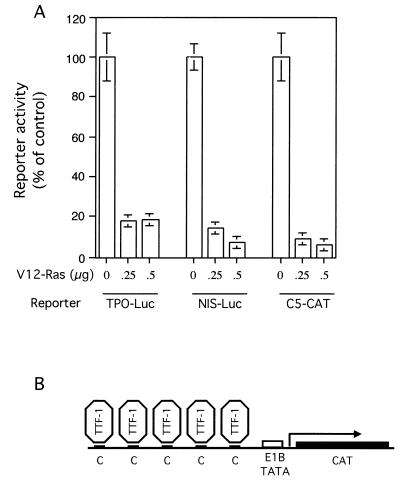
FIG. 1
FIG. 1
Transient expression of V12 Ras inhibits the activity of thyroid-specific promoters. (A) FRTL-5 cells were transiently transfected with 2.5 μg of TPO-Luc, NIS-Luc, or C5-CAT and pCMV encoding V12 Ras at various amounts (0, 0.25, and 0.5 μg). The amount of total DNA was held constant by including the pCMV-βGAL expression vector. After 72 h, cell extracts were prepared, normalized for protein content, and assayed for luciferase (Luc) or CAT activity as described in Materials and Methods. Reporter activity was expressed as a percentage of reporter activity in the absence of V12 Ras. Error bars indicate the standard errors of the means of four independent experiments. (B) Structure of the C5-CAT reporter gene. The artificial promoter, driving the CAT gene, was constructed by inserting five TTF-1 binding sites in tandem in front of the E1B TATA minimal region.
FIG. 2
FIG. 2
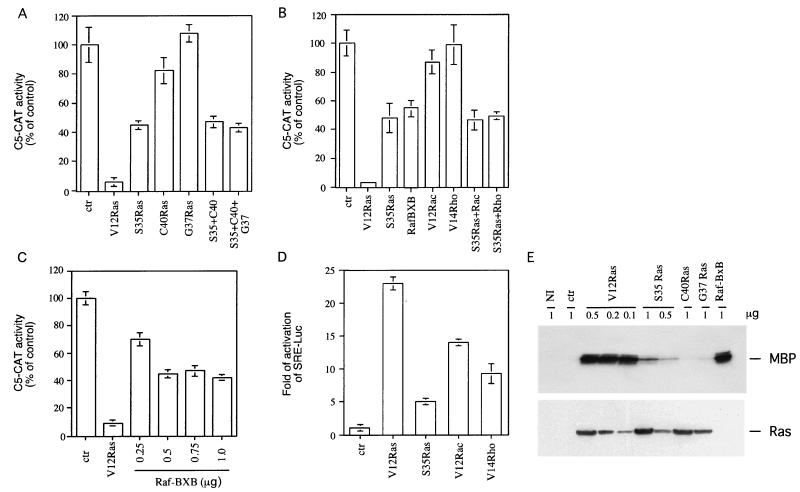
V12S35 Ras and Raf-BXB inhibit TTF-1 transcriptional activity. (A) FRTL-5 cells were transiently transfected with 2.5 μg of C5-CAT and with pCMV encoding V12 Ras (0.2 μg) or the various Ras effector mutants (1 μg) alone or in combination. The amount of Ras-expressing vectors was selected for equal protein expression in 293 cells (see panel E). Preliminary experiments were performed to ensure that maximal activity on the C5-CAT reporter gene was seen for each mutant. (B) FRTL-5 cells were transiently transfected with 2.5 μg of C5-CAT, CMV-βGAL as the control (ctr) (1 μg), V12 Ras (0.2 μg), V12S35 Ras (1 μg), or constitutively active forms of Raf (Raf-BXB; 1 μg), Rac (V12 Rac; 1 μg), and Rho (V14 Rho; 1 μg), either alone or in combination. (C) FRTL-5 cells were transiently transfected with 2.5 μg of C5-CAT, CMV-βGAL as the control (ctr), V12 Ras (0.2 μg), or various concentrations of V12S35 Ras (0.25, 0.5, 0.75, and 1 μg). The amount of total DNA was held constant by including pCMV-βGAL expression vector. These experiments were performed as described in the legend to Fig. 1. For panels A, B, and C, reporter activities were expressed as a percentage of the untreated controls, and error bars indicate the standard errors of the means of four independent experiments. (D) FRTL-5 cells were transiently transfected with 6 μg of SRE-Luc, CMV-βGAL (control [ctr]), and pCMV encoding V12 Ras (0.2 μg), V12S35 Ras (1 μg), V12 Rac (1 μg), and V14 Rho (1 μg). The reporter activity was expressed as fold activation over the untreated control (SRE-Luc transfected with CMV-βGAL). Error bars indicate the standard errors of the means of four independent experiments. (E) 293 cells were transiently transfected with pcDNA3-ERK2 (2 μg) in the presence of various amounts of pCMV vector encoding V12 Ras (0.1, 0.2, or 0.5 μg), V12S35 Ras (0.5 and 1 μg), V12C40 (1 μg), V12G37 (1 μg), Raf-BXB (1 μg), or βGAL as a control (ctr). After 48 h, cell extracts were prepared, and HA-ERK2 was immunoprecipitated with anti-HA epitope-specific antibodies, as described in Materials and Methods. The nonimmune (NI) sample was immunoprecipitated with unrelated control antibodies. Immunoprecipitated ERK2 was then subjected to an in vitro kinase assay with MBP as the substrate. Half of the samples were then run on SDS–4 to 15% PAGE and subjected to autoradiography (upper panel). The lower panel represents an immunoblot with the other half of the samples probed with anti-HA Ras antibody.
FIG. 3
FIG. 3
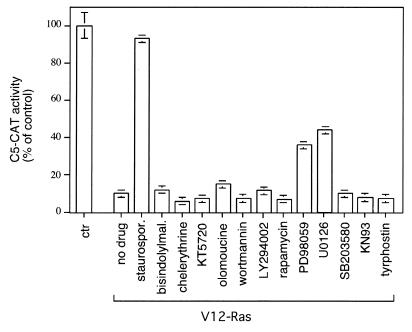
V12 Ras represses TTF-1 transcriptional activity with a kinase-dependent mechanism. FRTL-5 cells were transiently transfected with C5-CAT (2.5 μg) and with pCMV-V12 Ras (0.2 μg) or pCMV-βGAL as a control (ctr). After 24 h, cells were treated with a broad-spectrum kinase inhibitor (staurosporine, 100 nM), protein kinase C inhibitors (bisindolylmaleimide [500 nM] and chelerythrine [10 μM]), a protein kinase A inhibitor (KT5720, 2 μM), a cyclin-dependent kinase inhibitor (olomoucine, 200 μM), PI3K inhibitors (wortmannin [200 nM] and LY294002 [50 μM]), an S60 kinase inhibitor (rapamycin, 50 nM), MEK inhibitors (PD098059 [75 μM] and U0126 [50 μM]), a p38 MAP kinase inhibitor (SB203580, 10 μM), a calmodulin-dependent kinase inhibitor (KN93, 5 μM), or a tyrosine kinase inhibitor (tyrphostin, 50 μM). Treatment was repeated after 24 h. Cells were lysed after 72 h, and CAT activity was measured as described in the legend to Fig. 1. The amount of each drug was tested in preliminary experiments, and the maximum concentration that had minimal effects on cell viability was used. C5-CAT activity was calculated for each point by assuming that the activity of the drug-treated control in the absence of V12 Ras was 100%. Error bars indicate the standard errors of the means of four independent experiments.
FIG. 4
FIG. 4
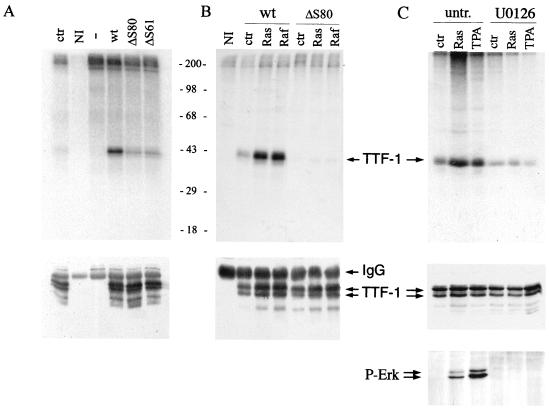
TTF-1 is a direct substrate of ERK2. (A) In vitro kinase assay. 293 cells were transiently transfected with RcCMV encoding wild-type TTF-1 (wt), a mutant carrying seven serine-to-alanine substitutions (ΔS80), a mutant carrying six serine-to-alanine substitutions (ΔS61), or βGAL as a negative control (—). After 48 h, cell lysates were prepared and TTF-1 was immunoprecipitated with anti-TTF-1 polyclonal antibodies or with control antibodies (NI). Immunoprecipitated TTF-1 was then subjected to an in vitro kinase assay by addition of bacterially produced activated ERK2, as described in Materials and Methods. To ensure that the kinase activity seen on TTF-1 was due to ERK and not to an immunoprecipitated kinase, a sample was incubated under the same conditions in the absence of ERK2 as a control (ctr). Samples were then run on SDS–10% PAGE and subjected to autoradiography. The migration of molecular mass standards is indicated (in kilodaltons). Samples were also run on SDS–4 to 15% PAGE gradient gels and subjected to Western blotting with anti-TTF-1 antibodies (lower panel). (B) In vivo labeling experiment. 293 cells were transfected with RcCMV encoding wild-type (wt) or mutant (ΔS80) TTF-1, pCMV encoding V12 Ras (Ras), Raf-BXB (Raf), or βGAL as a control (ctr). After 24 h, cells were metabolically labeled with 32Pi for 4 h and then lysed, as described in Materials and Methods. Cell lysates were subjected to immunoprecipitation with antibodies to TTF-1, run on SDS–10% PAGE, and subjected to autoradiography (upper panel). The migration of molecular mass standards is indicated (in kilodaltons). Samples were run on an SDS–4 to 15% PAGE gradient gel and subjected to immunoblotting with anti-TTF-1 antibodies (lower panel). (C) In vivo labeling experiment. 293 cells were transfected with RcCMV encoding wild-type TTF-1 in the presence or absence of V12 Ras (Ras) or with βGAL as a control (ctr). After 24 h, cells were incubated with DMEM–0.2% calf serum for 18 h and then left untreated (untr.) or treated with U0126 (50 μM) for 4 h. Subsequently, cells were incubated for 45 min with 32Pi in the presence or absence of the phorbol ester PMA (100 nM). Cell lysates were subjected to immunoprecipitation with antibodies to TTF-1, run on SDS–10% PAGE, and subjected to autoradiography (upper panel). As a control, total cell extracts were run on an SDS–4 to 15% PAGE gradient gel and subjected to Western blotting with anti-TTF-1 antibodies (middle panel). In the lower panel, immunoblotting was performed with anti-phospho-specific-ERK antibodies, showing that the expression of activated Ras and PMA treatment induced ERK phosphorylation to a similar extent. Treatment with U0126 completely suppressed ERK phosphorylation. Arrows indicate TTF-1 (∼42 kDa) and the immunoglobulin G heavy chains (IgG). The TTF-1 double pattern in the immunoblot is not due to phosphorylation of the sites taken into consideration in this study, since it is present in the wild type as well as in the ΔS80 mutant. However, TTF-1 phosphorylation occurs predominantly in the upper band, as shown by autoradiography and Western blotting of the same filter.
FIG. 5
FIG. 5
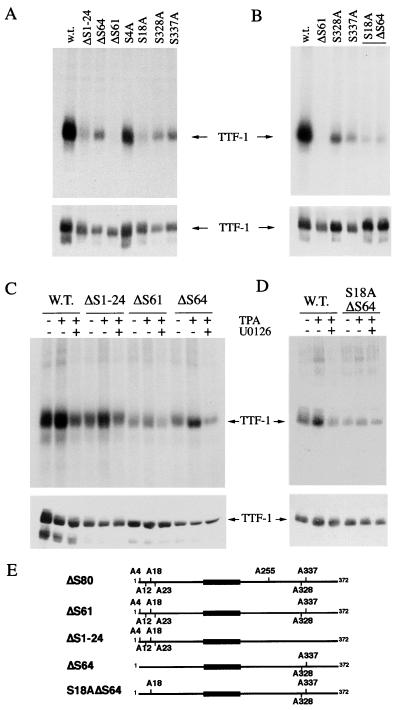
ERK-mediated phosphorylation of the TTF-1 protein occurs at serine residues 18, 328, and 337. (A and B) In vitro kinase assays. 293 cells were transiently transfected with RcCMV encoding wild-type TTF-1 (wt) and various mutants containing serine-to-alanine substitutions (see panel E for details on the specific mutants). After 48 h, cell lysates were prepared and TTF-1 was immunoprecipitated with anti-TTF-1 polyclonal antibodies. Immunoprecipitated TTF-1 was then subjected to an in vitro kinase assay using bacterially produced ERK2 as the active kinase (see Materials and Methods). Samples were then run on a long SDS–10% PAGE gel and then blotted on a PVDF membrane as described in Materials and Methods. After transfer, the membrane was subjected to autoradiography and then used to perform immunoblotting with anti-TTF-1 antibodies (lower panel). (C and D) In vivo labeling experiments. 293 cells were transfected with RcCMV encoding wild-type (wt) or mutant TTF-1 as indicated. After 24 h, cells were incubated with DMEM supplemented with 0.2% calf serum for 18 h and treated (+) with U0126 (50 μM) for 4 h or left untreated (−). Subsequently, cells were incubated for 45 min with 32Pi in the presence (+) or in the absence (−) of the phorbol ester PMA (100 nM) and then lysed as described in Materials and Methods. TTF-1 was immunoprecipitated with anti-TTF-1 polyclonal antibodies. Samples were then run on a long SDS–10% PAGE gel and blotted on a PVDF membrane as described in Materials and Methods. After transfer, the membrane was subjected to autoradiography and then used to perform immunoblotting with anti-TTF-1 antibodies (lower panel). (E) Schematic diagram of the TTF-1 serine-to-alanine mutants. The ΔS80 mutant encodes a full-length TTF-1 protein containing Ser-to-Ala substitutions at residues 4, 12, 18, 23, 255, 328, and 337. The ΔS61 mutant encodes a full-length TTF-1 protein containing Ser-to-Ala substitutions at residues 4, 12, 18, 23, 328, and 337. The ΔS1-24 mutant encodes a full-length TTF-1 protein containing Ser-to-Ala substitutions only at the N terminus at residues 4, 12, 18, and 23. The ΔS64 mutant encodes a full-length TTF-1 protein containing only the two carboxy-terminal Ser-to-Ala substitutions at residues 328 and 337. Finally, the S18AΔS64 mutant encodes a full-length TTF-1 protein containing Ser-to-Ala substitutions at residues 18, 328, and 337. Single-amino-acid substitutions such as S4A (Ser-to-Ala substitution at residue 4), S18A, S328A, and S337A were also tested (panels A and B).
FIG. 6
FIG. 6
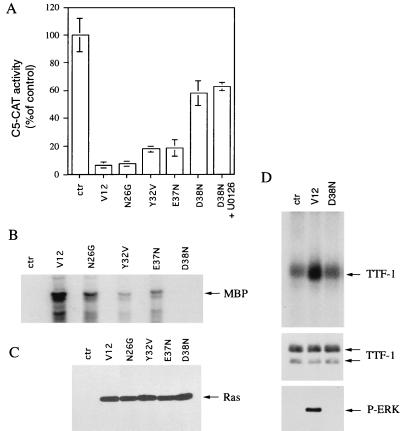
V12N38 Ras mutant inhibits TTF-1 function without inducing MAP kinase activation. (A) FRTL-5 cells were transfected with C5-CAT and pCMV expressing V12 Ras (0.2 μg), V12N26G Ras (1 μg), V12Y32V Ras (1 μg), V12E37N Ras (1 μg), V12D38N Ras (1 μg), or βGAL as a control (ctr). In the case of V12D38N Ras, samples were either untreated (D38N) or treated with 50 μM U0126 for 48 h before the end of the experiment (D38N+U0126). The CAT assay was performed as described in the legend to Fig. 1. C5-CAT activity was expressed as a percentage of reporter activity in the absence of Ras. Error bars indicate the standard errors of the means of four independent experiments. (B) The Ras mutant ability to activate MAP kinase was evaluated by transient transfection in 293 cells in the presence of pCMV HA-ERK2. Lysates were immunoprecipitated with anti-Ha antibodies, and ERK activity was measured by an in vitro kinase assay with MBP as the substrate (see Materials and Methods). This experiment was repeated twice with similar results. (C) The 293 total cell lysates used for panel B were subjected to immunoblotting with anti-H-Ras antibodies to ensure equal amounts of Ras proteins in the extracts. (D) In vivo labeling experiment. 293 cells were transfected with pCMV encoding wild-type TTF-1 in the presence of V12 Ras (V12), V12D38N Ras (D38N), or βGAL as a control (ctr). After 24 h, cells were incubated with 0.2% calf serum for 18 h and then incubated for 2 h with 32Pi in serum- and phosphate-free DMEM. Cell lysates were subjected to immunoprecipitation with anti-TTF-1 antibodies, run on SDS–10% PAGE, and then blotted on a PVDF membrane as described in Materials and Methods. After transfer, the membrane was subjected to autoradiography (upper panel) and then used to perform immunoblotting with anti-TTF-1 antibodies (middle panel). In the lower panel, total cell extracts were run on SDS–4 to 15% PAGE gel gradient, and immunoblotting was performed with anti-phospho-specific-ERK antibodies.
FIG. 7
FIG. 7
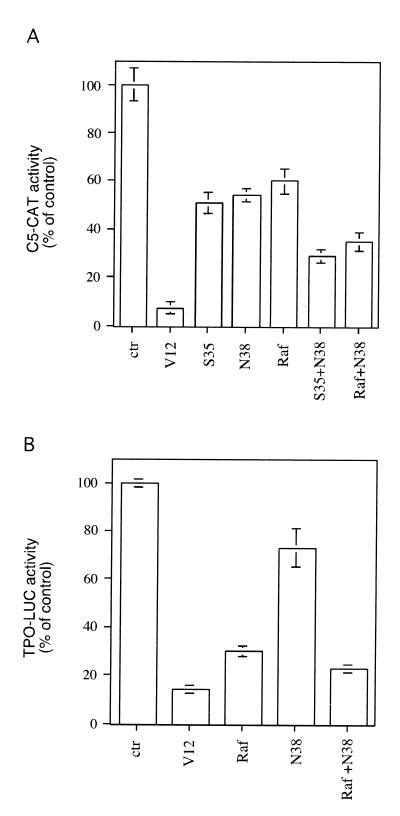
Concomitant expression of V12N38 Ras and Raf-BXB inhibits thyroid-specific gene expression. (A) FRTL-5 cells were transfected with C5-CAT (2.5 μg), pCMV expressing various Ras constructs (V12 Ras [0.2 μg], V12S35 Ras [1 μg], and V12N38 Ras [1 μg]), Raf-BXB (1 μg), or βGAL as a control (ctr). CAT activity was measured as described in the legend to Fig. 1. (B) FRTL-5 cells were transfected as in A except that TPO-Luc (2.5 μg) was used as the reporter gene. Luciferase activity was measured as described in the legend to Fig. 1. The reporter activities were calculated as a percentage of the untreated controls. Error bars indicate the standard errors of the means of four independent experiments.

References

    1. Akasaka K, Tamada M, Wang F, Kariya K, Shima F, Kikuchi A, Yamamoto M, Shirouzu M, Yokoyama S, Kataoka T. Differential structural requirements for interaction of Ras protein with its distinct downstream effectors. J Biol Chem. 1996;271:5353–5360. - PubMed
    1. Ambesi-Impiombato F S, Parks L A M, Coon H G. Culture of hormone-dependent functional epithelial cells from rat thyroids. Proc Natl Acad Sci USA. 1980;77:3455–3459. - PMC - PubMed
    1. Baker S J, Markowitz S, Fearon E R, Willson J K, Vogelstein B. Suppression of human colorectal carcinoma cell growth by wild-type p53. Science. 1990;249:912–915. - PubMed
    1. Bos J L. The ras gene family and human carcinogenesis. Mutat Res. 1988;195:255–271. - PubMed
    1. Brasier A R, Tate J E, Habener J F. Optimized use of the firefly luciferase assay as a reporter gene in mammalian cell lines. Biotechniques. 1989;7:1116–1122. - PubMed

Publication types