. 2000 Apr;20(8):2852-64.
doi: 10.1128/MCB.20.8.2852-2864.2000.

Fission yeast homologs of human CENP-B have redundant functions affecting cell growth and chromosome segregation

Affiliations

Fission yeast homologs of human CENP-B have redundant functions affecting cell growth and chromosome segregation

M Baum et al. Mol Cell Biol. 2000 Apr.

Abstract

Two functionally important DNA sequence elements in centromeres of the fission yeast Schizosaccharomyces pombe are the centromeric central core and the K-type repeat. Both of these DNA elements show internal functional redundancy that is not correlated with a conserved DNA sequence. Specific, but degenerate, sequences in these elements are bound in vitro by the S. pombe DNA-binding proteins Abp1p (also called Cbp1p) and Cbhp, which are related to the mammalian centromere DNA-binding protein CENP-B. In this study, we determined that Abp1p binds to at least one of its target sequences within S. pombe centromere II central core (cc2) DNA with an affinity (K(s) = 7 x 10(9) M(-1)) higher than those of other known centromere DNA-binding proteins for their cognate targets. In vivo, epitope-tagged Cbhp associated with centromeric K repeat chromatin, as well as with noncentromeric regions. Like abp1(+)/cbp1(+), we found that cbh(+) is not essential in fission yeast, but a strain carrying deletions of both genes (Deltaabp1 Deltacbh) is extremely compromised in growth rate and morphology and missegregates chromosomes at very high frequency. The synergism between the two null mutations suggests that these proteins perform redundant functions in S. pombe chromosome segregation. In vitro assays with cell extracts with these proteins depleted allowed the specific assignments of several binding sites for them within cc2 and the K-type repeat. Redundancy observed at the centromere DNA level appears to be reflected at the protein level, as no single member of the CENP-B-related protein family is essential for proper chromosome segregation in fission yeast. The relevance of these findings to mammalian centromeres is discussed.


Figures
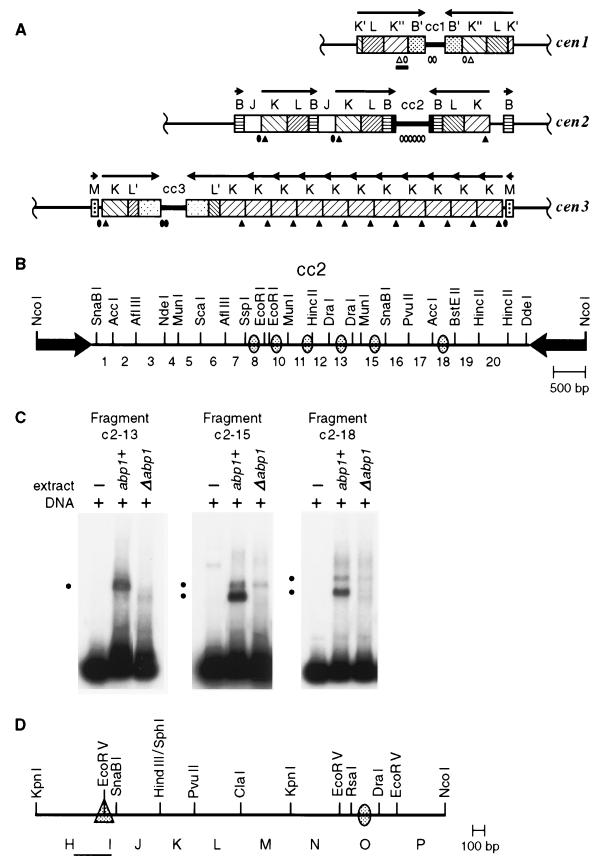
FIG. 1
FIG. 1
Organization of Abp1p and Cbh1p in vitro binding sites in S. pombe centromeres from strain Sp223. The ovals and triangles represent Abp1p and Cbh1p binding sites, respectively, summarized from this and previous studies (24, 38, 50). (A) The three S. pombe centromeres consist of a limited set of repeated DNA elements that are arranged in an inverted repeat around a central core (cc) region that, in the case of cc2, is unique in the genome, whereas cc1 and cc3 share extensive homology (14, 65). The central core and K-type repeat, which are necessary and sufficient for centromere function, were examined for in vitro protein binding sites by electrophoretic mobility shift assay. The open symbols mark the locations of sites identified in mobility shift assays. The solid symbols correspond to homologous sequences in the other centromeres. The arrows indicate the orientations of the centromeric repeat arrays. (B) Enlarged view of cc2 showing the numbered restriction fragments that were tested in mobility shift assays and the approximate locations of Abp1p binding sites within those fragments that show specific interactions. (C) Electrophoretic mobility shift assays of the central core fragments c2-13 (359 bp), c2-15 (376 bp), and c2-18 (383 bp) indicated in panel B. Five femtomoles of radiolabeled cc2 fragment DNA (∼1 ng) and an excess of poly(dI-dC) nonspecific competitor DNA (1 μg) were mixed in binding buffer with 1.2 μg of protein from a 0.4 M KCl crude extract of chromatin prepared from abp1+ (Sp223) or Δabp1 (SBP070196-F5C) logarithmically growing cultures (24). The black dots to the left of each panel indicate the positions of specific protein-DNA complexes formed. (D) Enlargement of a portion of the cen1 K" repeat, corresponding to the black bar in panel A, showing the location of Abp1p and Cbh1p binding sites. The KpnI-KpnI subfragment is termed the centromere enhancer and is found in all K repeat elements. Within this region, Cbh1p binds specifically to fragment HI (PCR product corresponding to the thin black line).
FIG. 2
FIG. 2
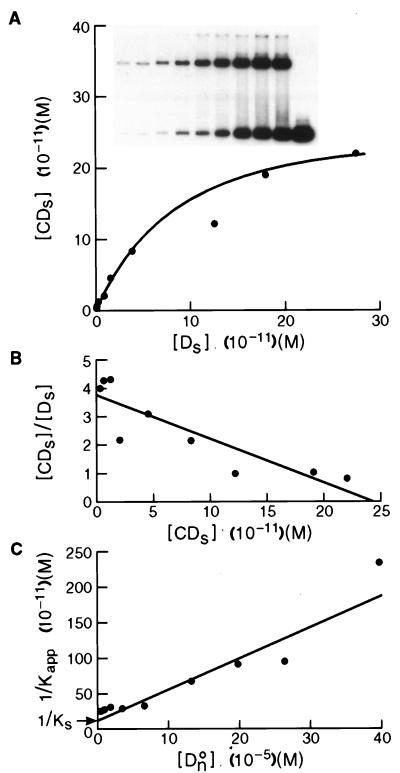
Determination of an equilibrium binding constant for Abp1p to c2-10 DNA. (A) Saturation binding curve using increasing amounts of radiolabeled c2-10 DNA and a constant amount of affinity-purified Abp1p in the presence of nonspecific poly(dI-dC) DNA. The concentration of Abp1p complexed with c2-10 [CDs] is plotted versus free c2-10 [Ds]. (B) The same data are plotted to graphically solve equation 2 (see Materials and Methods). The slope of the line equals Kapp, and the x intercept equals CO, the number of binding sites in the reaction. (C) Correction of Kapp for the contribution made by binding to nonspecific DNA. Binding between constant amounts of affinity-purified Abp1p and radiolabeled c2-10 DNA was competed by increasing amounts of nonspecific poly(dI-dC) DNA. The inverse of Kapp, determined from equation 3, is plotted versus the concentration of nonspecific DNA [DnO] to graphically solve equation 5 for Kn and Ks, the nonspecific and specific binding constants, respectively (3, 7). The y intercept equals 1/Ks, and the slope of the line is equal to Kn/Ks. Thus, Kn is equal to the slope divided by the y intercept.
FIG. 3
FIG. 3
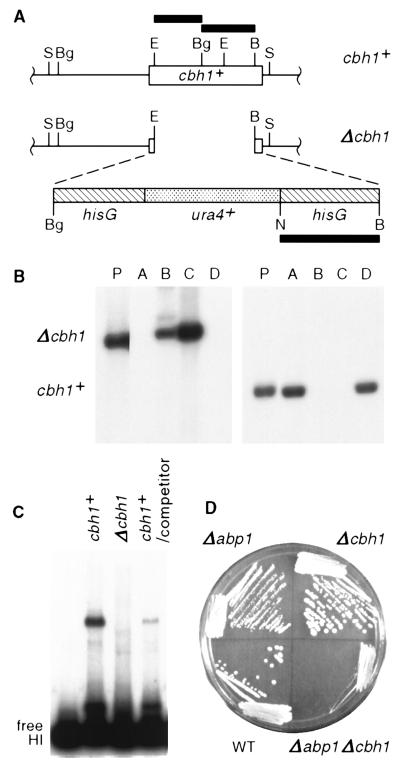
The CENP-B-related gene cbh1+ is not essential, but deletion of both abp1+ and cbh1+ has a synergistic effect on fission yeast growth. (A) Structures of cbh1+ and the Δcbh1 construct (see Materials and Methods). The solid bars correspond to radiolabeled probes used for panel B. Restriction site abbreviations: B, BamHI; Bg, BglII; E, EcoRI; N, NheI; S, SalI. (B) The viability of Δcbh1 strains was verified by Southern analysis of the meiotic products (A to D; SBP060498-21) corresponding to one tetrad that resulted from sporulation of a heterozygous (Δcbh1/cbh1+) parent (P; SBPD051198). Duplicate aliquots of SalI-digested fission yeast DNA were electrophoresed on a 1% agarose gel, blotted, and probed with a 1.3-kb NheI-BamHI hisG fragment, which hybridizes to a 6.4-kb SalI fragment (left), or a mixture of the 0.6-kb EcoRI-BglII and 0.7-kb BglII-BamHI fragments from cbh1+, which hybridize to a 2.9-kb SalI fragment (right). (C) Extract prepared from a Δcbh1 strain (SBP060498-21C) lacks HI-binding activity. Binding reactions were performed as described in the legend to Fig. 1. The specificity of Cbh1p for the HI PCR-generated K" fragment (Fig. 1D) is demonstrated in the rightmost lane, where binding to 5 fmol of radiolabeled HI fragment was competed by addition of a 25-fold molar excess of unlabeled HI fragment. (D) Growth of a Δcbh1 strain was equivalent to that of the wild type, but a Δabp1 Δcbh1 strain grew extremely slowly. The strains (SBP072198-1A to -D) were grown for 9 days at room temperature and photographed.
FIG. 4
FIG. 4
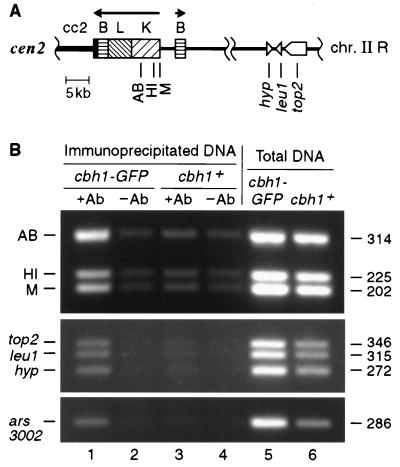
GFP-tagged Cbh1p is associated with both centromeric and noncentromeric chromatin in vivo. (A) Schematic of a portion of chromosome II shows the locations that were examined for association with Cbh1p-GFP using a ChIP technique (51, 52). Besides ars3002 and fragment HI of the centromeric K repeat, which were tested as likely cognate targets because they bind Cbh1p in vitro, several other random noncoding and coding sequences were also tested. PCR primer sets are indicated by vertical lines. Fragments AB, HI, and M are located within the centromeric K repeat that is found in 16 to 18 copies in the S. pombe genome. The single-copy genes top2, leu1, and a hypothetical open reading frame (hyp) are located greater than 300 kb from cen2 (Sanger Centre S. pombe Genome Project [http://www.sanger.ac.uk]). The location of ars3002, a telomere-proximal unique sequence on chromosome III, is not shown. Centromeric DNA elements are indicated by solid or patterned boxes. Genes are marked by open, pointed symbols, with the direction of transcription proceeding toward the tip. (B) Coimmunoprecipitation of centromeric K repeat DNA, ars3002 DNA, and random transcribed DNA with Cbh1p-GFP. Cross-linked chromatin from an integrated cbh1-GFP (SBP071198-2) or cbh1+ (SBP040398) strain was immunoprecipitated with antibody (+Ab) against GFP (lanes 1 and 3, respectively) or beads only (−Ab) (lanes 2 and 4, respectively). Total DNA (lanes 5 and 6) and immunoprecipitated DNA were used for PCR with primers specific for the indicated fragments (see Materials and Methods). The corresponding densitometry values for immunoprecipitated DNA normalized to total DNA from cbh1-GFP and cbh1+ strains, respectively, are as follows: AB, 0.707 and 0.192; HI, 0.385 and 0.167; M, 0.391 and 0.147; top2, 0.268 and 0.184; leu1, 0.255 and 0.196; hyp, 0.253 and 0.212; and ars3002, 0.253 and 0.212. The size of each amplified fragment is indicated in base pairs.
FIG. 5
FIG. 5
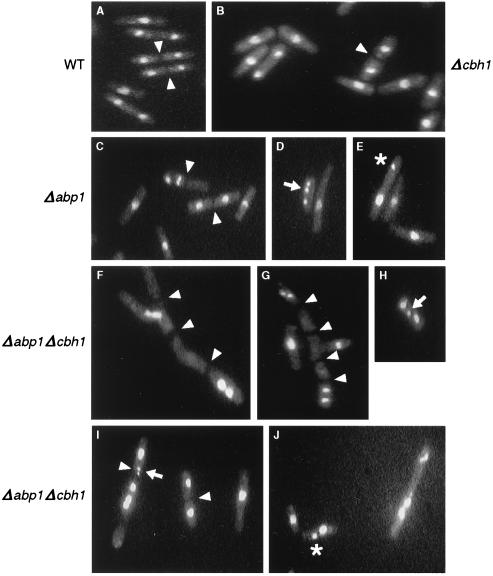
Chromosome missegregation and defective cytokinesis in a Δabp1 Δcbh1 strain. Ethanol-fixed, propidium iodide-stained cells were examined by fluorescence microscopy as described in footnote a to Table 3. Wild-type (A) and Δcbh1 (B) cells appeared uniformly normal, whereas Δabp1 (C to E) cells showed rare instances of missegregation. In contrast, Δabp1 Δcbh1 (F to J) cells showed frequent mistakes in chromosome segregation, as well as many cells with branched, multiseptated morphology (magnification, ×120). Cell septa (arrowheads), lagging chromosomes (arrows), and unequal distribution of chromatin masses (asterisks) are indicated. (See Tables 3 and 4 for a summary of the data). All cultures were grown at 32°C.
FIG. 6
FIG. 6
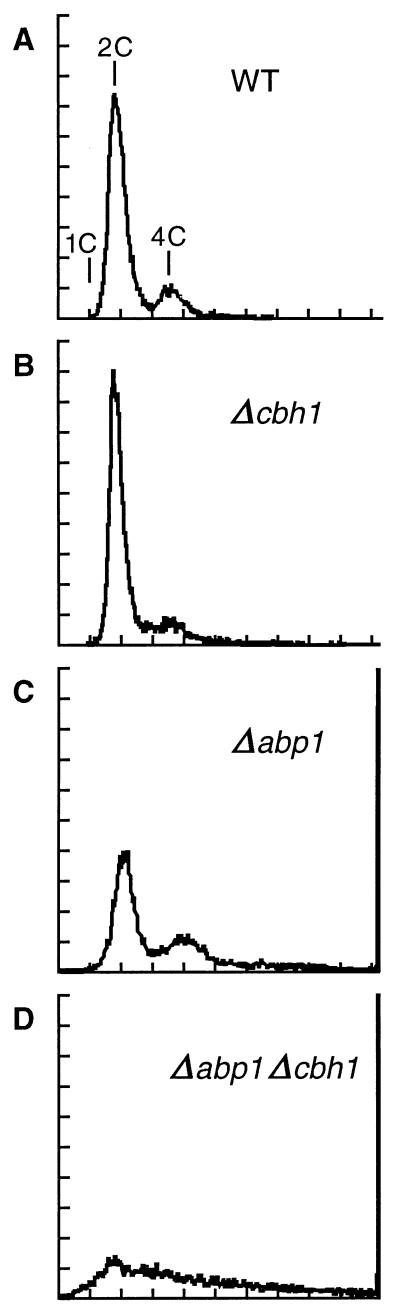
A Δabp1 Δcbh1 double-deletion strain accumulates cells at higher ploidy. DNA content was estimated by FACS analysis. See Materials and Methods for details of the procedure and footnote a to Table 3 for strain names. Peaks representing 1C (nitrogen-starved haploid cells), 2C, and 4C DNA content are indicated. Fluorescence, which corresponds to DNA content, is plotted on an arbitrary scale (x axis) versus relative cell number (y axis). All cultures were grown at 32°C.

References

    1. Allshire R C. Centromeres, checkpoints and chromatid cohesion. Curr Opin Genet Dev. 1997;7:264–273. - PubMed
    1. Altschul S F, Madden T L, Schaffer A A, Zhang J, Zhang Z, Miller W, Lipman D J. Gapped BLAST and PSI-BLAST: a new generation of protein database search programs. Nucleic Acids Res. 1997;25:3389–3402. - PMC - PubMed
    1. Baker R E, Gabrielsen O, Hall B D. Effects of tRNATyr point mutations on the binding of yeast RNA polymerase III transcription factor C. J Biol Chem. 1986;261:5275–5282. - PubMed
    1. Baker R E, Fitzgerald-Hayes M, O'Brien T C. Purification of the yeast centromere binding protein CP1 and a mutational analysis of its binding site. J Biol Chem. 1989;264:10843–10850. - PubMed
    1. Baker R E, Masison D C. Isolation of the gene encoding the Saccharomyces cerevisiae centromere-binding protein CP1. Mol Cell Biol. 1990;10:2458–2467. - PMC - PubMed

Publication types

MeSH terms

LinkOut - more resources