


Comment
doi: 10.1073/pnas.97.7.2965.
Singing in the brain
Affiliations
- PMID: 10737777
- PMCID: PMC34308
- DOI: 10.1073/pnas.97.7.2965
Item in Clipboard
Comment
Singing in the brain
Proc Natl Acad Sci U S A.
.
No abstract available
Figures
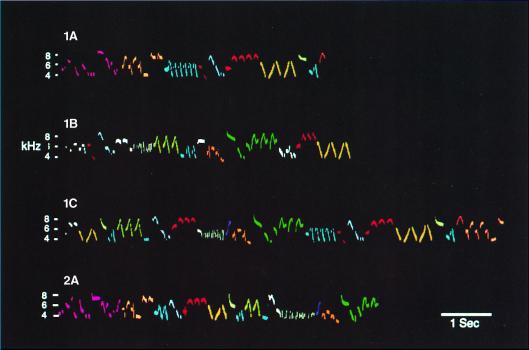
The winter wren, Troglodytes troglodytes, has one of the
most elaborate bird songs. A male has a repertoire of 5–10 song types,
each up to 10 sec in duration. Song types share many phrases, patterned
in different sequences, as in these three songs of male 1 (1 A–C).
Male 2 (2A), a neighbor, shares some phrases, but arranges them
differently (54).
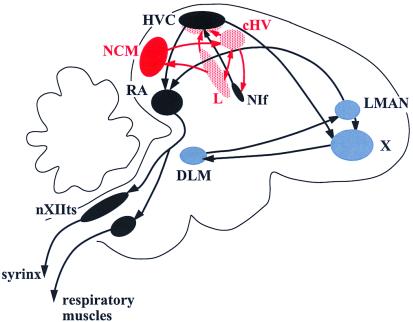
A schematic cross section of the songbird brain depicting the
traditionally defined song system and associated auditory areas. A
network of discrete areas is devoted to song learning and production:
the “motor pathway” (in black) is required throughout life for
normal song production; the anterior forebrain circuit (in blue) is
more important for song learning and plasticity. The NCM is one of the
interconnected telecephalic auditory areas (in red), including the
thalamorecipient area field L, that project directly and indirectly to
the song system. For song system abbreviations, see Brenowitz et
al. (3).
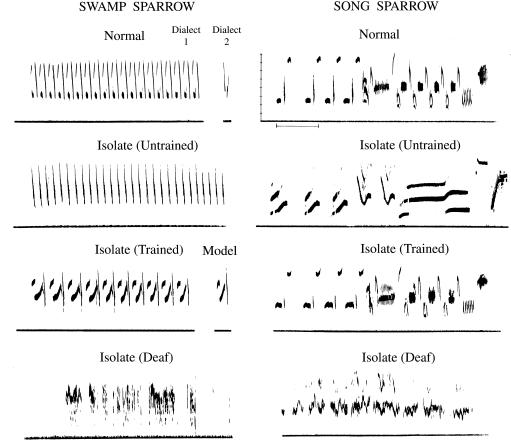
Audition plays a double role in song development, for birds to hear a
tutor and to listen to their own voices. At the top are normal songs of
adult male swamp and song sparrows (Melospiza georgiana
and M. melodia). Males raised in isolation with no song
stimulation have simpler songs. Songs of males raised in isolation but
tutored with tape-recorded song during the sensitive period are normal.
The inset shows one syllable of the swamp sparrow tutor song. The song
sparrow tutor was the normal song shown above. Much more amorphous
songs are developed by males deafened before song production (55, 56).
Highly degraded songs are produced after early deafening, whether the
bird was tutored beforehand or not (23). Thus auditory feedback is
necessary for production of both normal song and isolate song.
Frequencies are marked in 1-kHz intervals. The time marker is 0.5
sec.
Comment on
-
Localized neuronal activation in the zebra finch brain is related to the strength of song learning.Proc Natl Acad Sci U S A. 2000 Feb 29;97(5):2282-5. doi: 10.1073/pnas.030539097. Proc Natl Acad Sci U S A. 2000. PMID: 10681421 Free PMC article.
References
-
- Kroodsma D E. Acoustic Communication in Birds, Vol. 2: Song Learning and Its Consequence. New York: Academic; 1982. pp. 1–23.
-
- Marler P. Trends Neurosci. 1991;14:199–206. - PubMed
-
- Brenowitz E A, Margoliash D, Nordeen K W. J Neurobiol. 1997;33:495–500. - PubMed
-
- Nottebohm F, Stokes T M, Leonard C M. J Comp Neurol. 1976;165:457–486. - PubMed
-
- Wild J M. J Neurobiol. 1997;33:653–670. - PubMed
Publication types
MeSH terms
LinkOut - more resources
Full Text Sources
