


Structure and function in rhodopsin: destabilization of rhodopsin by the binding of an antibody at the N-terminal segment provides support for involvement of the latter in an intradiscal tertiary structure
- PMID: 10737783
- PMCID: PMC16184
- DOI: 10.1073/pnas.97.7.3016
Structure and function in rhodopsin: destabilization of rhodopsin by the binding of an antibody at the N-terminal segment provides support for involvement of the latter in an intradiscal tertiary structure
Abstract
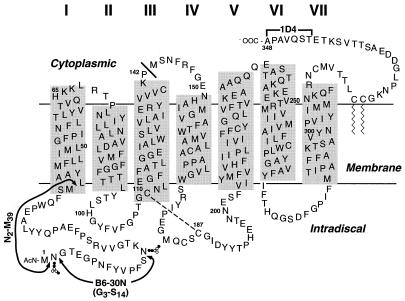
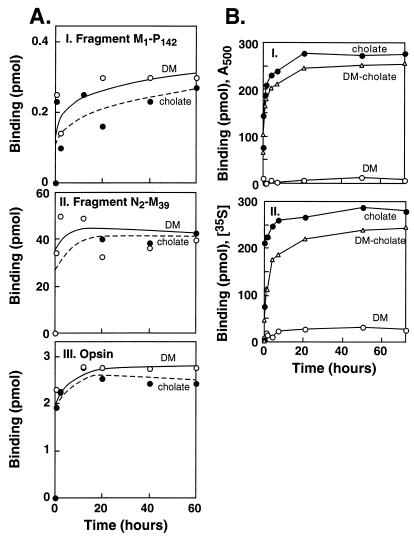
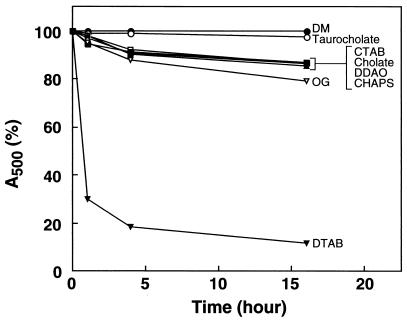
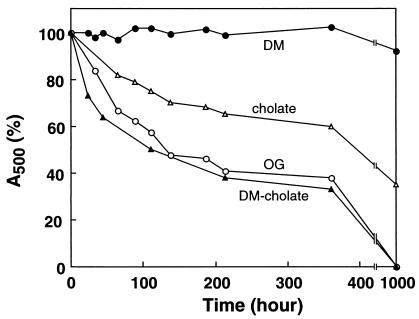
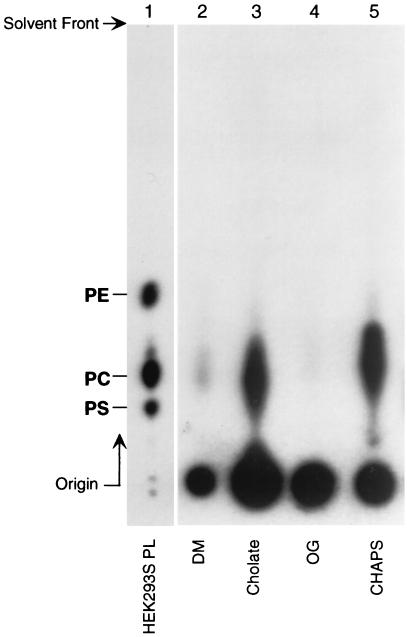
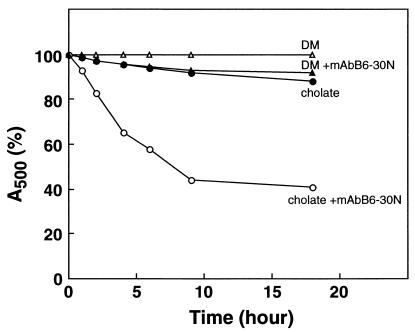
A monoclonal anti-rhodopsin antibody (B6-30N), characterized by Hargrave and coworkers [Adamus, G., Zam, Z. S., Arendt, A., Palczewski, K., McDowell, J. M. & Hargrave, P. (1991) Vision Res. 31, 17-31] as recognizing a short peptide sequence at the N terminus, failed to bind to rhodopsin when the latter was solubilized in dodecylmaltoside (DM). Of the detergents tested thus far, DM affords maximum stability to rhodopsin. Solubilization of rhodopsin in cholate allowed binding of the antibody, but the binding caused destabilization as evidenced by the accelerated loss of absorbance at 500 nm. The result provides support for the earlier conclusion that the N-terminal segment is an integral part of a tertiary structure in the intradiscal domain of native rhodopsin coupled to a tertiary structure in the transmembrane domain. Additional comparative studies on the stability of rhodopsin in different detergents were carried out after direct solubilization from rod outer segments and after extensive treatments to remove the endogenous phospholipids. Purification of rhodopsin in DM resulted in essentially quantitative removal of endogenous phospholipids. When rhodopsin thus purified was treated with the above antibody in DM and in cholate, enhanced destabilization (5-fold) was observed in the latter detergent.
Figures
References
-
- Molday R S, McKenzie D. Biochemistry. 1983;22:653–660. - PubMed
-
- Adamus G, Zam Z S, Arendt A, Palczewski K, McDowell J M, Hargrave P. Vision Res. 1991;31:17–31. - PubMed
-
- Ridge K D, Lee S S J, Abdulaev N G. J Biol Chem. 1996;271:7860–7867. - PubMed
-
- Laird D W, Wong S Y C, Molday R S. In: Membrane Proteins: Proceedings of the Membrane Protein Symposium. Goheen S C, editor. Richmond, CA: Bio-Rad Lab; 1987.
Publication types
MeSH terms
Substances
Grants and funding
LinkOut - more resources
Full Text Sources
