. 2000 Apr;66(4):1384-97.
doi: 10.1086/302844. Epub 2000 Mar 17.

The frequency of heteroplasmy in the HVII region of mtDNA differs across tissue types and increases with age

Affiliations

The frequency of heteroplasmy in the HVII region of mtDNA differs across tissue types and increases with age

C D Calloway et al. Am J Hum Genet. 2000 Apr.

Abstract

An immobilized sequence-specific oligonucleotide (SSO) probe system consisting of 16 SSO probes that detect sequence polymorphisms within five regions of the mtDNA control region was used to investigate the frequency of heteroplasmy in human mtDNA. Five regions of hypervariable region II (HVII) of the control region were studied in blood-, muscle-, heart-, and brain-tissue samples collected from 43 individuals during autopsy. An initial search for heteroplasmy was conducted by use of the SSO probe system. Samples in which multiple probe signals were detected within a region were sequenced for the HVII region, to verify the typing-strip results. The frequency of heteroplasmy was 5 of 43 individuals, or 11.6%. The frequency of heteroplasmy differed across tissue types, being higher in muscle tissue. The difference in the frequency of heteroplasmy across different age groups was statistically significant, which suggests that heteroplasmy increases with age. As a test for contamination and to confirm heteroplasmy, the samples were sequenced for the HVI region and were typed by use of a panel of five polymorphic nuclear markers. Portions of the tissues that appeared to be heteroplasmic were extracted at least one additional time; all gave identical results. The results from these tests indicate that the multiple sequences present in individual samples result from heteroplasmy and not from contamination.


Figures
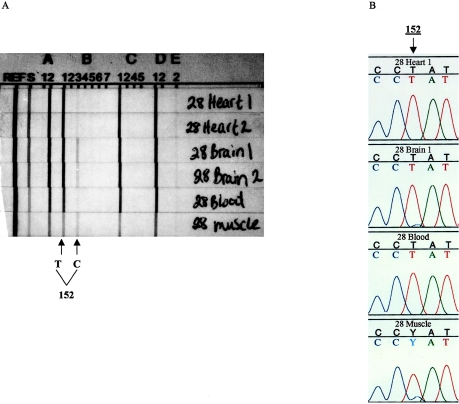
Figure  1
Figure 1
Immobilized SSO probe strip and DNA sequencing results from a heteroplasmic individual. A, Immobilized SSO probe strip results. The immobilized SSO probe system utilizes 16 SSO probes that detect sequence polymorphisms within five regions of the HVII, referred to as regions A–E. Regions A–D detect 1–3 nt substitutions, and region E detects an insertion of one or more C residues within the HVII C stretch (positions 303–309). Most samples have either one or no positive signal within each of the five regions. If two probes within a region are observed, the sample contains a mixture of two sequences, a mixture that may be due to either contamination or heteroplasmy. For this individual, the two probe signals observed in region B (B1 and B3) are due to heteroplasmy. Probe signals B1 and B3 are clearly observed in the muscle- and brain-tissue samples. A B1 probe signal and a weaker B3 probe signal were observed in the heart and blood tissues of this individual. Because the intensity of a probe signal correlates with the amount of DNA that hybridizes to a probe and is reflected in the S probe signal, probe signals on the same strip can be compared to determine relative amounts of each sequence in the sample; however, because the PCR-product input may vary between strips, absolute signals cannot be compared between strips. B, Sequence results for the region in which multiple sequences were detected from all collected tissues from individual 28. Because the sequences of both sections of the heart and brain tissues (designated as “1” and “2”) were identical, only results from heart 1 and brain 1 are presented. Sequence results verify the multiple sequences observed by the SSO probe system. Multiple sequences (both T and C) were clearly detected by sequencing at position 152 in the muscle and brain tissue of this individual. Although multiple probe signals were detected corresponding to this position in blood and heart tissue, multiple sequences are not detected by sequencing. This observation may be explained by the greater sensitivity of the SSO probe system relative to sequencing.
Figure  2
Figure 2
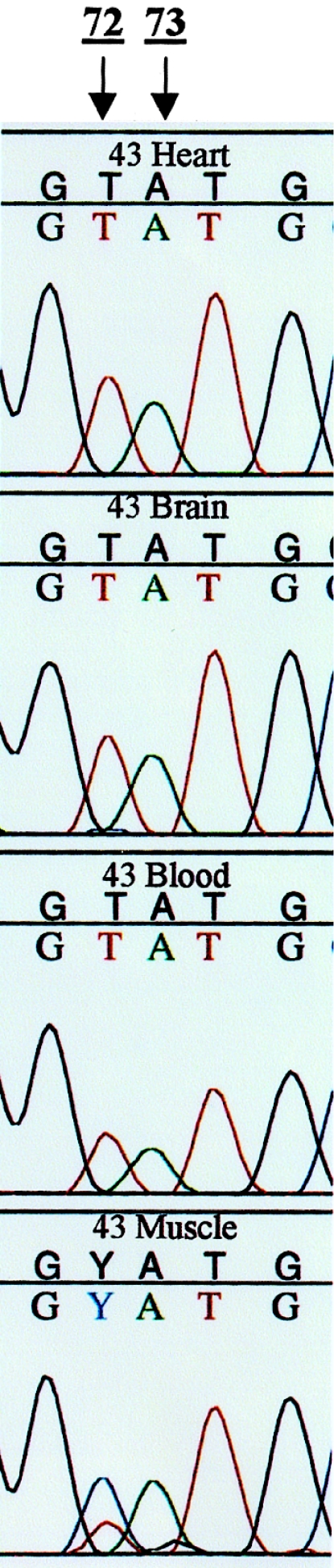
Sequencing results from an individual with heteroplasmy at multiple positions and with a complete switch of mtDNA sequences in the muscle tissue. Multiple sequences were observed at three confirmed positions in the muscle tissue of this individual, 43. Sequencing results from two of the heteroplasmic positions (72 and 73) are represented. The multiple sequences observed at position 73 were detected by the SSO probe system and correspond to region A. Both A and G were detected at position 73 in the muscle tissue, as expected on the basis of the SSO probe analysis. The G peak is off center, but this result was found to be typical of multiple sequences detected at this position. Sequencing analysis also revealed multiple sequences at position 72 in the muscle tissue of this individual. In the heart, brain, and blood, only a T was observed, whereas in the muscle both C and T were observed at this position in the muscle tissue (C→ T). Thus, a switch of predominant mtDNA sequences is observed in the muscle tissue, compared with the other sequenced tissue samples. Similar results were observed in individual 10.
Figure  3
Figure 3
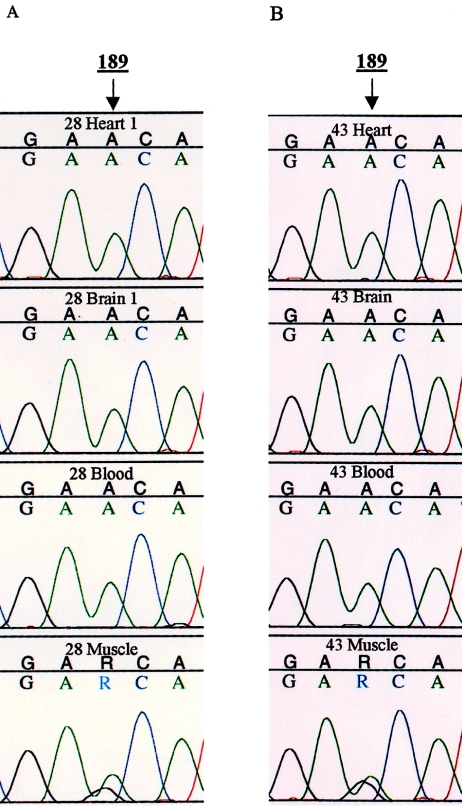
Sequencing results from two individuals with heteroplasmy at position 189 in the muscle tissue. Heteroplasmy was confirmed at position 189 in four of the five heteroplasmic individuals. Heteroplasmy at this position was observed only in the muscle tissue; muscle tissue was not collected from the fifth heteroplasmic individual. Representative sequencing results of the multiple mtDNA sequences observed at position 189 in the tissue samples sequenced from individuals 28 and 43 are presented (sequencing results of the other positions in which heteroplasmy was detected are presented in figs. 1B and 2). Both A and G signals were observed at nearly equal ratios at this position in muscle tissue.

References

    1. Allen M, Engstrom AS, Meyers S, Handt O, Saldeen T, von Haeseler A, Pääbo S, et al (1998) Mitochondrial DNA sequencing of shed hairs and saliva on robbery caps: sensitivity and matching probabilities. J Forensic Sci 43:453–464 - PubMed
    1. Anderson S, Bankier AT, Barrell BG, de Bruijn MH, Coulson AR, Drouin J, Eperon IC, et al (1981) Sequence and organization of the human mitochondrial genome. Nature 290:457–465 - PubMed
    1. Aquadro CF, Greenberg BD (1983) Human mitochondrial DNA variation and evolution: analysis of nucleotide sequences from seven individuals. Genetics 103:287–312 - PMC - PubMed
    1. Bendall KE, Macaulay VA, Baker JR, Sykes BC (1996) Heteroplasmic point mutations in the human mtDNA control region. Am J Hum Genet 59:1276–1287 - PMC - PubMed
    1. Bendall KE, Sykes BC (1995) Length heteroplasmy in the first hypervariable segment of the human mtDNA control region. Am J Hum Genet 57:248–256 - PMC - PubMed

Publication types

MeSH terms