


Selective accumulation may account for shellfish-associated viral illness
- PMID: 10742214
- PMCID: PMC91995
- DOI: 10.1128/AEM.66.4.1375-1378.2000
Selective accumulation may account for shellfish-associated viral illness
Abstract
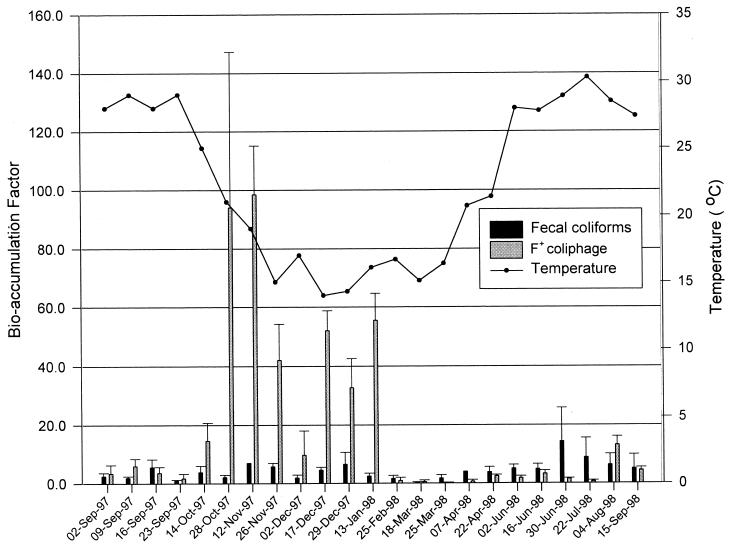
From 1991 through 1998, 1,266 cases of shellfish-related illnesses were attributed to Norwalk-like viruses. Seventy-eight percent of these illnesses occurred following consumption of oysters harvested from the Gulf Coast during the months of November through January. This study investigated the ability of eastern oysters (Crassostrea virginica) to accumulate indicator microorganisms (i.e., fecal coliforms, Escherichia coli, Clostridium perfringens, and F(+) coliphage) from estuarine water. One-week trials over a 1-year period were used to determine if these indicator organisms could provide insight into the seasonal occurrence of these gastrointestinal illnesses. The results demonstrate that oysters preferentially accumulated F(+) coliphage, an enteric viral surrogate, to their greatest levels from late November through January, with a concentration factor of up to 99-fold. However, similar increases in accumulation of the other indicator microorganisms were not observed. These findings suggest that the seasonal occurrence of shellfish-related illnesses by enteric viruses is, in part, the result of seasonal physiological changes undergone by the oysters that affect their ability to accumulate viral particles from estuarine waters.
Figures
References
-
- Abeyta C. Comparison of iron milk and official AOAC methods for enumeration of Clostridium perfringens from fresh seafood. J Assoc Off Anal Chem. 1983;66:1175–1177. - PubMed
-
- American Public Health Association. Recommended procedures for the examination of seawater and shellfish. 4th ed. Washington, D.C.: American Public Health Association; 1970.
-
- Burkhardt W, III, Rippey S R, Watkins W D. Depuration rates of northern quahogs Mercenaria mercenaria and eastern oysters Crassostrea virginica in ozone- and ultraviolet light-disinfected seawater systems. J Shellfish Res. 1992;11:105–109.
-
- Burkhardt, W., III, K. R. Calci, W. D. Watkins, S. R. Rippey, and S. J. Chirtel. Inactivation of indicator organisms in estuarine waters. Water Res., in press.
MeSH terms
LinkOut - more resources
Full Text Sources
Medical
