


doi: 10.1128/AEM.66.4.1680-1684.2000.
Engineering desiccation tolerance in Escherichia coli
Affiliations
- PMID: 10742260
- PMCID: PMC92041
- DOI: 10.1128/AEM.66.4.1680-1684.2000
Item in Clipboard
Engineering desiccation tolerance in Escherichia coli
Appl Environ Microbiol.
2000 Apr.
Abstract
Recombinant sucrose-6-phosphate synthase (SpsA) was synthesized in Escherichia coli BL21DE3 by using the spsA gene of the cyanobacterium Synechocystis sp. strain PCC 6803. Transformants exhibited a 10,000-fold increase in survival compared to wild-type cells following either freeze-drying, air drying, or desiccation over phosphorus pentoxide. The phase transition temperatures and vibration frequencies (P==O stretch) in phospholipids suggested that sucrose maintained membrane fluidity during cell dehydration.
Figures
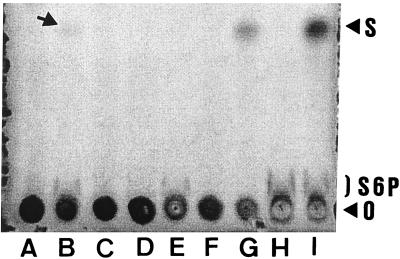
E. coli BL21DE3(pSpsA) synthesizes sucrose-6-P and sucrose, as determined by TLC analysis of cell extracts and carbohydrate standards. Lanes A, B, and C, 2-μl aliquots of 350-μl cell extracts obtained from 200-ml M9 medium-induced cultures of BL21DE3(pT7-7) (lane A), BL21DE3(pSpsA) clone 1 (used throughout this study) (lane B), and BL21DE3(pSpsA) clone 2 (a desiccation-sensitive clone) (lane C); lanes D and E, 20-μl aliquots of 250-μl cell extracts obtained from 500-ml cultures of BL21DE3(pT7-7) (lane D) and BL21DE3(pSpsA) (lane E) induced in medium M9 without glucose; lanes F and G, 2-μl aliquots of CIP-treated cell extracts from BL21DE3(pT7-7) (lane F) and BL21DE3(pSpsA) (lane G) cultures induced in M9 medium; lane H, 2 μl of sucrose-6-P (3 mg ml−1); lane I, 2 μl of sucrose 6-P and sucrose (3 mg ml−1 each). S, sucrose; S6P, sucrose-6-P; O, origin. The arrow in lane B indicates the position of sucrose.
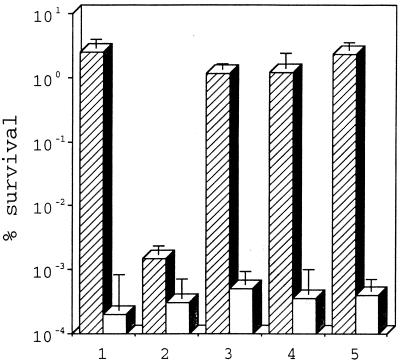
spsA enhances survival of E. coli BL21DE3(pSpsA). The data points are means of three values, and the error bars indicate standard deviations based on more than 20 trials. Open bars, BL21DE3(pT7-7); cross-hatched bars, BL21DE3(pSpsA). Data set 1, freeze-drying in the light; data set 2, air drying in the light; data set 3, air drying in the dark; data set 4, chemical desiccation in the light; data set 5, chemical desiccation in the dark.
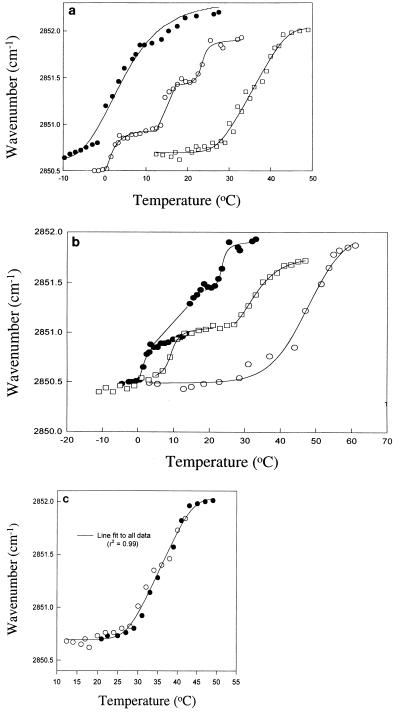
FTIR spectroscopy of membrane phospholipids. (a) Symbols: ●, fully hydrated wild-type strain BL21DE3; ○, freeze-dried BL21DE3(pSpsA); □, freeze-dried BL21DE3(pT7-7). (b) BL21DE3(pSpsA). Symbols: ○, first heating; ●, second heating; □, third heating after incubation for 45 min at −10°C. (c) BL21DE3(pT7-7). Symbols: ○, first heating; ●, second heating. The line was fit to all of the data (R2 = 0.99).
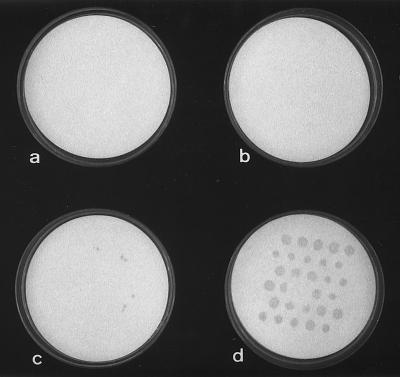
Enhanced survival of E. coli BL21DE3(pSpsA) after immobilization on nylon membranes, storage at −20°C, and rehydration with LB medium at 37°C. (a) BL21DE3(pT7-7) spotted onto untreated membrane. (b) BL21DE3(pT7-7) spotted onto treated (100 mM trehalose) membrane. (c) BL21DE3(pSpsA) spotted onto untreated membrane. (d) BL21DE3(pSpsA) spotted onto treated (100 mM trehalose) membrane.
References
-
- Billi, D., and M. Potts. Desiccation. In K. B. Storey and J. M. Storey (ed.), Cell and molecular responses to stress, in press. Elsevier Science, Amsterdam, The Netherlands.
-
- Cano R, Borucki M K. Revival and identification of bacterial spores in 25-million-year-old to 40-million-year-old Dominican amber. Science. 1995;268:1060–1064. - PubMed
-
- Crowe J H, Crowe L M, Chapman D. Preservation of membranes in anhydrobiotic organisms: the role of trehalose. Science. 1984;223:701–703. - PubMed
-
- Crowe J H, Crowe L M. Membrane integrity in anhydrobiotic organisms: toward a mechanism for stabilizing dry cells. In: Somero G N, Osmond C B, Bolis C L, editors. Water in life: comparative analysis of water relationships at the organismic, cellular, and molecular level. Berlin, Germany: Springer-Verlag; 1992. pp. 87–103.
-
- Crowe J H, Hoekstra F A, Crowe L M, Anchordoguy T J, Drobnis E. Lipid phase transitions measured in intact-cells with fourier-transform infrared spectroscopy. Cryobiology. 1989;26:76–78. - PubMed
Publication types
MeSH terms
Substances
LinkOut - more resources
Full Text Sources
Other Literature Sources
