. 2000 Apr;66(4):1715-9.
doi: 10.1128/AEM.66.4.1715-1719.2000.

Prokaryotic diversity in Zostera noltii-colonized marine sediments

Affiliations

Prokaryotic diversity in Zostera noltii-colonized marine sediments

A Cifuentes et al. Appl Environ Microbiol. 2000 Apr.

Abstract

The diversity of microorganisms present in a sediment colonized by the phanerogam Zostera noltii has been analyzed. Microbial DNA was extracted and used for constructing two 16S rDNA clone libraries for Bacteria and Archaea. Bacterial diversity was very high in these samples, since 57 different sequences were found among the 60 clones analyzed. Eight major lineages of the Domain Bacteria were represented in the library. The most frequently retrieved bacterial group (36% of the clones) was delta-Proteobacteria related to sulfate-reducing bacteria. The second most abundant group (27%) was gamma-Proteobacteria, including five clones closely related to S-oxidizing endosymbionts. The archaeal clone library included members of Crenarchaeota and Euryarchaeota, with nine different sequences among the 15 analyzed clones, indicating less diversity when compared to the Bacteria organisms. None of these sequences was closely related to cultured Archaea organisms.


Figures
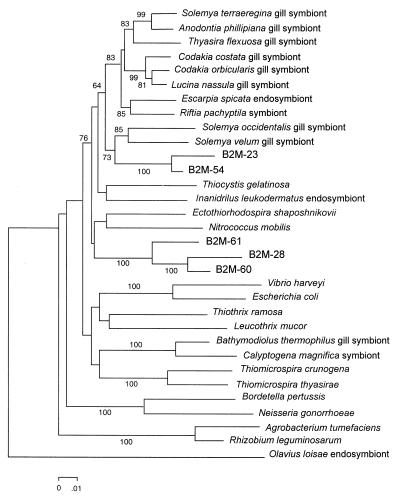
FIG. 1
FIG. 1
Phylogenetic tree from complete 16S rDNA gene of clones related to sulfur-oxidizing bacterial endosymbionts and reference strains. The tree was built with the neighbor-joining method by using the Jukes-Cantor distance estimation. Bootstrap values higher than 50% are indicated at the main nodes. Nucleotide sequence accession numbers are as follows: A. phillipiana gill symbiont, L25711; A. tumefaciens, AH007805; B. pertussis, AF142327; B. thermophilus gill symbiont, M99445; C. costata gill symbiont, L25712; C. magnifica symbiont, L25718; C. orbicularis gill symbiont, X84979; E. coli, U00096; E. shaposhnikovii, M59151; E. spicata endosymbiont, U77482; L. mucor, X87277; L. nassula gill symbiont, X95229; N. gonorrhoeae, AJ239304; N. mobilis, g530889; O. loisae endosymbiont, AF104475; R. leguminosarum, U89831; R. pachyptila symbiont, U77478; S. occidentalis gill symbiont, U41049; S. terraeregina gill symbiont, U62131; S. velum gill symbiont, M90415; T. crunogena, AF064545; T. flexuosa gill symbiont, L01575; T. gelatinosa, Y11317; T. ramosa, g987512; T. thyasirae, AF016046; V. harveyi, X56578; and Y. leukodermatus endosymbiont, U24110.
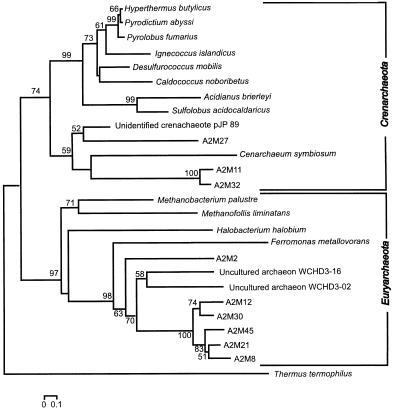
FIG. 2
FIG. 2
Relationships between partial 16S archaeal rDNA gene clones and reference strains. The tree was constructed as that in Fig. 1. T. thermophilus was used as the outgroup. Nucleotide sequence accession numbers are as follows: A. brierleyi, X90477; C. noboribetus, D85038; C. symbiosum, U51469; crenarchaeotal sp. clone pJP 89, L25305; D. mobilis, M36474; F. metallovorans, AJ224936; H. salinarium, AJ002947; H. butylicus, X99553; I. islandicus, X99562; M. palustre, AF093061; M. liminatans, Y16428; P. abyssi, X99559; P. fumarius, X99555; S. acidocaldarius, D14053; T. waimanguensis, AF098975; T. thermophilus, X07998; uncultured archaeon WCHD3-16, AF050618; and uncultured archaeon WCHD3-02, AF050616.

References

    1. Acinas S G, Antón J, Rodríguez-Valera F. Diversity of free-living and attached bacteria in offshore Western Mediterranean waters as depicted by analysis of genes encoding 16S rRNA. Appl Environ Microbiol. 1999;65:514–522. - PMC - PubMed
    1. Altschul S F, Madden T L, Schäffer A A, Zhang J, Zhang Z, Miller W, Lipman D J. Gapped BLAST and PSI-BLAST: a new generation of protein database search programs. Nucleic Acids Res. 1997;25:3389–3402. - PMC - PubMed
    1. Amann R I, Ludwig W, Schleifer K-H. Phylogenetic identification and in situ detection of individual microbial cells without cultivation. Microbiol Rev. 1995;59:143–169. - PMC - PubMed
    1. Blaabjerg V, Mouritsen K N, Finster K. Diel cycles of sulfate reduction in sediments of a Zostera marina bed (Denmark) Aquat Microb Ecol. 1998;15:97–102.
    1. Canale-Parola E. Free-living saccharolytic spirochetes: the genus Spirochaeta. In: Balows A, Trüper H G, Dworkin M, Harder W, Schleifer K-H, editors. The prokaryotes. 2nd ed. New York, N.Y: Springer-Verlag; 1992. pp. 3524–3536.

Publication types

MeSH terms

Associated data

LinkOut - more resources