. 2000 Apr;129(7):1309-14.
doi: 10.1038/sj.bjp.0703166.

The role of lipopolysaccharide injected systemically in the reactivation of collagen-induced arthritis in mice

Affiliations

The role of lipopolysaccharide injected systemically in the reactivation of collagen-induced arthritis in mice

S Yoshino et al. Br J Pharmacol. 2000 Apr.

Abstract

1. We investigated the role of bacterial lipopolysaccharide (LPS) in the reactivation of autoimmune disease by using collagen-induced arthritis (CIA) in mice in which autoimmunity to the joint cartilage component type II collagen (CII) was involved. 2. CIA was induced by immunization with CII emulsified with complete Freund's adjuvant at the base of the tail (day 0) followed by a booster injection on day 21. Varying doses of LPS from E. coli were i.p. injected on day 50. 3. Arthritis began to develop on day 25 after immunization with CII and reached a peak on day 35. Thereafter, arthritis subsided gradually but moderate joint inflammation was still observed on day 50. An i.p. injection of LPS on day 50 markedly reactivated arthritis on a dose-related fashion. Histologically, on day 55, there were marked oedema of synovium which had proliferated by the day of LPS injection, new formation of fibrin, and intense infiltration of neutrophils accompanied with a large number of mononuclear cells. The reactivation of CIA by LPS was associated with increases in anti-CII IgG and IgG2a antibodies as well as various cytokines including IL-12, IFN-gamma, IL-1beta, and TNF-alpha. LPS from S. enteritidis, S. typhimurium, and K. neumoniae and its component, lipid A from E. coli also reactivated the disease. Polymyxin B sulphate suppressed LPS- or lipid A-induced reactivation of CIA. 4. These results suggest that LPS may play an important role in the reactivation of autoimmune joint inflammatory diseases such as rheumatoid arthritis in humans.


Figures
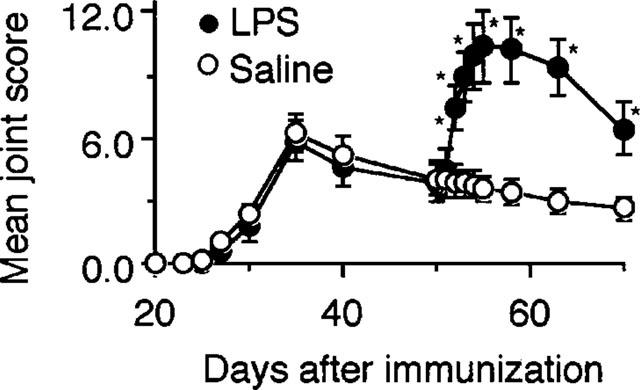
Figure 1
Figure 1
Reactivation of CIA by LPS. Mice were immunized with CII on day 0 followed by a booster injection on day 21 as described in Methods. The severity of arthritis was determined on days 20, 23, 25, 27, 30 and 35, 40, 50, 51, 52, 53, 54, 55, 58, 63 and 70. Five micrograms of LPS was i.p. injected on day 50. Saline was administered as a control on the same days. Bars show the mean±s.e.mean of 12 mice. *P<0.05 versus saline, Mann-Whitney U-test. Data are representative of three experiments.
Figure 2
Figure 2
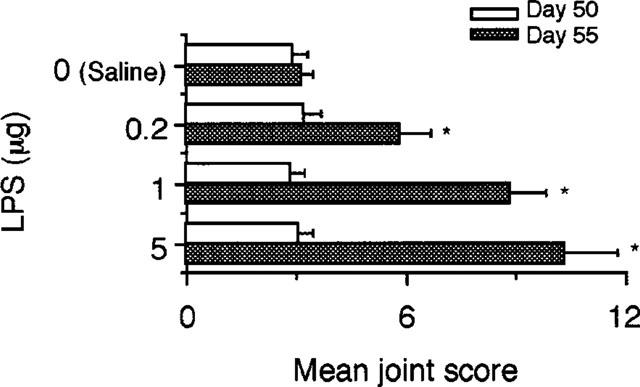
Dose-related reactivation of CIA by LPS. Mice were immunized with CII on day 0 followed by a booster injection on day 21 as described in Methods. On day 50, saline and the indicated doses of LPS were i.p. injected. The severity of arthritis was determined on day 50, i.e. immediately before administration of LPS and on day 55. Bars show the mean±s.e.mean of ten mice. *P<0.05 versus saline, Mann-Whitney U-test. Data are representative of three experiments.
Figure 3
Figure 3
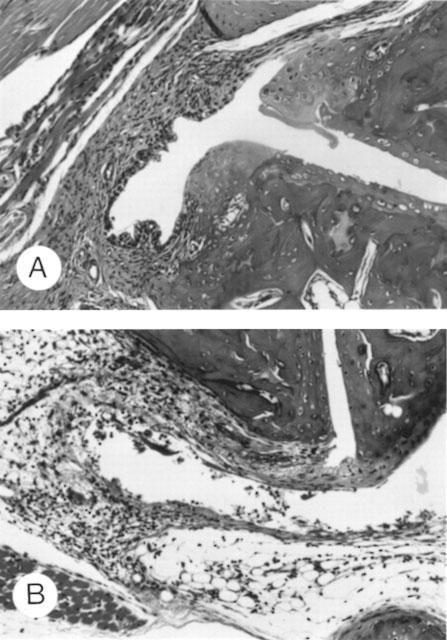
Histologic changes in tarsal joints of mice with CIA following administration of LPS. Mice were immunized with CII on day 0 followed by a booster injection on day 21 as described in Methods. Saline or 5 μg of LPS was i.p. injected on day 50. Tarsal joints were histologically examined on day 50, i.e. immediately before injection of LPS (A) and on day 55 after injection of LPS (B). Haematoxylin and eosin stained, ×200 (original magnification).
Figure 4
Figure 4
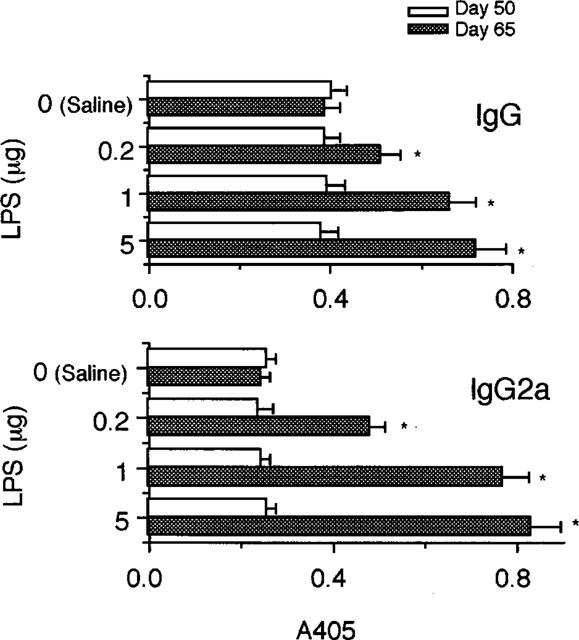
Enhancement of anti-CII antibody production by LPS. Mice were immunized with CII on day 0 followed by a booster injection on day 21 as described in Methods. On day 50, saline and the indicated doses of LPS were i.p. injected and the serum levels of anti-CII IgG and IgG2a antibodies were determined on day 50, i.e. immediately before administration of LPS and on day 65. Bars show the mean±s.e.mean of six mice. *P<0.05 versus saline, Mann-Whitney U-test. Data are representative of three experiments.
Figure 5
Figure 5
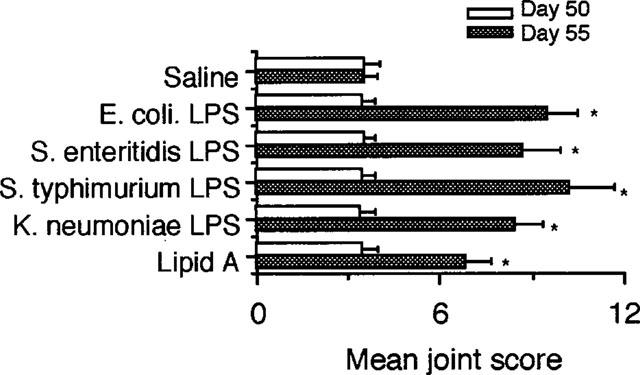
Reactivation of CIA by varying types of LPS and lipid A. Mice were immunized with CII on day 0 followed by a booster injection on day 21 as described in Methods. On day 50, saline, 5 μg of LPS from E. coli, S. enteritidis, S. typhimurium, and K. peumoniae, and 2 μg of lipid A from E. coli were i.p. injected. The severity of arthritis was determined on day 50, i.e. immediately before administration of LPS and on day 55. Bars show the mean±s.e.mean of eight mice. *P<0.05 versus saline, Mann-Whitney U-test. Data are representative of two experiments.
Figure 6
Figure 6
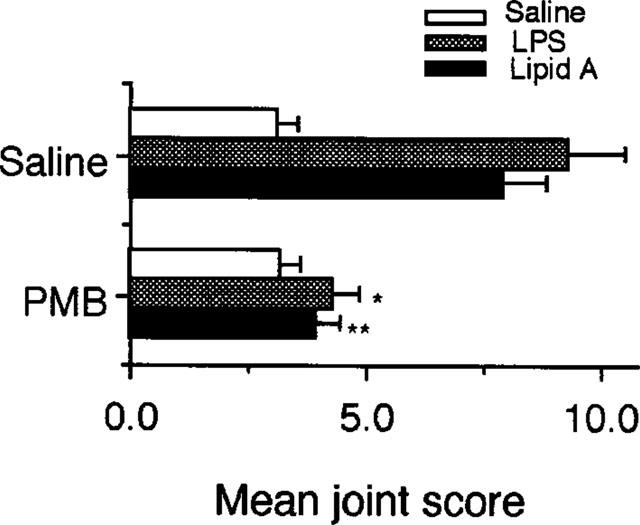
Suppression by polymyxin B of LPS-induced reactivation of CIA. Mice were immunized with CII on day 0 followed by a booster injection on day 21 as described in Methods. On day 50, 100 μl of saline alone or 100 μl of saline containing 50 μg of polymyxin B sulphate (PMB) was mixed with saline, 5 μg of LPS, and 2 μg of lipid A and then i.p. injected on day 50. The severity of arthritis was determined on day 55. Bars show the mean±s.e.mean of ten mice. *P<0.05 versus saline- and LPS-treatment; **P<0.05 versus saline- and lipid A-treatment, Mann-Whitney U-test. Data are representative of two experiments.
Figure 7
Figure 7
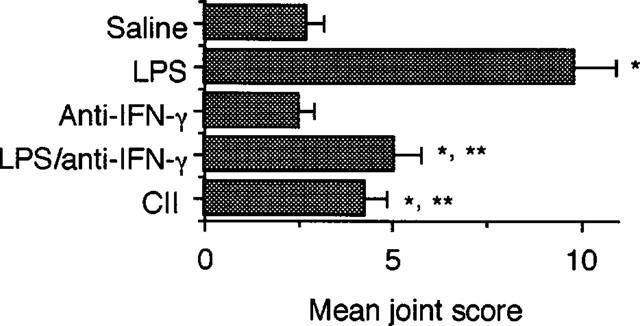
Effect of anti-IFN-γ mAb on reactivation of CIA by LPS. Mice were immunized with CII on day 0 followed by a booster injection on day 21 as described in Methods. On day 50, saline, 5 μg of LPS alone, 500 μg of anti-IFN-γ mAb alone, 5 μg of LPS plus 500 μg of anti-IFN-γ mAb, or 100 μg of CII was i.p. injected. Injection of anti-IFN-γ mAb was continued daily from days 51 to 55. The severity of arthritis was determined on day 60. Bars show the mean±s.e.mean of eight mice. *P<0.05 versus saline; **P<0.05 versus LPS alone, Mann-Whitney U-test. Data are representative of two experiments.

References

    1. AOKI S., YOSHIKAWA K., YOKOYAMA T., NONOGAKI T., IWASAKI S., MITSUI T., NIWA S. Role of enteric bacteria in the pathogenesis of rheumatoid arthritis: evidence for antibodies to enterobacterial common antigens in rheumatoid sera and synovial fluids. Ann. Rheum. Dis. 1996;55:363–369. - PMC - PubMed
    1. AREND W.P., DAYER J.M. Inhibition of the production and effects of interleukin-1 and tumor necrosis factor alpha in rheumatoid arthritis. Arth. Rheum. 1995;38:151–160. - PubMed
    1. BRENNAN F.M., MAINI R.N., FELDMANN M. TNF-alpha: a pivotal role in rheumatoid arthritis. Br. J. Rheumatol. 1992;31:293–298. - PubMed
    1. CLAQUE R.B., MOORE L.J. IgG and IgM antibody to native type II collagen in rheumatoid arthritis serum and synovial fluid: evidence for the presence of collagen-anticollagen immune complexes in synovial fluid. Arth. Rheum. 1984;27:1370–1377. - PubMed
    1. COURTENAY J.S., DALLMAN M.J., DAYAN A.D., MARTIN A., MOSEDALE B. Immunization against heterologous type II collagen induces arthritis in mice. Nature. 1980;283:666–668. - PubMed