. 2000 May;74(9):4039-46.
doi: 10.1128/jvi.74.9.4039-4046.2000.

Subgenomic negative-strand RNA function during mouse hepatitis virus infection

Affiliations

Subgenomic negative-strand RNA function during mouse hepatitis virus infection

R S Baric et al. J Virol. 2000 May.

Abstract

Mouse hepatitis virus (MHV)-infected cells contain full-length and subgenomic-length positive- and negative-strand RNAs. The origin and function of the subgenomic negative-strand RNAs is controversial. In this report we demonstrate that the synthesis and molar ratios of subgenomic negative strands are similar in alternative host cells, suggesting that these RNAs function as important mediators of positive-strand synthesis. Using kinetic labeling experiments, we show that the full-length and subgenomic-length replicative form RNAs rapidly accumulate and then saturate with label, suggesting that the subgenomic-length negative strands are the principal mediators of positive-strand synthesis. Using cycloheximide, which preferentially inhibits negative-strand and to a lesser extent positive-strand synthesis, we demonstrate that cycloheximide treatment equally inhibits full-length and subgenomic-length negative-strand synthesis. Importantly, following treatment, previously transcribed negative strands remain in transcriptionally active complexes even in the absence of new negative-strand synthesis. These findings indicate that the subgenomic-length negative strands are the principal templates of positive-strand synthesis during MHV infection.


Figures
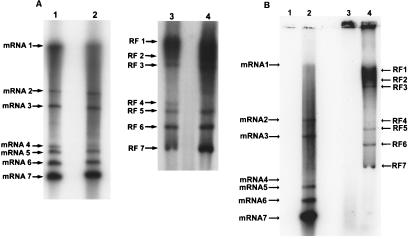
FIG. 1
FIG. 1
MHV-H2 RNA synthesis in murine and hamster cell lines. Cultures of murine 17CL1 (A) cells and syrian hamster BHK (B) cells were infected with MHV-A59 or MHV-H2 at an MOI of 10 for 1 h. At 6 and 17 h postinfection respectively, cultures of 17CL1 cells and BHK cells were labeled with 300 μCi of 32Pi as described in Materials and Methods. Intracellular RNA was isolated from infected cells and analyzed for the presence of virus-specific mRNAs and RF RNAs. Lanes: 1, MHV-A59 mRNAs; 2, MHV-H2 mRNAs; 3, MHV-A59 RF RNAs; 4, MHV-H2 RF RNAs.
FIG. 2
FIG. 2
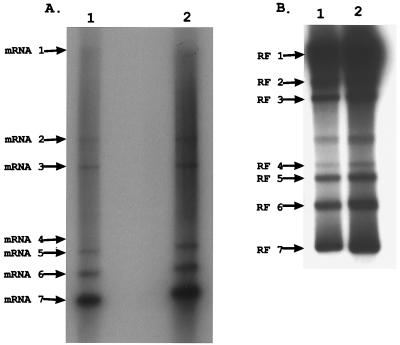
MHV-H2 mRNA and RF RNA synthesis in CHO and DDT-1 cells. Cultures of CHO and DDT-1 Syrian smooth muscle cell lines were infected with MHV-H2 at an MOI of 10 for 1 h. At 8 and 17 h postinfection, respectively, the cultures were labeled with 300 μCi of 32Pi for 1 h. Intracellular RNA was isolated and treated as described in Materials and Methods and then separated in 0.8% agarose gels for mRNA (A) and RF RNA (B) analysis. Lanes: 1, CHO cells; 2, DDT-1 cells.
FIG. 3
FIG. 3
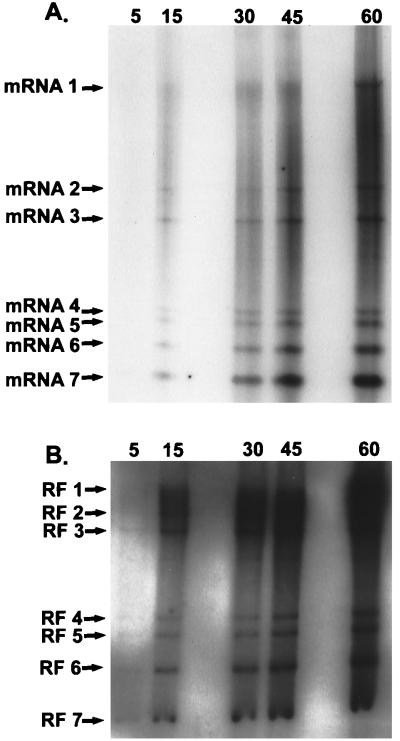
MHV mRNA and RF RNA synthesis during MHV infection. Cultures of 17CL1 cells were infected with MHV-A59 at an MOI of 10 for 1 h. The cultures were treated with AMD and radiolabeled with 1,000 μCi of 32Pi for 5, 15, 30, 45, and 60 min at 6.0 h postinfection. Intracellular RNA was isolated and treated as described in Materials and Methods for mRNA (A) and RF RNA (B) analysis in 0.8% agarose gels.
FIG. 4
FIG. 4
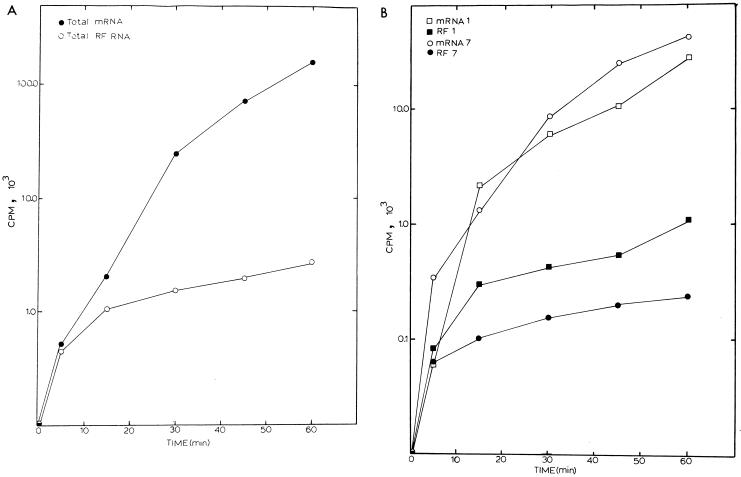
Labeling kinetics of full-length and subgenomic-length RNAs during MHV infection. The gels shown in Fig. 3 were scanned by AMBIS RIS for 12 h, and radioactivity in each mRNA and RF RNA was determined and plotted as a function of time. (A) Incorporation of label into all seven viral mRNAs and RF RNAs; (B) radiolabeling kinetics of mRNA 1, mRNA 7, RF RNA 1, and RF RNA 7.
FIG. 5
FIG. 5
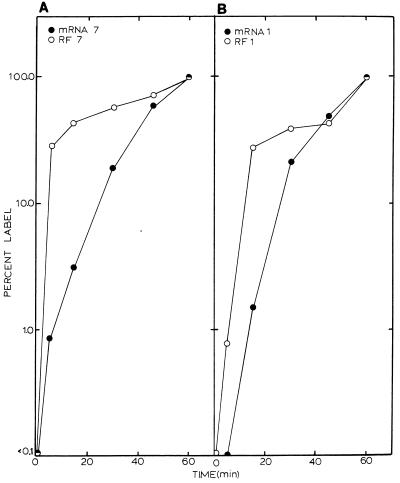
Saturation kinetics of full-length and subgenomic-length RF RNAs. Radiolabeling kinetics of the MHV viral mRNAs and RF RNAs 1 and 7 were plotted as a function of percent label in a 1-h labeling period. (A) mRNA and RF RNA 7; (B) mRNA and RF RNA 1.
FIG. 6
FIG. 6
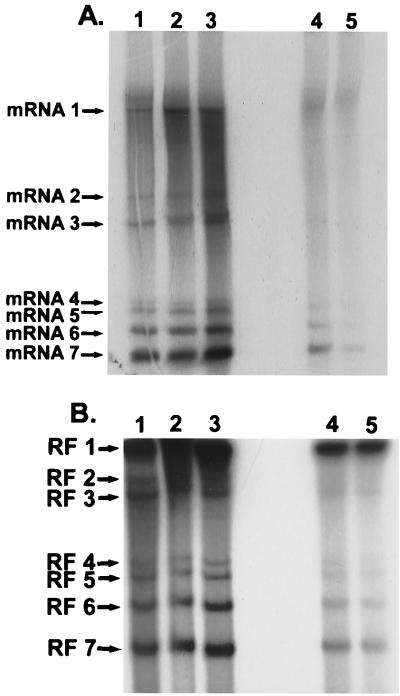
Effect of cycloheximide treatment on full-length and subgenomic-length mRNA and RF RNA synthesis. Cultures of 17Cl1 cells were infected with MHV-A59 at an MOI of 10 for 1 h. At 4.5 h postinfection, cycloheximide was added to one half of the cultures for 30 min; the cultures were radiolabeled with 32Pi (300 μCi/ml) for 1 h at 4.5 to 5.5, 6 to 7, and 7 to 8 h postinfection. Intracellular RNAs were isolated and treated as described in Materials and Methods and separated in 0.8% agarose gels. The gels were dried and exposed to X-ray film. (A) mRNA synthesis; (B) RF RNA synthesis. Lanes: 1, 4.5 to 5.5 h postinfection without cycloheximide treatment; 2, 6 to 7 h postinfection without cycloheximide treatment; 3, 7 to 8 h postinfection without cycloheximide treatment; 4, 6 to 7 h postinfection after cyclohixamide treatment; 5, 7 to 8 h postinfection after cycloheximide treatment.
FIG. 7
FIG. 7
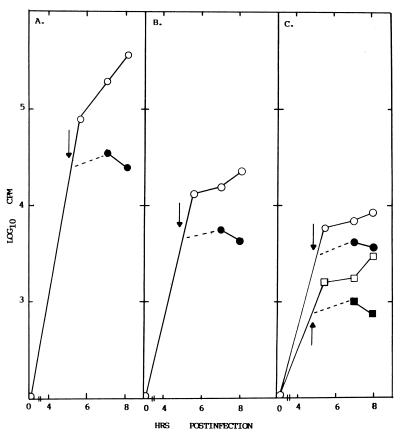
Subgenomic-length negative strands remain in transcriptionally active complexes after cycloheximide treatment. The gels in Fig. 6 were scanned by AMBIS RIS for 12 h, and radioactivity in each mRNA and RF RNA was quantified by counting. (A) Total mRNA synthesis before (○) and after (●) cycloheximide treatment; (B) total RF RNA synthesis before (○) and after (●) cycloheximide treatment; (C) effect of cycloheximide treatment on mRNA 1 (○), RF RNA 1 (●), mRNA 7 (□), and RF RNA 7 (■) synthesis.

References

    1. Baker S C, Lai M M C. An in vitro system for the leader-primed transcription of coronavirus mRNAs. EMBO J. 1990;9:4173–4179. - PMC - PubMed
    1. Baric R S, Lineberger D W, Johnston R E. Reduced synthesis of Sindbis virus negative-strand RNA in cultures treated with host transcription inhibitors. J Virol. 1983;47:46–54. - PMC - PubMed
    1. Baric R S, Stohlman S A, Lai M M C. Characterization of replicative intermediate RNA of mouse hepatitis virus: presence of leader RNA sequences on nascent chains. J Virol. 1983;48:633–640. - PMC - PubMed
    1. Baric R S, Fu K S, Schaad M C, Stohlman S A. Establishing a genetic recombination map for MHV-A59 complementation groups. Virology. 1990;177:646–656. - PMC - PubMed
    1. Baric R S, Yount B, Hensley L, Peel S A, Chen W. Episodic evolution mediates interspecies transfer of a murine coronavirus. J Virol. 1997;71:1946–1955. - PMC - PubMed

Publication types

LinkOut - more resources