. 2000 May;20(9):3004-14.
doi: 10.1128/MCB.20.9.3004-3014.2000.

Cyclic AMP signaling functions as a bimodal switch in sympathoadrenal cell development in cultured primary neural crest cells

Affiliations

Cyclic AMP signaling functions as a bimodal switch in sympathoadrenal cell development in cultured primary neural crest cells

M L Bilodeau et al. Mol Cell Biol. 2000 May.

Abstract

Cells of the vertebrate neural crest (crest cells) are an invaluable model system to address cell fate specification. Crest cells are amenable to tissue culture, and they differentiate to a variety of neuronal and nonneuronal cell types. Earlier studies have determined that bone morphogenetic proteins (BMP-2, -4, and -7) and agents that elevate intracellular cyclic AMP (cAMP) stimulate the development of the sympathoadrenal (SA, adrenergic) lineage in neural crest cultures. To investigate whether interactive mechanisms between signaling pathways influence crest cell differentiation, we characterized the combinatorial effects of BMP-2 and cAMP-elevating agents on the development of quail trunk neural crest cells in primary culture. We report that the cAMP signaling pathway modulates both positive and negative signals influencing the development of SA cells. Specifically, we show that moderate activation of cAMP signaling promotes, in synergy with BMP-2, SA cell development and the expression of the SA lineage-determining gene Phox2a. By contrast, robust activation of cAMP signaling opposes, even in the presence of BMP-2, SA cell development and the expression of the SA lineage-determining ASH-1 and Phox2 genes. We conclude that cAMP signaling acts as a bimodal regulator of SA cell development in neural crest cultures.


Figures
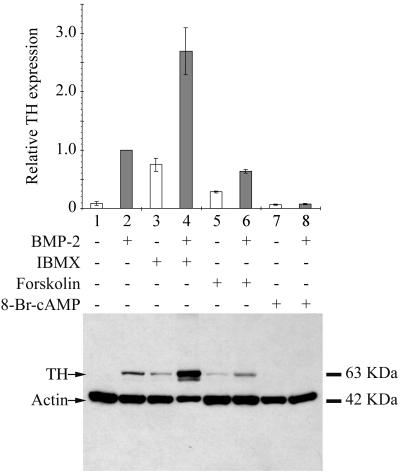
FIG. 1
FIG. 1
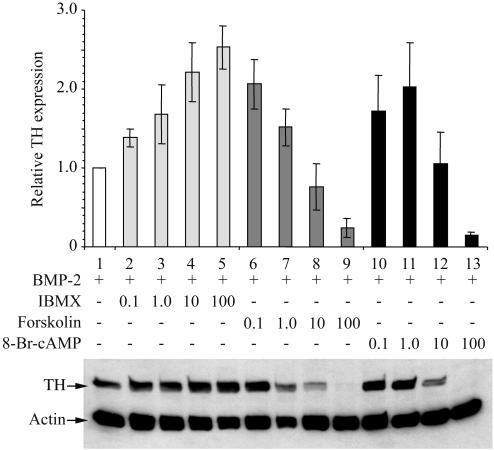
Western blot analysis of TH protein expression in neural crest cultures treated with cAMP-elevating agents and BMP-2. Cellular extracts were prepared from cultures grown 7 days in the presence of BMP-2 (10 ng/ml) and the cAMP-elevating agents IBMX (100 μM), forskolin (10 μM), and 8-Br-cAMP (100 μM) as indicated. The 63-kDa TH protein and 42-kDa actin protein, serving as an internal control, are indicated by arrows. The histogram was derived by densitometric scanning of blots from three independent cellular extract preparations. The effects of IBMX and forskolin compared to the control, the combination of BMP-2 with IBMX compared to treatment with either agent alone, and the combination of BMP-2 with forskolin or 8-Br-cAMP are significant at P < 0.05 (analysis of variance).
FIG. 2
FIG. 2
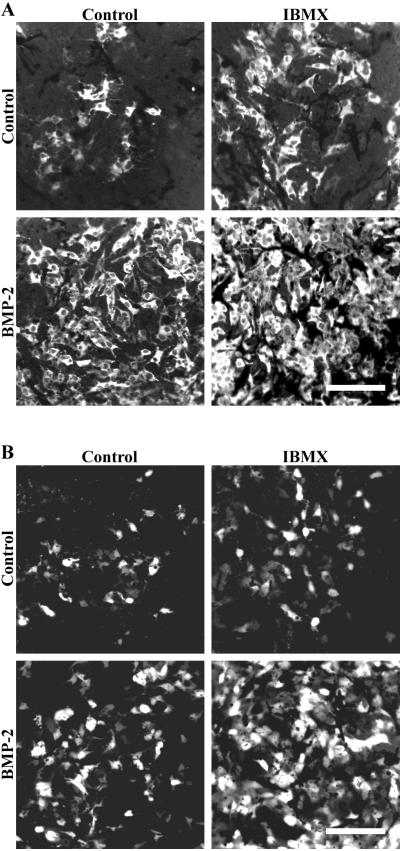
Differentiation of TH- and CA-positive cells in neural crest cultures. Crest cells were grown for 6 days in the presence of 10 ng of BMP-2 per ml and 100 μM IBMX as indicated. (A) Indirect immunofluorescence to visualize TH-expressing cells; (B) formaldehyde-induced fluorescence to visualize CA-containing cells (bar = 100 μm).
FIG. 3
FIG. 3
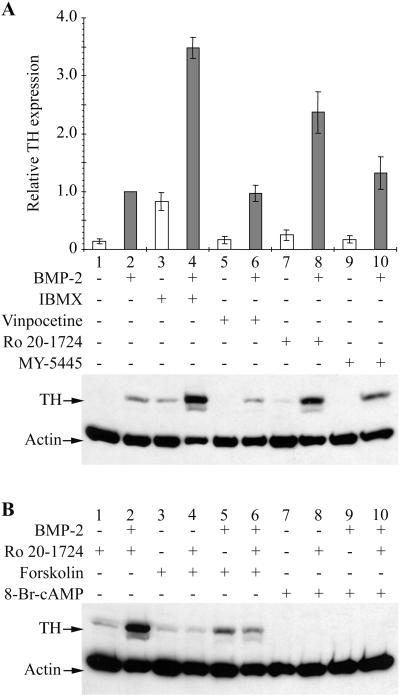
Effects of PDE inhibitors on TH protein expression in neural crest cultures. (A) Western blot analysis of TH protein expression in cultures grown for 7 days in the presence of BMP-2 (10 ng/ml) and PDE inhibitor IBMX (100 μM), vinpocetine (100 μM), Ro 20-1724 (20 μM), or MY-5445 (30 μM) as indicated. The histogram was derived by densitometric scanning of blots from three independent cellular extract preparations. The effects of BMP-2 and Ro 20-1724 compared to treatment with either agent alone are significant at P < 0.05 (analysis of variance). The effects of BMP-2 and either vinpocetine or MY-5445 are not significantly different from treatment with only BMP-2. (B) Western blot analysis of TH protein expression in cultures grown for 7 days in the presence of 10 ng of BMP-2 per ml, 20 μM Ro 20-1724, 10 μM forskolin, and 100 μM 8-Br-cAMP as indicated.
FIG. 4
FIG. 4
Low dose of forskolin or 8-Br-cAMP acts cooperatively with BMP-2 to stimulate development of SA cells in neural crest cell cultures. Shown is Western blot analysis of TH protein expression in cultures grown 5 days in the presence of 10 ng of BMP-2 per ml and 0.1, 1.0, 10, or 100 μM cAMP-elevating agent as indicated. The histogram was derived by densitometric scanning of blots from three independent cellular extract preparations. The effects of BMP-2 and either low (0.1 to 1.0 μM) or high (100 μM) doses of forskolin or 8-Br-cAMP are significant compared to treatment with BMP-2 alone (P < 0.05, analysis of variance). The effects of BMP-2 and low-dose forskolin or 8-Br-cAMP are not significantly different from treatment with BMP-2 and 1.0 to 100 μM IBMX.
FIG. 5
FIG. 5
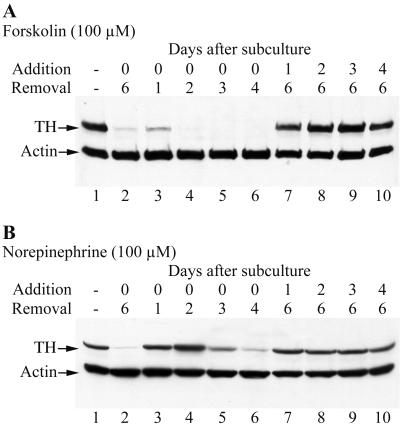
Temporal requirements of high doses of cAMP-elevating agents to antagonize SA cell development in neural crest cultures, determined by Western blot analysis of TH protein expression in 6-day cultures treated with 100 μM forskolin (A) and 100 μM norepinephrine (B).
FIG. 6
FIG. 6
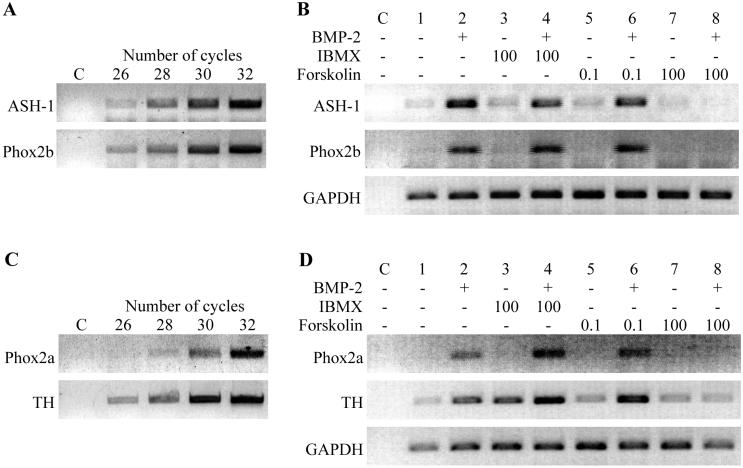
Synergy between the BMP-2 and cAMP signaling pathways regulates the SA lineage-determining gene Phox2a in neural crest cultures determined by RT-PCR of 1 μg of total RNA isolated from neural crest cells after 2 (A and B) days or 3 (C and D) days in culture. (A and C) Cycle-dependent amplification of TH and SA lineage-determining genes expressed by neural crest cultures grown in the presence of 10 ng of BMP-2 per ml. (B and D) Expression of TH and SA lineage-determining genes in neural crest cultures treated with combinations of 10 ng of BMP-2 per ml and the specified concentration (micromolar) of cAMP-elevating agent as indicated. Representative results of RT-PCR using 30 cycles of amplification to detect gene expression are shown. Amplification of the GAPDH gene was used as an internal control. Lane C is a negative control from which RNA was omitted in the RT-PCR.
FIG. 7
FIG. 7
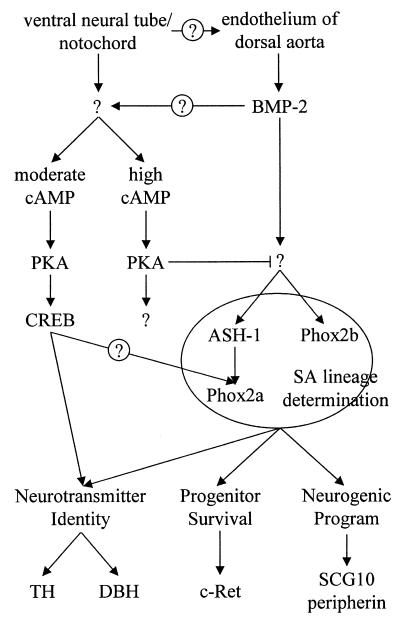
Model for the BMP-2 and cAMP signaling pathways in SA cell development. The diagram illustrates the possible molecular mechanisms regulating the observed synergy and antagonism between the BMP-2 and cAMP signaling pathways. Arrows indicate direct and indirect relationships. Differentiation of the SA lineage requires activation of the ASH-1 and Phox2 genes, which, in turn, regulate the neurogenic program, neurotransmitter identity, and progenitor survival (17). BMP-2 in combination with moderate intracellular levels of cAMP promotes differentiation of SA progenitor cells by inducing expression of ASH-1 and Phox2 genes. Conversely, high intracellular levels of cAMP activate a yet to be delineated mechanism antagonistic to development of the SA lineage which opposes BMP-2 signaling and the consequent expression of SA lineage-determining genes.

References

    1. Ahn H S, Crim W, Romano M, Sybertz E, Pitts B. Effects of selective inhibitors on cyclic nucleotide phosphodiesterases of rabbit aorta. Biochem Pharmacol. 1989;38:3331–3339. - PubMed
    1. Allan I J, Newgreen D F. Catecholamine accumulation in neural crest cells and the primary sympathetic chain. Am J Anat. 1977;149:413–421. - PubMed
    1. Anderson D J. Cellular and molecular biology of neural crest cell lineage determination. Trends Genet. 1997;13:276–280. - PubMed
    1. Anderson D J. Molecular control of cell fate in the neural crest: the sympathoadrenal lineage. Annu Rev Neurosci. 1993;16:1291–1258. - PubMed
    1. Anderson D J, Carnahan J F, Michelsohn A, Patterson P H. Antibody markers identify a common progenitor to sympathetic neurons and chromaffin cells in vivo and reveal the timing of commitment to neuronal differentiation in the sympathoadrenal lineage. J Neurosci. 1991;11:3507–3519. - PMC - PubMed

Publication types

MeSH terms