. 2000 Apr 25;97(9):4724-9.
doi: 10.1073/pnas.080063997.

RNA polymerase I transcription factor Rrn3 is functionally conserved between yeast and human

Affiliations

RNA polymerase I transcription factor Rrn3 is functionally conserved between yeast and human

B Moorefield et al. Proc Natl Acad Sci U S A. .

Abstract

We have cloned a human cDNA that is related to the RNA polymerase I transcription factor Rrn3 of Saccharomyces cerevisiae. The recombinant human protein displays both sequence similarity and immunological crossreactivity to yeast Rrn3 and is capable of rescuing a yeast strain carrying a disruption of the RRN3 gene in vivo. Point mutation of an amino acid that is conserved between the yeast and human proteins compromises the function of each factor, confirming that the observed sequence similarity is functionally significant. Rrn3 is the first RNA polymerase I-specific transcription factor shown to be functionally conserved between yeast and mammals, suggesting that at least one mechanism that regulates ribosomal RNA synthesis is conserved among eukaryotes.


Figures
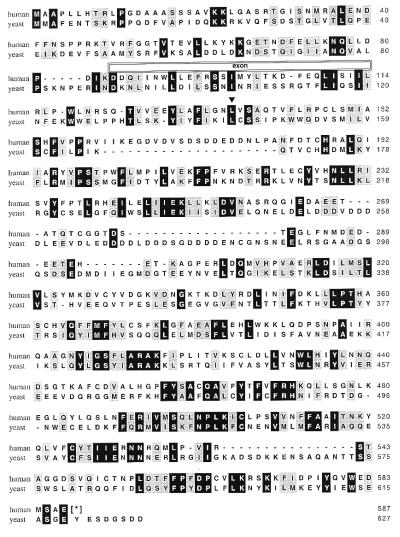
Figure 1
Figure 1
Amino acid sequence alignment of human and yRrn3. Identical amino acids are highlighted on black, conservative substitutions on gray. The translational stop codon introduced by the 3′ primer used for RT-PCR is indicated by an asterisk. The position of an exon in the human cDNA is indicated. The arrowhead indicates the position of a leucine-to-proline substitution of a temperature-sensitive yeast RRN3 mutant.
Figure 2
Figure 2
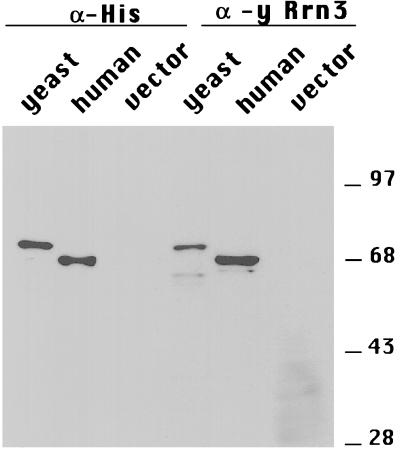
Human Rrn3 crossreacts with anti-yRrn3 antibodies. E. coli-expressed 6His fusions of yeast and hRrn3 are shown. To compensate for differences in expression levels of the recombinant proteins, the volume of each lysate loaded was adjusted to permit equal amounts of yeast and hRrn3 to be compared. Nineteen microliters of yeast, 2 μl of human, or 19 μl of vector control lysate were resolved by SDS/PAGE and probed with monoclonal anti-6His antibodies (lanes 1–3) or with anti-yRrn3 antiserum (lanes 4–6). Positions of protein molecular weight markers are indicated.
Figure 3
Figure 3
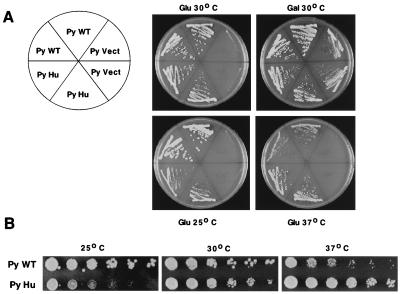
Human RRN3 complements the lethal phenotype of an rrn3 mutant. (A) rrn3 strain RLY303 was transformed with a 2-μm plasmid construct expressing polyoma-tagged yeast RRN3 (PyWT), human RRN3 (PyHu), or empty expression vector (PyVect). Two single colonies from each transformation were streaked on glucose (Glu) to assay rrn3 complementation or on galactose (Gal) as a positive control. Plates were incubated at the temperatures indicated for 3 days (30°C, 37°C) or 5 days (25°C) and photographed. (B) Effect of yeast or human RRN3 expression on cell growth. Five-fold serial dilutions of yeast (PyWT) or human (PyHu) RRN3 transformants were spotted onto glucose. Plates were incubated at 25°C, 30°C, or 37°C as described for A.
Figure 4
Figure 4
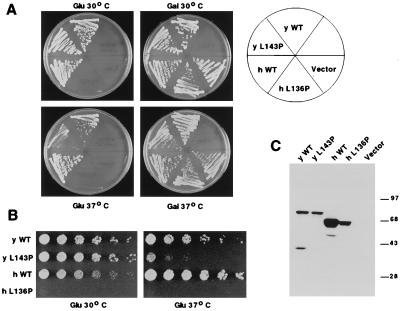
Functional comparison of yeast L143P and human L136P mutants. (A) Transformants of rrn3 strain RLY303 expressing polyoma-tagged wild-type yRrn3 (yWT), yeast mutant L143P (yL143P), wild-type hRrn3 (hWT), human mutant L136P (hL136P), or empty expression vector are compared. Colonies were streaked on glucose to assay rrn3 complementation or onto galactose as a positive control and were incubated at 30°C or 37°C for 3 days. (B) Five-fold serial dilutions of the yeast and hRrn3 transformants compared in A were spotted onto glucose and incubated for 3 days at 30°C or 37°C. (C) Western blot monitoring expression of Rrn3 proteins in RLY303 transformants. Crude lysates were prepared from cells grown to OD 600 = 2.0 at 30°C in galactose media lacking leucine to select for the expression construct. Equal amounts of protein were loaded in each lane, and the blot was probed with a monoclonal antibody against the polyoma epitope. The identity of each expression construct is indicated above the lanes, and the positions of molecular weight standards are indicated to the right of the figure.
Figure 5
Figure 5
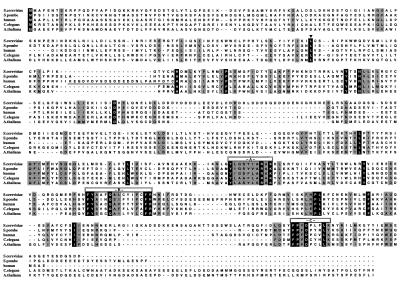
Comparison of Rrn3-related proteins. Alignment of the predicted protein sequences of Rrn3 from S. cerevisiae, S. pombe, H. sapiens, C. elegans, and A. thaliana. Amino acids that are identical or similar are highlighted in black or gray, respectively. Boxes labeled A, B, and C indicate three conserved regions whose function is unknown. The predicted PEST region of hRrn3 is double underlined. The arrowhead indicates the position of a conserved leucine residue that was mutated in the experiment shown in Fig. 4. Dashes indicate gaps introduced to maximize alignment.

References

    1. Keys D A, Vu L, Steffan J S, Dodd J A, Yamamoto R T, Nogi Y, Nomura M. Genes Dev. 1994;8:2349–2362. - PubMed
    1. Lin C W, Moorefield B, Payne J, Aprikian P, Mitomo K, Reeder R H. Mol Cell Biol. 1996;16:6436–6443. - PMC - PubMed
    1. Steffan J S, Keys D A, Dodd J A, Nomura M. Genes Dev. 1996;10:2551–2563. - PubMed
    1. Keener J, Josaitis C A, Dodd J A, Nomura M. J Biol Chem. 1998;273:33795–33802. - PubMed
    1. Lalo D, Steffan J S, Dodd J A, Nomura M. J Biol Chem. 1996;271:21062–21067. - PubMed

Publication types

MeSH terms

Substances

Associated data