. 2000 Apr;122(4):1231-8.
doi: 10.1104/pp.122.4.1231.

Genetic enhancement of fatty acid synthesis by targeting rat liver ATP:citrate lyase into plastids of tobacco

Affiliations

Genetic enhancement of fatty acid synthesis by targeting rat liver ATP:citrate lyase into plastids of tobacco

D Rangasamy et al. Plant Physiol. 2000 Apr.

Abstract

ATP:citrate lyase (ACL) catalyzes the conversion of citrate to acetyl-coenzyme A (CoA) and oxaloacetate and is a key enzyme for lipid accumulation in mammals and oleaginous yeasts and fungi. To investigate whether heterologous ACL genes can be targeted and imported into the plastids of plants, a gene encoding a fusion protein of the rat liver ACL with the transit peptide for the small subunit of ribulose bisphosphate carboxylase was constructed and introduced into the genome of tobacco. This was sufficient to provide import of the heterologous protein into the plastids. In vitro assays of ACL in isolated plastids showed that the enzyme was active and synthesized acetyl-CoA. Overexpression of the rat ACL gene led to up to a 4-fold increase in the total ACL activity; this increased the amount of fatty acids by 16% but did not cause any major change in the fatty acid profile. Therefore, increasing the availability of acetyl-CoA as a substrate for acetyl-CoA carboxylase and subsequent reactions of fatty acid synthetase has a slightly beneficial effect on the overall rate of lipid synthesis in plants.


Figures
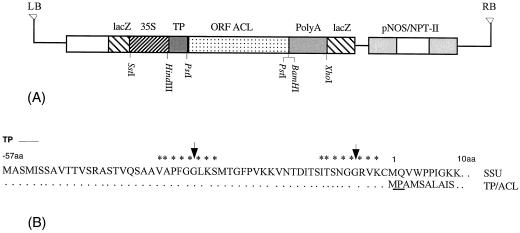
Figure 1
Figure 1
Map of plasmid SSU/ACL constructs. A, The open reading frame of rat ATP:citrate lyase was inserted between the transit peptide of SSU and polyadenylation signals under the control of the CaMV 35S promoter. Sites of action of the restriction endonucleases BamHI, HindIII, PstI, SstI, and XhoI are indicated. B, Amino acid sequences at the junction between the transit peptide of SSU (TP) and the N-terminal region of the rat ACL polypeptides. Sequences are aligned with the corresponding region of authentic Rubisco small subunit (SSU) precursor. Asterisks indicate the conserved amino acid residues for stromal protease recognition. Arrows show the cleavage sites between the TP and the mature ACL protein. The underlined sequence is the PstI site at which the ACL fragment was joined.
Figure 2
Figure 2
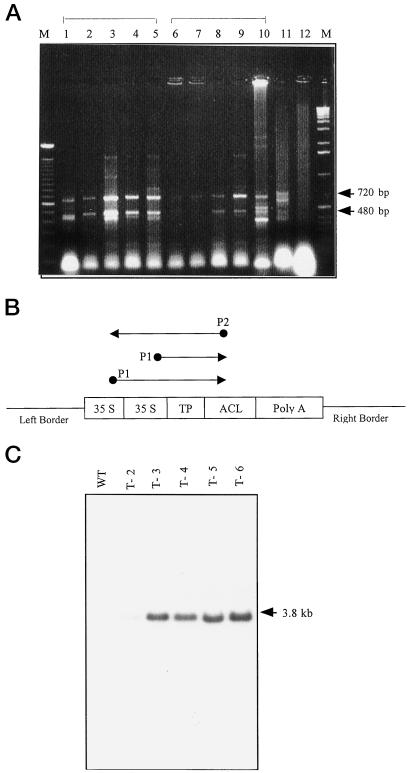
Analysis of five primary transformants by PCR and Southern blotting. A, Five nanograms of genomic DNA was used as a template for the PCR reaction as per McGarvey and Kaper (1991) but with an annealing temperature of 48°C (lanes 1–5 for transformants T2–T6) or 55°C (lanes 6–10 for same transformants). The plasmid SSU/ACL construct was used as a positive control (lane 11) and an untransformed plant (lane 12) as a negative control. B, Panel showing the location of primer sequences, P1 (CaMV primer) and P2 (ACL primer) in SSU/ACL constructs. The primer, P1, was expected to bind at two sites in the duplicated CaMV 35S promoters, giving rise to two sequences of DNA of 720 and 480 bp, which are seen in A. C, Southern analysis of PstI-digested genomic DNA (5 μg in each lane) of SSU/ACL transformants that were positive on PCR screening, probed with the rat ACL cDNA. Lane 1, Untransformed plant; lanes 2 to 6, SSU/ACL transformants; a 3.8-kb band corresponding to a fragment of the rat ACL can be observed.
Figure 3
Figure 3
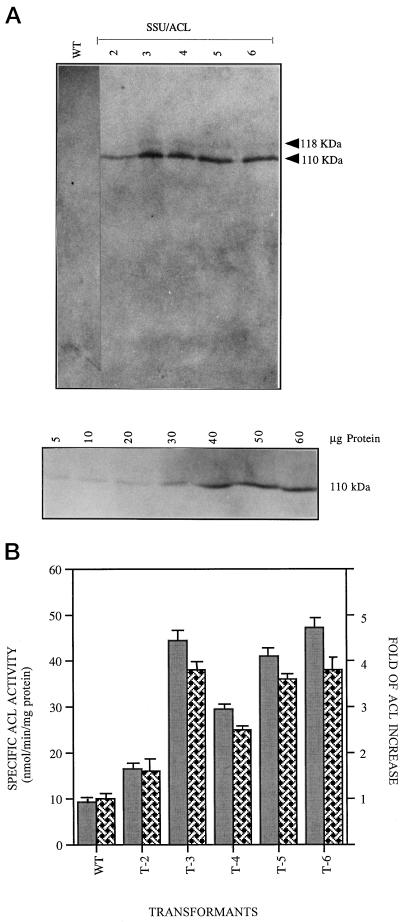
Expression of ACL in tobacco leaves. A, Protein extracts, 50 μg, of crude plastid fractions were loaded on 6% (w/v) SDS-PAGE, blotted on membranes, and probed with rat ACL antibody. Lane 1, Untransformed cells (wild type, WT); lanes 2 to 6, SSU/ACL transformants T2 to T6, respectively. The 110-kD band corresponds to the mature ACL protein. Bottom panel, Plastids isolated from an SSU/ACL transformant (T6) were treated with thermolysin and different amounts of proteins (5–60 μg) were loaded in each lane and probed with anti-ACL antibody. An increased intensity of signal was observed with an increase in the amount of proteins electrophoresed in individual lanes. B, Comparison of ACL activity (gray bars) and relative increase of ACL activity (hatched bars) among the SSU/ACL transformants T2 to T6 compared with the activity in the original, untransformed wild type (WT) cells. Bar represents the mean of three separate assays.
Figure 4
Figure 4
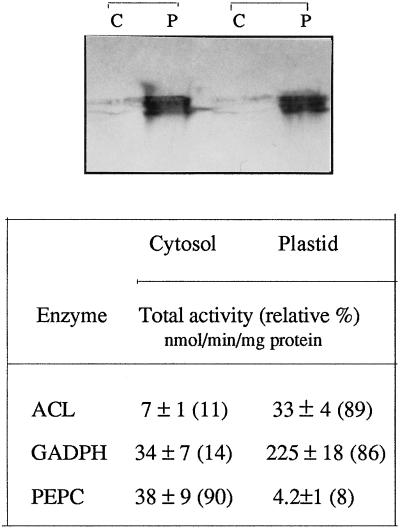
Localization of ACL protein in plastids. About 30 μg of protein extracts of both plastid (P) and cytosol (C) fractions were separated on SDS-PAGE and the resulting gel was immunoblotted with rat ACL antibody. The majority of ACL proteins localized in the plastidic fraction can be observed. This experiment was repeated with identical results (duplicate is shown in top panel). Bottom panel, Purity of plastid and cytosol fractions based on the activities of NADPH-glyceraldehyde-3-P dehydrogenase (as a plastidic marker) and PEP carboxylase (as a cytosolic marker). The relative percentage of activity is shown in parentheses.

References

    1. Anderson S, Smith SM. Synthesis of the small subunit of ribulose bisphosphate carboxylase from gene cloned into plasmids containing SP3 promoter. Biochem J. 1986;240:709–715. - PMC - PubMed
    1. Andrews TJ, Kane HJ. Pyruvate is a by-product of catalysis by ribulose bisphosphate carboxylase/oxygenase. J Biol Chem. 1991;266:9447–9450. - PubMed
    1. Armstrong J, Lemos EEP, Zobayed SMA, Justin FW, Armstrong W. A humidity induced convective throughflow ventilation system benefits Annona squamosa L. explants and coconut calloid. Anal Bot. 1996;79:31–40.
    1. Boulton CA, Ratledge C. ATP:citrate lyase: the regulatory enzyme for lipid biosynthesis in Lipomyces starkey? J Gen Microbiol. 1981;127:423–426.
    1. Bradford MM. A rapid and sensitive method for quantitation of microgram quantities of protein utilizing the principle of protein dye binding. Anal Biochem. 1976;72:248–254. - PubMed

Publication types

LinkOut - more resources