. 2000 Apr 25;97(9):4796-801.
doi: 10.1073/pnas.070560797.

Cytotoxic T cell immunity against telomerase reverse transcriptase in humans

Affiliations

Cytotoxic T cell immunity against telomerase reverse transcriptase in humans

B Minev et al. Proc Natl Acad Sci U S A. .

Abstract

Telomerase is a ribonucleoprotein enzyme which has been linked to malignant transformation in human cells. Telomerase activity is increased in the vast majority of human tumors, making its gene product the first molecule common to all human tumors. The generation of endogenously processed telomerase peptides bound to Class I MHC molecules could therefore target cytotoxic T lymphocytes (CTL) to tumors of different origins. This could advance vaccine therapy against cancer provided that precursor CTL recognizing telomerase peptides in normal adults and cancer patients can be expanded through immunization. We demonstrate here that the majority of normal individuals and patients with prostate cancer immunized in vitro against two HLA-A2.1 restricted peptides from telomerase reverse transcriptase (hTRT) develop hTRT-specific CTL. This suggests the existence of precursor CTL for hTRT in the repertoire of normal individuals and in cancer patients. Most importantly, the CTL of cancer patients specifically lysed a variety of HLA-A2(+) cancer cell lines, demonstrating immunological recognition of endogenously processed hTRT peptides. Moreover, in vivo immunization of HLA-A2.1 transgenic mice generated a specific CTL response against both hTRT peptides. Based on the induction of CTL responses in vitro and in vivo, and the susceptibility to lysis of tumor cells of various origins by hTRT CTL, we suggest that hTRT could serve as a universal cancer vaccine for humans.


Figures
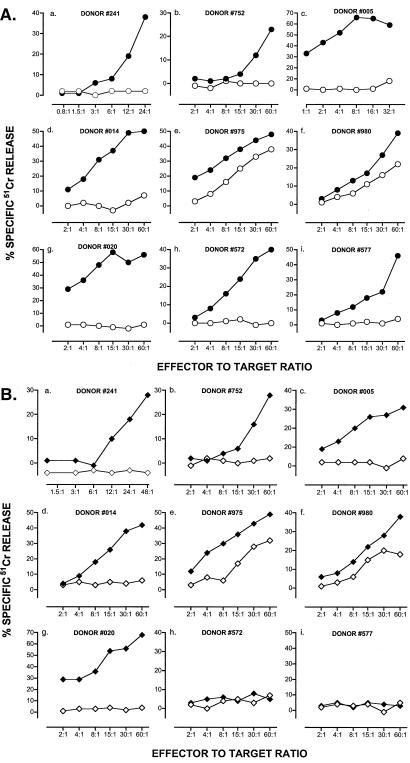
Figure 1
Figure 1
Induction of CTL against hTRT in PBMC from normal blood donors. T cells from HLA-A2+ individuals were stimulated by autologous PBMC pulsed with hTRT-derived synthetic peptides as detailed in Materials and Methods. (A) Results refer to effector cells from individual donors immunized in vitro against p540. (○) T2 cells and (●) T2 cells pulsed with p540 as targets. (B) Results refer to effector cells from individual donors immunized in vitro against p865. (⋄) T2 cells and (♦) T2 cells pulsed with p865 as targets. Effector-to-target ratios are indicated on an individual basis. Percent cytotoxicity was calculated as specified in Materials and Methods.
Figure 2
Figure 2
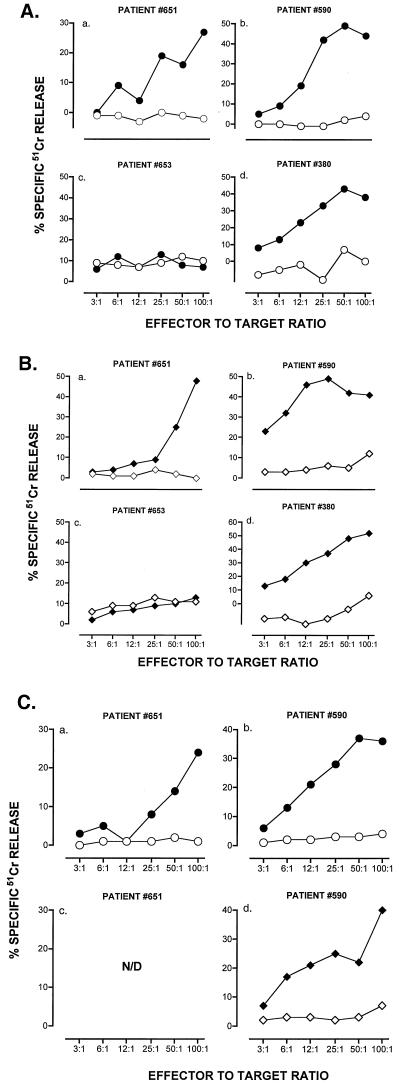
Induction of CTL against hTRT in PBMC from prostate cancer patients. (A). Results refer to effector cells from individual patients immunized against p540. Values refer to cells tested after three rounds of in vitro stimulation. (○) T2 cells and (●) T2 cells pulsed with p540 as targets. (B). Results refer to effector cells from individual patients immunized against p865. (⋄) T2 cells and (♦) T2 cells pulsed with p865 as targets. Effector-to-target ratios are indicated on an individual basis. (C). Results refer to effector cells from individual patients immunized in vitro against p540 (circles) or p865 (diamonds). Open symbols define the HLA-A2 PC-3 prostate cancer cell line as a target. Closed symbols define the HLA-A2+ prostate cancer cell line LnCap as a target. Percent cytotoxicity was calculated as specified in Material and Methods.
Figure 3
Figure 3
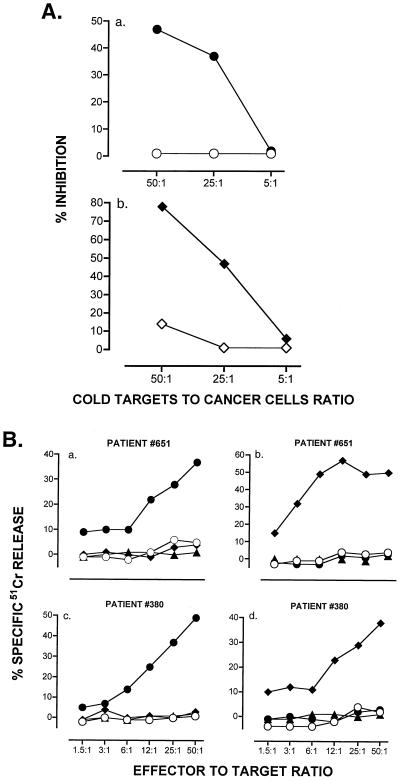
Molecular specificity of target recognition by CTL generated against hTRT peptides. (A). Cold target inhibition. 51Cr-labeled LnCap cells (5 × 10⁴ cells/ml) were mixed with T2 cells (open symbols) or T2 cells pulsed with p540 (●) or p865 (♦) (1 μg/ml) at a cold-to-hot target cell ratio of 5:1, 25:1, and 50:1. CTL lines 380.540.1 and 380.865.1 of patient no. 380 generated against p540 and p865, respectively, were added at an effector-to-target ratio of 50:1. (B) Lysis of T2 cells pulsed with irrelevant HLA-A2 binding peptides. Results refer to lysis by CTL of patient (no. 651) generated against p540 (a) or p865 (b), and CTL of patient (no. 380) generated against p540 (c) or p865 (d). Closed symbols define T2 cells pulsed with p540 (circles), p865 (diamonds), and MART-1 peptide (triangles). (○) Nonpulsed T2 cells. Percent cytotoxicity was calculated as specified in Materials and Methods.
Figure 4
Figure 4
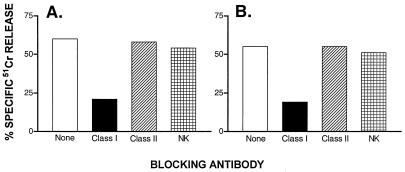
CTL of prostate cancer patient against hTRT are MHC Class I restricted. CTL lines 380.540.1 and 380.865.1 of a patient (no. 380) were tested in a 51Cr-labeled release assay by using as targets T2 cells pulsed with p540 (A) or p865 (B). The following inhibitory antibodies were used: murine monoclonal antibody BB7.2 (IgG2b) against MHC Class I, murine monoclonal antibody Q5/13 (IgG2a) against HLA-DR, and the engineered antibody γ1RGD3 that blocks NK cell function.

References

    1. Blackburn E H. Annu Rev Biochem. 1992;61:113–129. - PubMed
    1. Blackburn E H. Nature (London) 1991;350:569–573. - PubMed
    1. Greider C W. Curr Opin Genet Dev. 1994;4:203–211. - PubMed
    1. Counter C M, Avilion A A, LeFeuvre C E, Stewart N G, Greider C W, Harley C B, Bacchetti S. EMBO J. 1992;11:1921–1929. - PMC - PubMed
    1. Buchkovich K J, Greider C W. Mol Biol Cell. 1996;7:1443–1454. - PMC - PubMed

Publication types