. 2000 Apr 11;97(8):3919-24.
doi: 10.1073/pnas.97.8.3919.

Glucocorticoids repress NF-kappaB-driven genes by disturbing the interaction of p65 with the basal transcription machinery, irrespective of coactivator levels in the cell

Affiliations

Glucocorticoids repress NF-kappaB-driven genes by disturbing the interaction of p65 with the basal transcription machinery, irrespective of coactivator levels in the cell

K De Bosscher et al. Proc Natl Acad Sci U S A. .

Abstract

Glucocorticoids (GCs) are used to combat inflammatory diseases. Their beneficial effect relies mainly on the inhibition of NF-kappaB- and/or AP-1-driven proinflammatory gene expression. Previously, we have shown that GCs repress tumor necrosis factor-induced IL-6 gene expression by an NF-kappaB-dependent nuclear mechanism without changing the DNA-binding capacity of NF-kappaB or the expression levels of the cytoplasmic inhibitor of NF-kappaB (IkappaB-alpha). In the present work, we investigate the effect of GC repression on different natural and/or recombinant NF-kappaB-driven reporter gene constructs in the presence of increasing amounts of various coactivator molecules, such as CREB-binding protein (CBP), p300, and SRC-1. We found that GCs maintain their repressive capacities, irrespective of the amount of cofactor present in the cell. Similar results were obtained for the reciprocal transrepression of a GC receptor (GR) element-driven reporter gene by p65. We demonstrate that neither the expression levels of p65 and CBP nor their physical association are affected by activated GR. Using Gal4 chimeras, we show that repression by GCs is specific for p65-mediated transactivation, ruling out competition for limiting nuclear factors as the major underlying mechanism of gene repression. In addition, the transactivation potential of a point-mutated Gal4-p65 variant with a decreased CBP interaction capability is still repressed by GR. Finally, we present evidence that the specificity of GC repression on p65-driven gene expression is codetermined by the TATA box context.


Figures
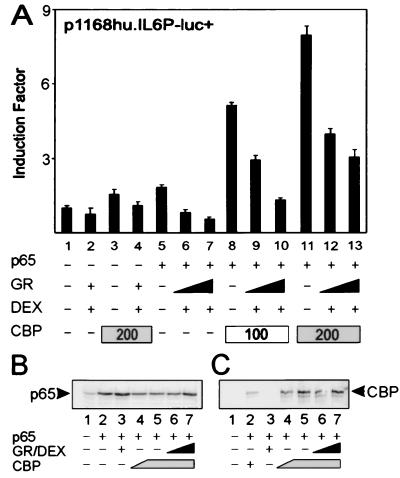
Figure 1
Figure 1
(A) HEK293T cells were transiently transfected with 80 ng of p1168hu.IL6P-luc+ and with pRSV-p65 (20 ng), pSVhGRα (100 to 200 ng), pCMV-CBP (as indicated), and/or pcDNA3 or pRSV, keeping the total amount of DNA constant at 600 ng per 24-well plate. Cell lysates were assayed for luc activities and normalized for protein content. Promoter activities are expressed as “induction factor,” i.e., the ratio of expression levels recorded either under induced and noninduced conditions or under transfected and mock-transfected conditions. Assays were performed in triplicate, and results are representative of at least four independent transfection experiments. (B) Western blot analysis of lysates of transfected cells corresponding to 25 μg of protein content (the luc activities had a similar regulation on a full IL-6 promoter-dependent reporter gene as shown in A). Samples were transfected with 100 ng (lane 4) or 200 ng (lanes 5–7) of pCMV-CBP or 25 ng (lane 6) or 100 ng (lanes 3 and 7) pSVhGRα. The membrane was probed with an anti-p65 rabbit polyclonal antibody. (C) Samples were transfected as described for B (except for lane 2 where a setup with 50 ng of pCMV-CBP was included), blotted, and probed with an anti-CBP rabbit polyclonal antibody.
Figure 2
Figure 2
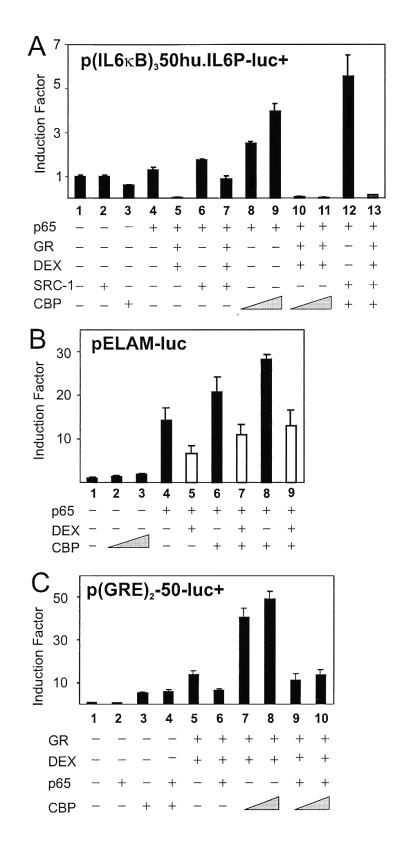
(A) HEK293T cells were transiently transfected with 80 ng of p(IL6κB)350hu.IL6P luc+ and, where indicated, with pRSV-p65 (10 ng), pSVhGRα (50 to 100 ng), pCMV-CBP (200 to 300 ng), PCR3.1-SRC-1a (100 ng), and/or pRSV or pcDNA3. (B) TC10 cells were transiently transfected with 100 ng of pELAM-luc and, where indicated, with pRSV-p65 (50 ng), pCMV-CBP (100 to 200 ng), and/or pRSV or pcDNA3. White bars indicate the repression levels when endogenous GR was activated by DEX. (C) HEK293T cells were transiently transfected with 80 ng of p(GRE)2-50-luc+, pSVhGRα (100 ng), pRSV-p65 (100 ng), pCMV-CBP (100 to 300 ng), and/or the corresponding empty control plasmids. Total DNA content was kept at 600 ng. Cell lysates were assayed and plotted as described for Fig. 1.
Figure 3
Figure 3
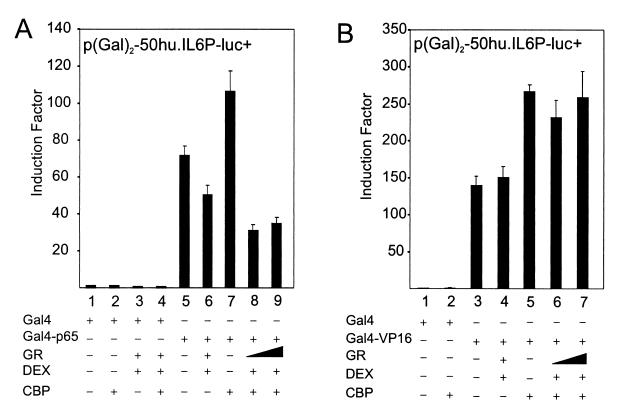
HEK293T cells were transiently transfected with 80 ng of p(Gal)2-50.huIL6P-luc+ and with various expression plasmids, the total amount of DNA being fixed at 400 ng, i.e., pGal4 (40 ng) or pGal4-p65 (10 ng) (A) or pGal4-VP16 (40 ng) (B), whether or not with pCMV-CBP (25 ng or 100 ng) and/or pSVhGRα (25 ng or 100 ng). In control lanes with CBP and GR, + corresponds to the highest concentration. Assays were performed in triplicate and are representative of two independent experiments.
Figure 4
Figure 4
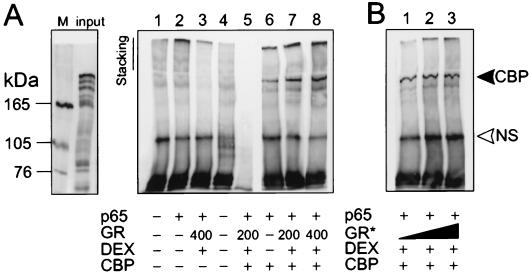
(A) Immunoprecipitation with anti-p65 (lanes 1–4 and 6–8) or an irrelevant antibody (lane 5) of cell lysates, transfected with pRSV-p65 (200 ng), pCMV-CBP (1 μg), and/or pSVhGRα (200 ng or 400 ng), followed by Western blot analysis with anti-CBP antibody. Lane 4 is a control with lysis buffer only. The input lane represents one-third of the amount used in the assay. The M lane represents molecular mass markers. (B) Similar lysate preparation to which increasing amounts (3, 5, and 10 μl corresponding to approximately 30, 50, and 100 ng) of in vitro translated GR protein (GR*) are added, followed by immunoprecipitation and Western blot analysis as described for A. The upper arrow marks the 265-kDa band corresponding with coimmunoprecipitated CBP protein. NS, nonspecific band. The result is representative of three independent experiments.
Figure 5
Figure 5
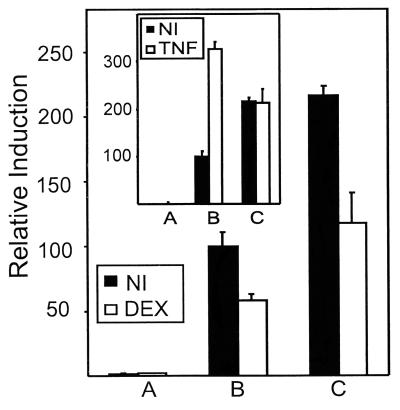
L929sA cells with stably integrated pGal4 (A), pGal4-p65 (B), or pGal4-p65S276C (C) were transiently transfected with 250 ng of p(Gal)2-50-luc+ and 250 ng of β-Gal expression plasmid. Total amount of DNA was adjusted to 1,500 ng with empty vector DNA. NI, noninduced; DEX, 10−6 M at 24 h for a total of 30 h; TNF, 2,000 units/ml for a total of 6 h. The difference in activity between Gal4-p65 variants is due to different activities of the stable cell clones. The experiment is representative of three independent experiments.
Figure 6
Figure 6
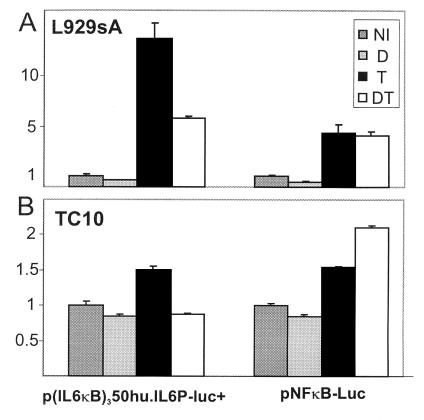
L929sA cells were transiently transfected with 250 ng of p(IL6κB)350hu.IL6P-luc+ or pNFκB-Luc and 250 ng of β-Gal expression plasmid, adjusting the total DNA amount to 1,500 ng with empty vector DNA. TC10 cells were transiently transfected with 100 ng of p(IL6κB)350hu.IL6P-luc+ or pNFκB-Luc and 50 ng of β-Gal expression plasmid, adjusting the total DNA amount to 400 ng with empty vector DNA. NI, noninduced; DEX, 10−6 M at 2 h for a total of 8 h; TNF, 2,000 units/ml for a total of 6 h.
Figure 7
Figure 7
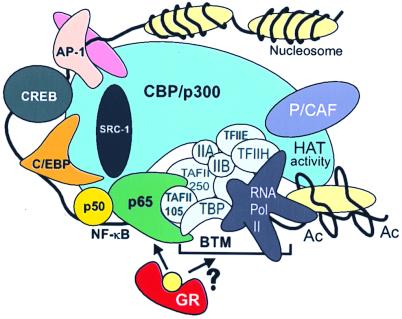
A model for GC repression of NF-κB-driven genes. The cointegrator molecule CBP/p300 contacts various transcription factors along the IL-6 promoter DNA and shows HAT activity when NF-κB is activated (17). The latter factor complex also has direct contacts with various components of the basal transcription machinery (see Discussion). Activated GR targets p65 and may thus disturb the necessary conformation or interactions necessary for transcriptional enhancement. BTM, basal transcription machinery; Ac, acetylated nucleosome.

References

    1. Göttlicher M, Heck S, Herrlich P. J Mol Med. 1998;76:480–489. - PubMed
    1. Katzenellenbogen J A, Katzenellenbogen B S. Chem Biol. 1996;3:529–536. - PubMed
    1. Ghosh S, May M J, Kopp E B. Annu Rev Immunol. 1998;16:225–260. - PubMed
    1. Mercurio F, Manning A M. Curr Opin Cell Biol. 1999;11:226–232. - PubMed
    1. Zhong H, Voll R E, Ghosh S. Mol Cell. 1998;1:661–671. - PubMed

Publication types

MeSH terms