


Ecological character displacement in Plethodon: biomechanical differences found from a geometric morphometric study
- PMID: 10760280
- PMCID: PMC18164
- DOI: 10.1073/pnas.97.8.4106
Ecological character displacement in Plethodon: biomechanical differences found from a geometric morphometric study
Abstract
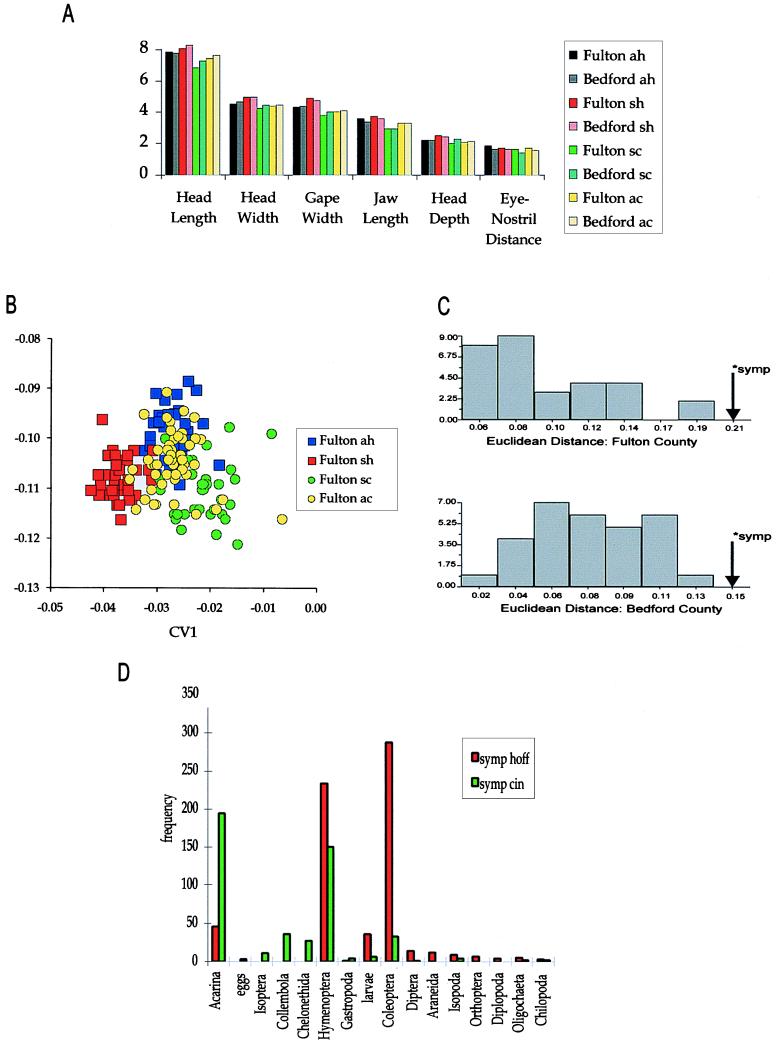
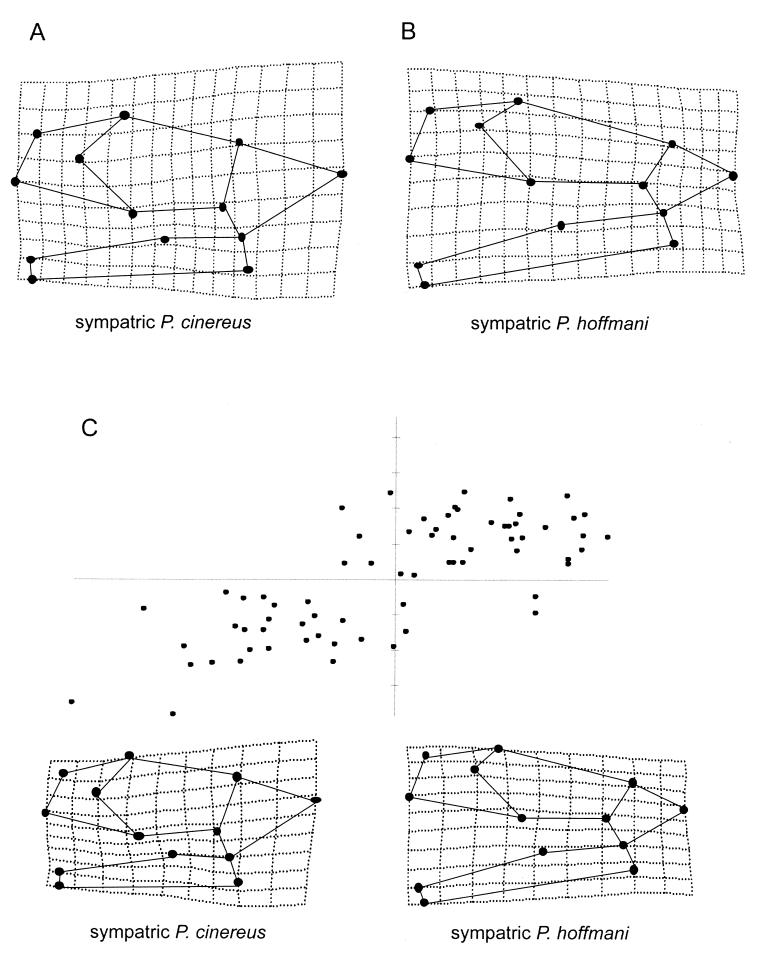
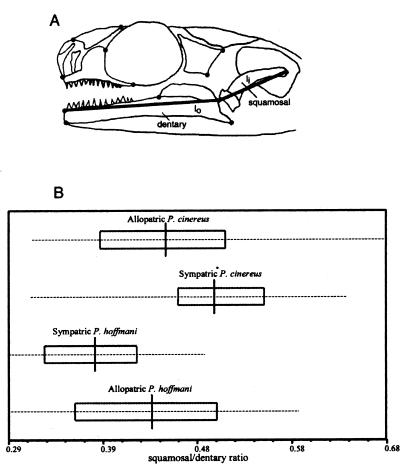
Ecological character displacement describes a pattern where morphological differences between sympatric species are enhanced through interspecific competition. Although widely considered a pervasive force in evolutionary ecology, few clear-cut examples have been documented. Here we report a case of ecological character displacement between two salamander species, Plethodon cinereus and Plethodon hoffmani. Morphology was quantified by using linear measurements and landmark-based geometric morphometric methods for specimens from allopatric and sympatric populations from two geographic transects in south-central Pennsylvania, and stomach contents were assayed to quantify food resource use. Morphological variation was also assessed in 13 additional allopatric populations. In both transects, we found significant morphological differentiation between sympatric populations that was associated with a reduction in prey consumption in sympatry and a segregation of prey according to prey size. No trophic morphological or resource use differences were found between allopatric populations, and comparisons of sympatric populations with randomly paired allopatric populations revealed that the observed sympatric morphological differentiation was greater than expected by chance. The major trophic anatomical differences between sympatric populations relates to functional and biomechanical differences in jaw closure: sympatric P. hoffmani have a faster closing jaw, whereas sympatric P. cinereus have a slower, stronger jaw. Because salamanders immobilize prey of different sizes in different ways, and because the observed sympatric biomechanical differences in jaw closure are associated with the differences in prey consumption, the observed character displacement has a functional ecological correlate, and we can link changes in form with changes in function in this apparent example of character displacement.
Figures
Comment in
-
Ecological character displacement and the study of adaptation.Proc Natl Acad Sci U S A. 2000 May 23;97(11):5693-5. doi: 10.1073/pnas.97.11.5693. Proc Natl Acad Sci U S A. 2000. PMID: 10823930 Free PMC article. No abstract available.
References
-
- Brown W L, Wilson E O. Syst Zool. 1956;5:49–64.
-
- Grant P R. Evol Biol. 1975;8:237–337.
-
- Arthur W A. Adv Ecol Res. 1982;12:127–187.
-
- Grant P R. Science. 1994;266:746–747. - PubMed
-
- Schluter D, Grant P R. Am Nat. 1984;123:175–196.
Publication types
MeSH terms
LinkOut - more resources
Full Text Sources
