. 2000 Apr;15(2):103-11.
doi: 10.1177/074873040001500204.

Retinal innervation of calbindin-D28K cells in the hamster suprachiasmatic nucleus: ultrastructural characterization

Affiliations

Retinal innervation of calbindin-D28K cells in the hamster suprachiasmatic nucleus: ultrastructural characterization

D N Bryant et al. J Biol Rhythms. 2000 Apr.

Abstract

The authors have described a subregion of the hamster hypothalamic suprachiasmatic nucleus (SCN) containing cells that are immunopositive for the cytosolic calcium-binding protein, Calbindin-D28K (CaBP). Several lines of evidence indicate that this region may constitute the site of the pacemaker cells that are responsible for the regulation of circadian locomotor rhythms. First, 79% of the CaBP-immunoreactive (ir) neurons express Fos in response to photic stimulation, indicating that they are close to or part of the input pathway to pacemakers. Second, at the light microscopy level, retinal terminals innervate the CaBP subnucleus. Finally, destruction of this subnucleus renders animals arrhythmic in locomotor activity. In this study, the authors examined the ultrastructural relationship between cholera toxin (CTbeta) labeled retinal fibers and the CaBP-ir subregion within the hamster SCN. CTbeta-ir retinal terminals make primarily axo-somatic, symmetric, synaptic contacts with CaBP-ir perikarya. In addition, retinal terminals form synapses with CaBP processes as well as with unidentified profiles. There are also complex interactions between retinal terminals, CaBP perikarya, and unidentified profiles. Given that axo-somatic synaptic input has a more potent influence on a cell's electrical activity than does axo-dendritic synaptic input, cells of the CaBP subregion of the SCN are ideally suited to respond rapidly to photic stimulation to reset circadian pacemakers.


Figures
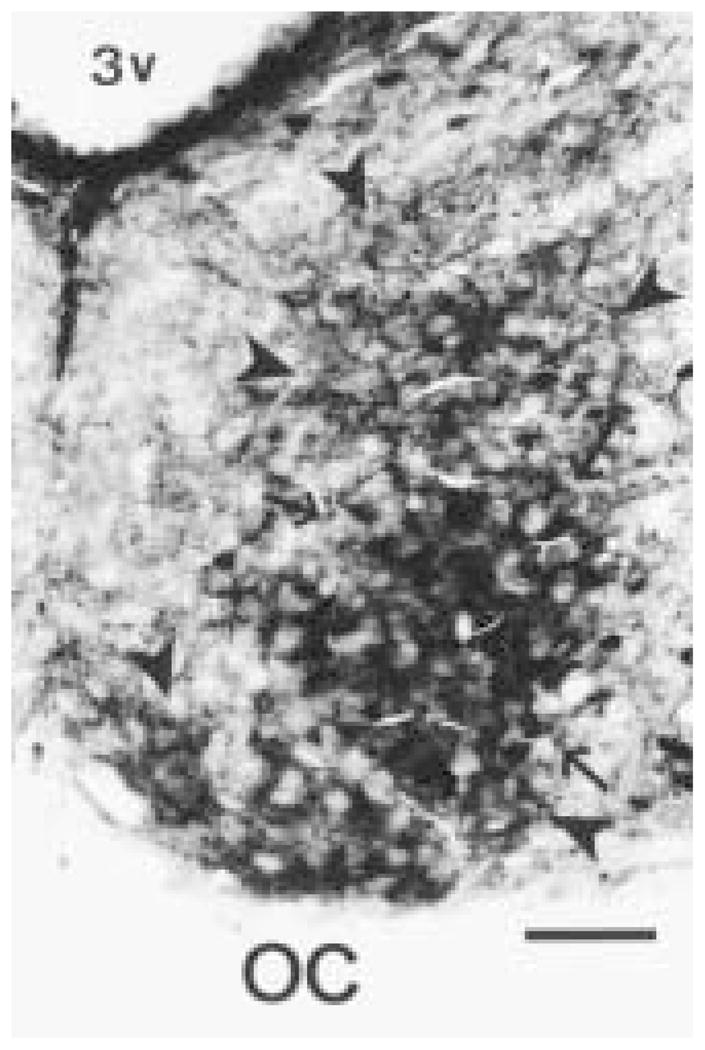
Figure 1
Figure 1
Photomicrograph of the unilateral hamster SCN double labeled for cholera toxin β subunit (CTβ) and Calbindin-D28K (CaBP) at the light microscopy level. CTβ-immunoreactive (ir) retinal terminals are observed throughout the SCN (arrow heads). The CaBP-ir subnucleus (arrows) is surrounded by an area devoid of CaBP-ir structures. 3v = third ventricle. Magnification bar = 100 μm.
Figure 2
Figure 2
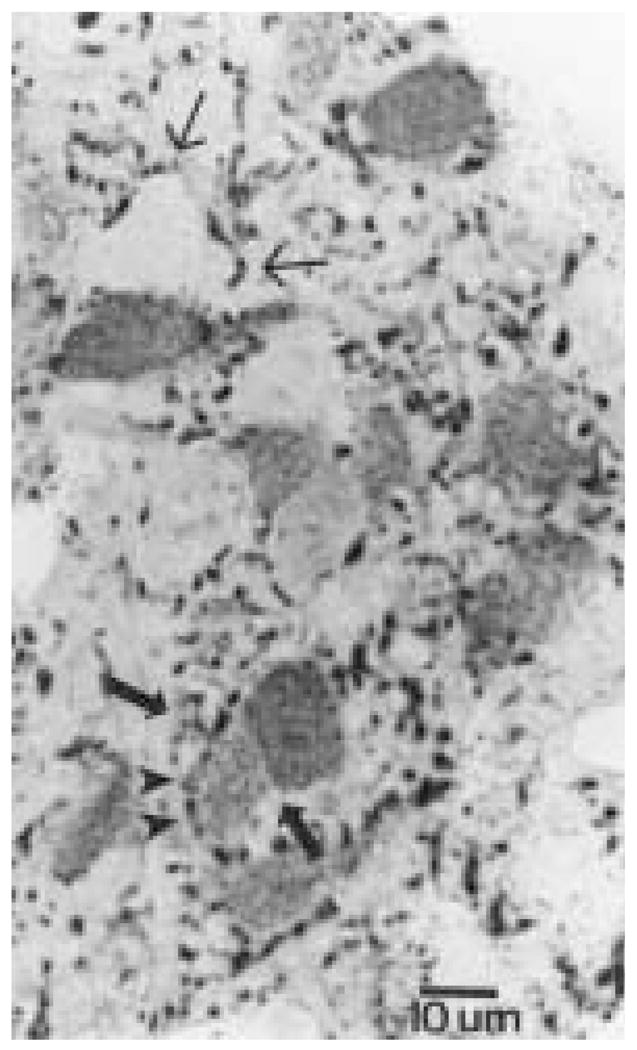
Micrograph of a semithin section (0.75 μm) depicting several Calbindin-D28K (CaBP)-immunoreactive (ir) cells surrounded by cholera toxin β subunit (CTβ)-ir fibers. Two CaBP-ir cells are observed close to each other (large arrows). A CTβ-ir fiber partially encircles one of the CaBP-ir cells (arrowheads). Non-identified perikarya are also encircled by retinal terminals, which are also abundant in the neuropil (small arrows). Magnification bar = 10 μm.
Figure 3
Figure 3
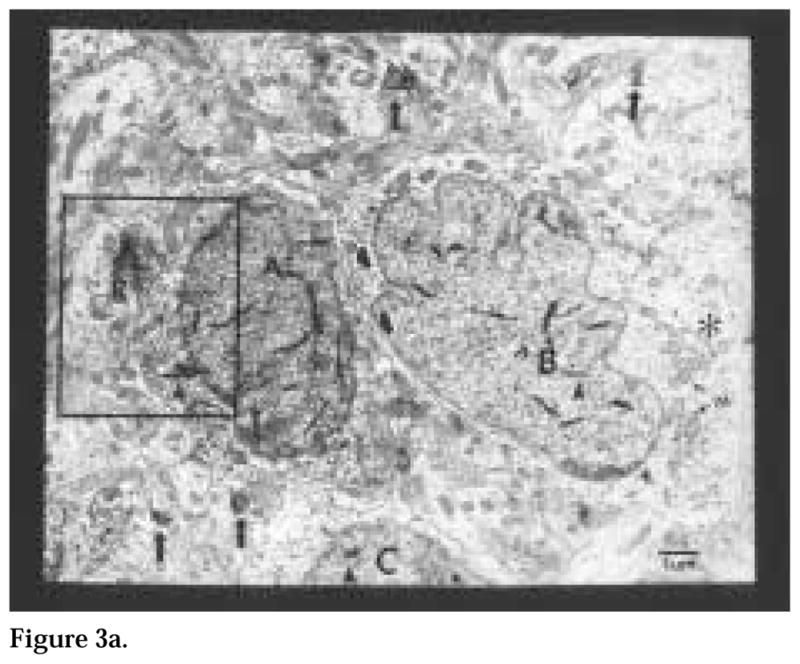
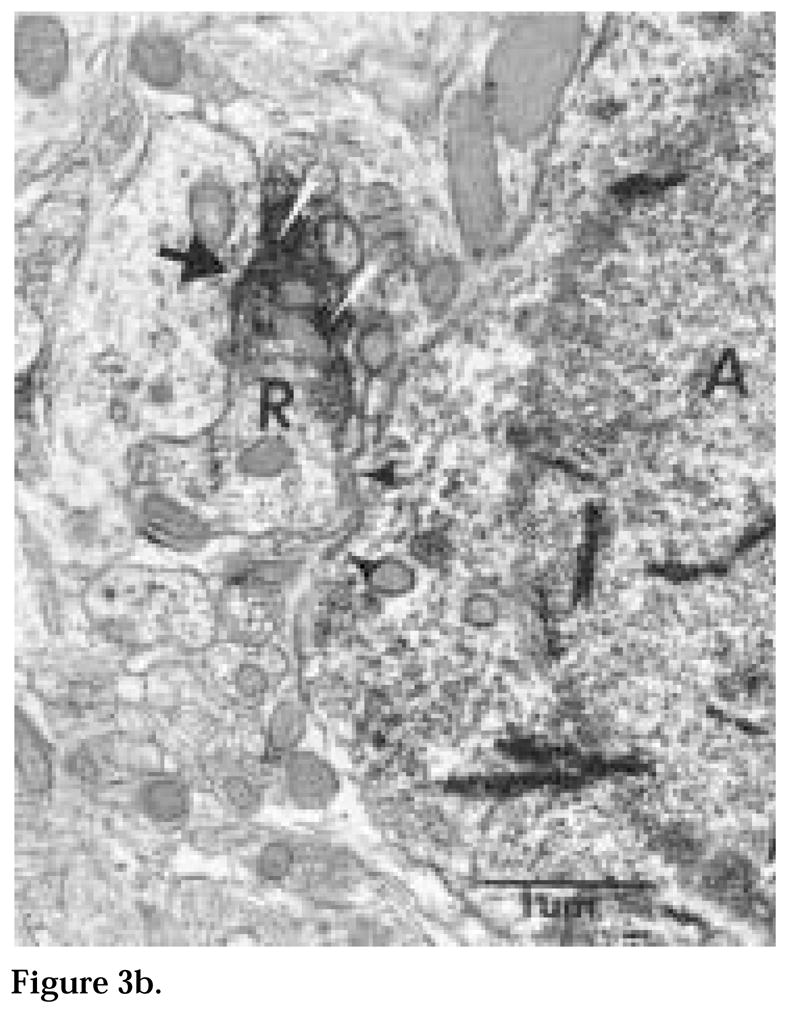
Figure 3a. A cluster of three Calbindin-D28K-immunoreactive (ir) neurons (A, B, C), indicated by the presence of tetramethylbenzidine crystals (arrowheads), lie close to each other. Unidentified membranes (black and white arrow heads), possibly glia, are interposed between neurons (A) and (B). These cells also have large invaginated nuclei, occupying most of the cross-sectional surface area. The perikaryon of cell (B) contains numerous mitochondria (M) and golgi apparatus (asterisk). A cholera toxin β subunit (CTβ)-ir terminal (R) is also close to cell (A). The neuropil contains small profiles of retinal axons in passage (arrows). Magnification = × 18,500. Figure 3b. An enlargement of the cholera toxin β subunit (CTβ)-immunoreactive retinal terminal in proximity to cell (A) described in Fig. 3a. This terminal is not uniformly immunolabeled. While a few synaptic vesicles can be discerned in the intensely labeled portion of the terminal (white arrows), there appear to be no vesicles in the lightly labeled portion of the terminal. The retinal terminal synapses (large arrow) on an unidentified dendrite but not on the Calbindin-D28K neuron (arrow heads). Magnification = × 40,500.
Figure 3
Figure 3
Figure 3a. A cluster of three Calbindin-D28K-immunoreactive (ir) neurons (A, B, C), indicated by the presence of tetramethylbenzidine crystals (arrowheads), lie close to each other. Unidentified membranes (black and white arrow heads), possibly glia, are interposed between neurons (A) and (B). These cells also have large invaginated nuclei, occupying most of the cross-sectional surface area. The perikaryon of cell (B) contains numerous mitochondria (M) and golgi apparatus (asterisk). A cholera toxin β subunit (CTβ)-ir terminal (R) is also close to cell (A). The neuropil contains small profiles of retinal axons in passage (arrows). Magnification = × 18,500. Figure 3b. An enlargement of the cholera toxin β subunit (CTβ)-immunoreactive retinal terminal in proximity to cell (A) described in Fig. 3a. This terminal is not uniformly immunolabeled. While a few synaptic vesicles can be discerned in the intensely labeled portion of the terminal (white arrows), there appear to be no vesicles in the lightly labeled portion of the terminal. The retinal terminal synapses (large arrow) on an unidentified dendrite but not on the Calbindin-D28K neuron (arrow heads). Magnification = × 40,500.
Figure 4
Figure 4
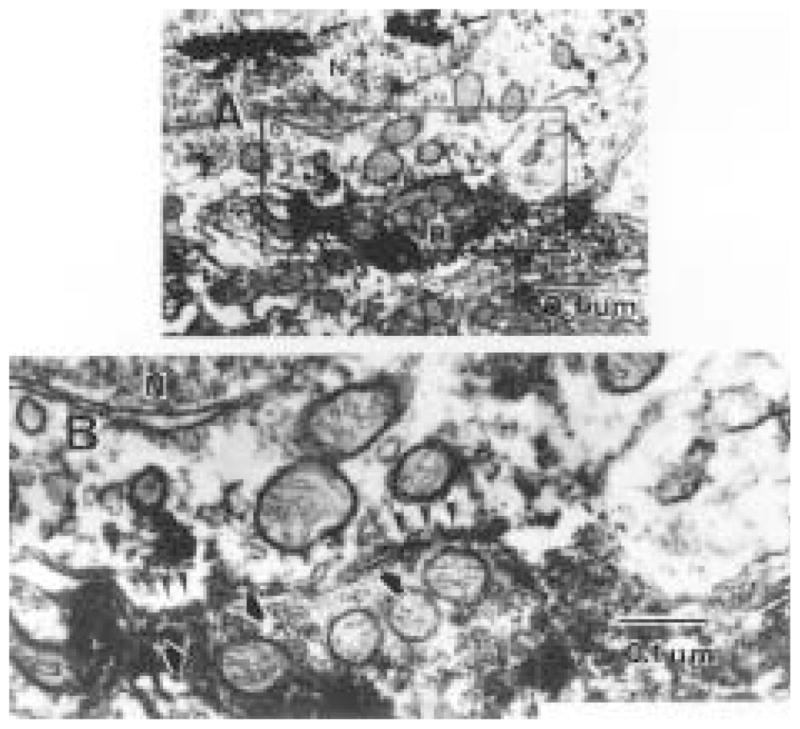
(A) A cholera toxin β subunit (CTβ)-immunoreactive (ir) retinal terminal synapses on the perikaryal membrane of a Calbindin-D28K-ir cell, indicated by the presence of tetramethylbenzidine crystals in the nucleus (arrows). Numerous mitochondria are observed on both the presynaptic and postsynaptic sides of the synaptic profile (magnification = × 34,000). At higher magnification (B), two postsynaptic enlargements (arrow heads) are visible near each other. Synaptic vesicles (black/white arrows) are present in the presynaptic profile near each synapse, although they are partially obscured by the intense immunolabel. Magnification = × 97,000.
Figure 5
Figure 5
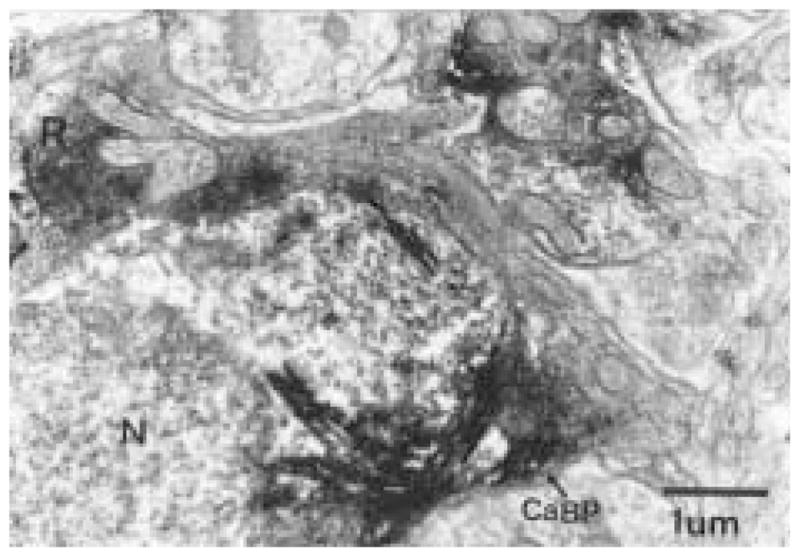
A Calbindin-D28K (CaBP)-immunoreactive (ir) neuron receives two axo-somatic appositions, one from a retinal terminal (R) and the other from a CaBP-ir fiber. The electron-dense TMB reaction product used to identify CaBP profiles makes it difficult to discern synaptic vesicles or a synaptic cleft between the CaBP-ir neuron and CaBP terminal. However, the presence of a cleft and synaptic vesicles is more apparent in the active zone of the retinal terminal as opposed to that of the CaBP-ir. Magnification = × 22,000.
Figure 6
Figure 6
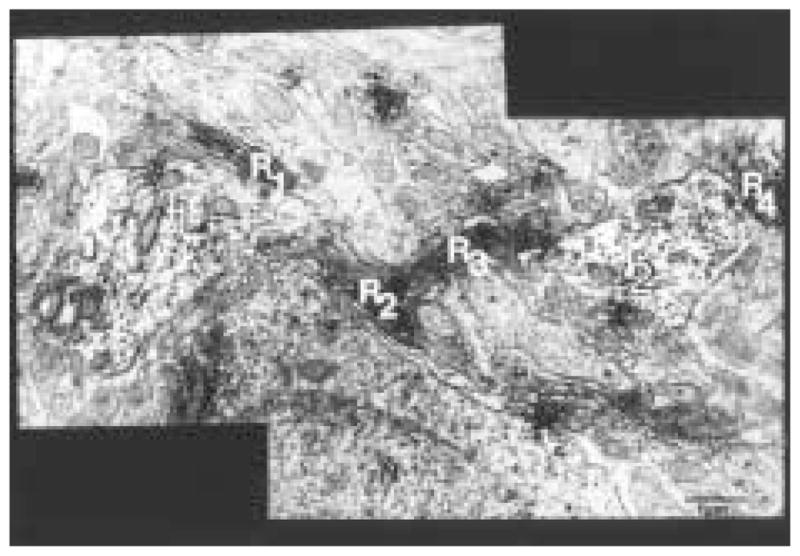
Four longitudinally sectioned cholera toxin β subunit (CTβ)–immunoreactive (ir) axons of passage (R1-R4) surround considerable portions of Calbindin-D28K (CaBP) dendrites (T1 and T2). This type of arrangement is found throughout the neuropil of the CaBP subnucleus. Magnification = × 30,000.
Figure 7
Figure 7
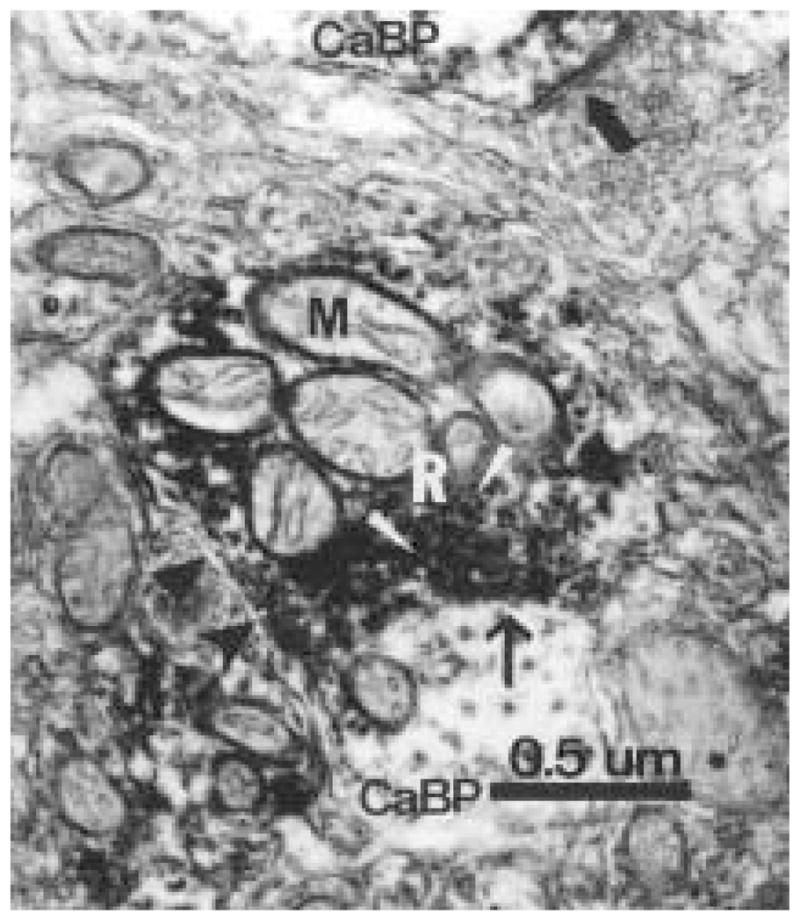
A cholera toxin β subunit–immuonoreative (ir) retinal terminal (R) forms a synaptic contact with a Calbindin-D28K (CaBP) dendritic profile (arrow). The retinal terminal (R) contains numerous mitochondria (M) and synaptic vesicles (white arrowheads). The retinal bouton and CaBP-ir terminal are partially enclosed by unidentified membranes, which are possibly glia (arrowheads). This photomicrograph also depicts a nonidentified axonal bouton forming a symmetrical axo-somatic synapse with a CaBP-ir profile (large arrow). Magnification = × 54,000.
Figure 8
Figure 8
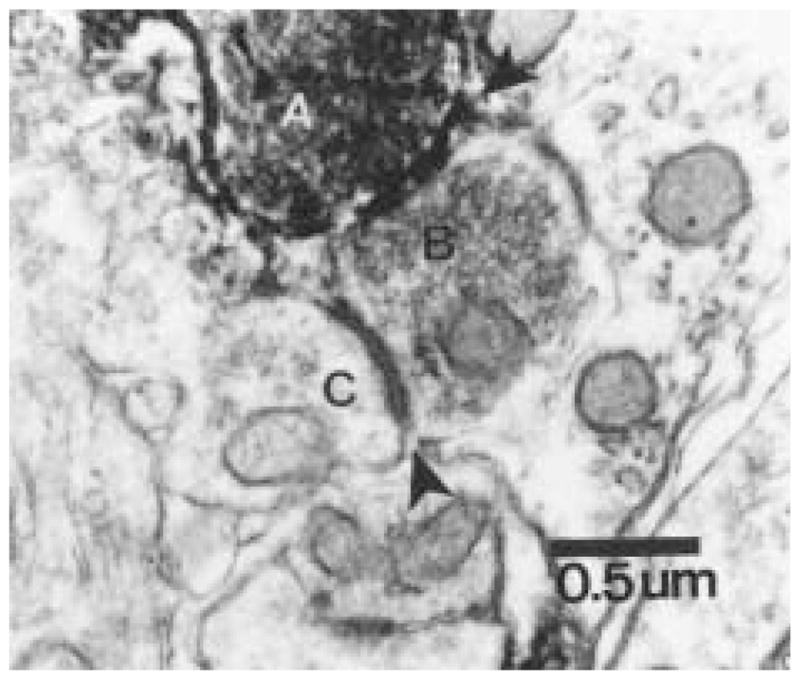
A cholera toxin β subunit–immuonoreative retinal terminal (A) synapses with an unidentified axonal profile (B), which contains numerous synaptic vesicles. This profile in turn synapses on another unidentified dendritic profile (C). This complex interaction suggests that axo-axonal retinal input modulates the response of SCN neurons to light in both a direct and indirect manner. Magnification = × 40,000.

References

    1. Abrahamson EE, Moore RY. The organization of the mouse suprachiasmatic nucleus (SCN): Immunocytochemical analysis of retinal innervation and cell and fiber distribution. Soc Res Biol Rhythms Abstr. 1998;6:83.
    1. Aïoun J, Chambille I, Peytevin J, Martinet L. Neurons containing gastrin releasing peptide and vasoactive intestinal polypeptide are involved in the reception of the photic signal in the suprachiasmatic nucleus of the Syrian hamster: An immunocytochemical ultrastructural study. Cell Tissue Res. 1998;291:231–253. - PubMed
    1. Baimbridge KG, Celio MR, Rogers JH. Calcium-binding proteins in the nervous system. Trends Neurosci. 1992;15:303–308. - PubMed
    1. Bryant DN, LeSauter J, Silver R, Romero M-T. Retinal synapses on calbindin-ir cells in the hamster suprachiasmatic nucleus: A double label immunoelectron microscopy study. Soc Neurosci Abstr. 1996;22:1140.
    1. Burke RE. Spinal cord: Ventral horn. In: Shepherd GM, editor. The Synaptic Organization of the Brain. Oxford University Press; New York: 1998. pp. 77–120.

Publication types