. 2000 May;182(9):2498-506.
doi: 10.1128/JB.182.9.2498-2506.2000.

Effects of bfp mutations on biogenesis of functional enteropathogenic Escherichia coli type IV pili

Affiliations

Effects of bfp mutations on biogenesis of functional enteropathogenic Escherichia coli type IV pili

R P Anantha et al. J Bacteriol. 2000 May.

Abstract

Enteropathogenic Escherichia coli expresses a type IV fimbria known as the bundle-forming pilus (BFP) that is required for autoaggregation and localized adherence (LA) to host cells. A cluster of 14 genes is sufficient to reconstitute BFP biogenesis in a laboratory strain of E. coli. We have undertaken a systematic mutagenesis of the individual genes to determine the effect of each mutation on BFP biogenesis and LA. Here we report the construction and analysis of nonpolar mutations in six genes of the bfp cluster, bfpG, bfpB, bfpC, bfpD, bfpP, and bfpH, as well as the further analysis of a previously described bfpA mutant strain that is unable to express bundlin, the pilin protein. We found that mutations in bfpB, which encodes an outer membrane protein; bfpD, which encodes a putative nucleotide-binding protein; and bfpG and bfpC, which do not have sequence homologues in other type IV pilus systems, do not affect prebundlin expression or processing but block both BFP biogenesis and LA. The mutation in bfpP, the prepilin peptidase gene, does not affect prebundlin expression but blocks signal sequence cleavage of prebundlin, BFP biogenesis, and LA. The mutation in bfpH, which is predicted to encode a lytic transglycosylase, has no effect on prebundlin expression, prebundlin processing, BFP biogenesis, or LA. For each mutant for which altered phenotypes were detected, complementation with a plasmid containing the corresponding wild-type allele restored the wild-type phenotypes. We also found that association of prebundlin or bundlin with sucrose density flotation gradient fractions containing both inner and outer membrane proteins does not require any accessory proteins. These studies indicate that many bfp gene products are required for biogenesis of functional type IV pili but that mutations in the individual genes do not lead to the identification of new phases of pilus assembly.


Figures
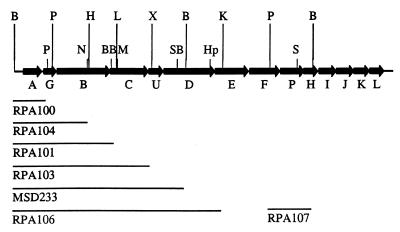
FIG. 1
FIG. 1
Location of bfp mutants and complementing fragments. Lines beneath the genes show the fragments of the cluster used to construct complementing and control plasmids. For each mutant except bfpA and bfpP mutants, a plasmid containing the fragment ending within the corresponding mutated gene served as the control plasmid and a plasmid containing the fragment ending within the gene immediately downstream of the mutated gene served as the complementing plasmid. For the bfpA and bfpP mutants, the vector served as the control plasmid and the vector containing the corresponding gene served as the complementing plasmid. The upper row of restriction sites shows the beginning and endpoint of each fragment. The lower row of restriction sites indicates where the kanamycin cassette was inserted into each gene. Restriction enzyme abbreviations: B, BamHI; BB, BstBI, H, HindIII; Hp, HpaI; K, KpnI; L, BalI; M, MfeI; N, NruI; P, PstI; S, SpeI; SB, SnaBI; X, XbaI.
FIG. 2
FIG. 2
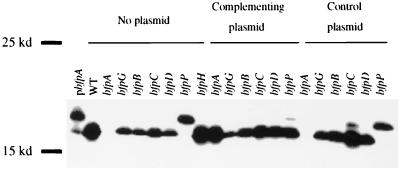
Expression and processing of bundlin in wild-type EPEC and mutant strains. Whole-cell lysates of cells grown in DMEM were prepared, separated by SDS-PAGE electrophoresis on a 15% polyacrylamide gel, and analyzed by immunoblotting with an antibundlin monoclonal antibody. Lanes 2 to 9 contain wild-type EPEC and mutant strains, lanes 10 to 15 contain complemented mutant strains, and lanes 16 to 21 contain mutants with control plasmids. Lane 1, pMSD205, unprocessed bundlin control; lane 2, wild-type (WT) EPEC strain E2348/69; lanes 3, 10, and 16, bfpA mutant strain UMD901; lanes 4, 11, and 17, bfpG mutant strain UMD928; lanes 5, 12, and 18, bfpB mutant strain UMD923; lanes 6, 13, and 19, bfpC mutant strain UMD924; lanes 7, 14, and 20, bfpD mutant strain UMD926; lanes 8, 15, and 21, bfpP mutant strain UMD932; lane 9, bfpH mutant strain UMD918.
FIG. 3
FIG. 3
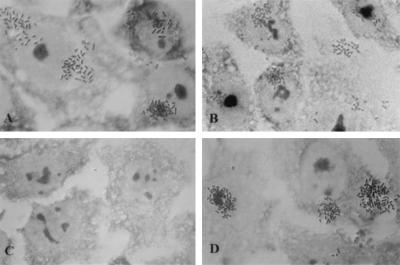
Localized adherence of wild-type EPEC and mutant strains to epithelial cells. HEp-2 cells were incubated with bacteria for 3 h, washed, fixed, and stained with Giemsa stain. Slides were examined by light microscopy with a 63× objective lens. (A) Wild-type EPEC strain E2348/69. (B) bfpH mutant strain UMD918. (C) bfpC mutant strain UMD924. (D) bfpC mutant strain UMD924 containing plasmid pRPA103. Mutant and complemented strains not shown were indistinguishable from strains UMD924 and UMD924(pRPA103).
FIG. 4
FIG. 4
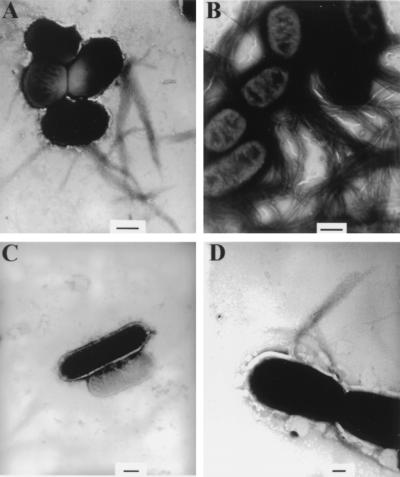
Expression of BFP by wild-type EPEC and mutant strains. Strains were grown in DMEM, spotted on Formvar-copper-coated grids, negatively stained with phosphotungstic acid, and examined by electron microscopy. (A) Wild-type EPEC strain E2348-69. (B) bfpH mutant strain UMD918. (C) bfpG mutant strain UMD928. (D) bfpG mutant strain UMD928 containing plasmid pRPA104. Mutant and complemented strains not pictured were indistinguishable from strains UMD928 and UMD928(pRPA104), respectively. Bars, 500 (A to C) and 200 (D) nm.
FIG. 5
FIG. 5
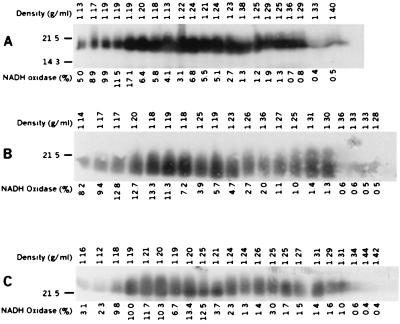
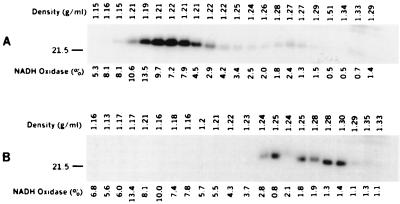
Distribution of bundlin in membrane fractions from recombinant E. coli strain DH5α containing the entire bfp gene cluster on plasmid pKDS302 (A), containing bfpA on plasmid pMSD230 and bfpP on plasmid pDN19PB (B), and containing bfpA on plasmid pMSD230 and a bfpP deletion on plasmid pDN19PBΔ (C). Fractions collected from the sucrose flotation density gradients were analyzed by immunoblotting with antibodies against bundlin. NADH oxidase activity was measured and displayed as a percentage of the total NADH oxidase activity per fraction. Fractions were loaded on SDS–15% PAGE gels in order from the top to the bottom of the gradient (left to right, respectively). The density of each fraction is indicated above each blot. Variations from the linear trend of increasing density can be ascribed to pipetting error. Data are representative of two separate experiments with similar results. Numbers to the left of each panel indicate molecular mass(es) in kilodaltons.
FIG. 6
FIG. 6
Redistribution of previously fractionated prebundlin from low-density (A) and high-density (B) fractions after a second round of sucrose flotation density gradient fractionation. Fractions collected from the sucrose flotation gradient were analyzed by immunoblotting with antibodies against bundlin. NADH oxidase activity was measured and displayed as a percentage of the total NADH oxidase activity per fraction. Fractions were loaded on SDS–15% PAGE gels in order from the top to the bottom of the gradient (left to right, respectively). The density of each fraction is indicated above each blot. Variations from the linear trend of increasing density can be ascribed to pipetting error. Numbers to the left of the panels indicate molecular mass in kilodaltons.

References

    1. Alm R A, Bodero A J, Free P D, Mattick J S. Identification of a novel gene, pilZ, essential for type 4 fimbrial biogenesis in Pseudomonas aeruginosa. J Bacteriol. 1996;178:46–53. - PMC - PubMed
    1. Alm R A, Hallinan J P, Watson A A, Mattick J S. Fimbrial biogenesis genes of Pseudomonas aeruginosa: PilW and pilX increase the similarity of type 4 fimbriae to the GSP protein-secretion systems and pilY1 encodes a gonococcal PilC homologue. Mol Microbiol. 1996;22:161–173. - PubMed
    1. Alm R A, Mattick J S. Identification of a gene, pilV, required for type 4 fimbrial biogenesis in Pseudomonas aeruginosa, whose product possesses a pre-pilin-like leader sequence. Mol Microbiol. 1995;16:485–496. - PubMed
    1. Alm R A, Mattick J S. Genes involved in the biogenesis and function of type-4 fimbriae in Pseudomonas aeruginosa. Gene. 1997;192:89–98. - PubMed
    1. Anantha R P, Stone K D, Donnenberg M S. The role of BfpF, a member of the PilT family of putative nucleotide-binding proteins, in type IV pilus biogenesis and in interactions between enteropathogenic Escherichia coli and host cells. Infect Immun. 1998;66:122–131. - PMC - PubMed

Publication types

LinkOut - more resources