. 2000 May;182(9):2611-8.
doi: 10.1128/JB.182.9.2611-2618.2000.

Generation of dominant selectable markers for resistance to pseudomonic acid by cloning and mutagenesis of the ileS gene from the archaeon Methanosarcina barkeri fusaro

Affiliations

Generation of dominant selectable markers for resistance to pseudomonic acid by cloning and mutagenesis of the ileS gene from the archaeon Methanosarcina barkeri fusaro

P Boccazzi et al. J Bacteriol. 2000 May.

Abstract

Currently, only one selectable marker is available for genetic studies in the archaeal genus Methanosarcina. Here we report the generation of selectable markers that encode resistance to pseudomonic acid (PA(r)) in Methanosarcina species by mutagenesis of the isoleucyl-tRNA synthetase gene (ileS) from Methanosarcina barkeri Fusaro. The M. barkeri ileS gene was obtained by screening of a genomic library for hybridization to a PCR fragment. The complete 3,787-bp DNA sequence surrounding and including the ileS gene was determined. As expected, M. barkeri IleS is phylogenetically related to other archaeal IleS proteins. The ileS gene was cloned into a Methanosarcina-Escherichia coli shuttle vector and mutagenized with hydroxylamine. Nine independent PA(r) clones were isolated after transformation of Methanosarcina acetivorans C2A with the mutagenized plasmids. Seven of these clones carry multiple changes from the wild-type sequence. Most mutations that confer PA(r) were shown to alter amino acid residues near the KMSKS consensus sequence of class I aminoacyl-tRNA synthetases. One particular mutation (G594E) was present in all but one of the PA(r) clones. The MIC of pseudomonic acid for M. acetivorans transformed with a plasmid carrying this single mutation is 70 microgram/ml of medium (for the wild type, the MIC is 12 microgram/ml). The highest MICs (560 microgram/ml) were observed with two triple mutants, A440V/A482T/G594E and A440V/G593D/G594E. Plasmid shuttle vectors and insertion cassettes that encode PA(r) based on the mutant ileS alleles are described. Finally, the implications of the specific mutations we isolated with respect to binding of pseudomonic acid by IleS are discussed.


Figures
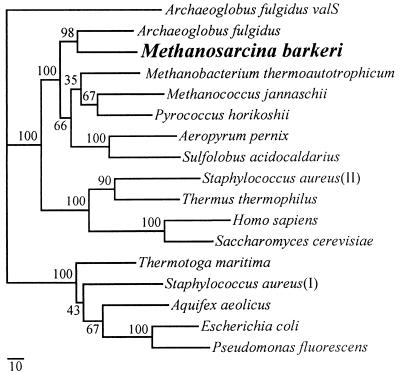
FIG. 1
FIG. 1
Phylogeny of the M. barkeri IleS protein. The standardized, exponentially weighted consensus tree of the 500 most parsimonious trees, evaluated by maximum-likelihood analysis, is shown. A percentage at a node represents the relative-likelihood support for that branch, as calculated by the TreeCons program. The tree was rooted using the valS gene of A. fulgidus. The scale bar represents the estimated number of substitutions per 100 amino acid positions along each branch. The Swiss Protein database accession numbers of the sequences used are, from top to bottom, O28059 (A. fulgidus valS), O29622 (A. fulgidus), P26499 (M. thermoautotrophicum), Q58357 (M. jannaschii). P46215 (S. acidocaldarius), P41368 (S. aureus II, a plasmid-encoded copy that confers PAr). P56690 (T. thermophilus), P41252 (H. sapiens), P09436 (S. cerevisiae), P46213 (T. maritima), P41972 (S. aureus I, genomic copy), P46207 (A. aeolicus), P00956 (E. coli), and P18330 (P. fluorescens). The A. pernix and P. horikoshii sequences were from the respective genome databases.
FIG. 2
FIG. 2
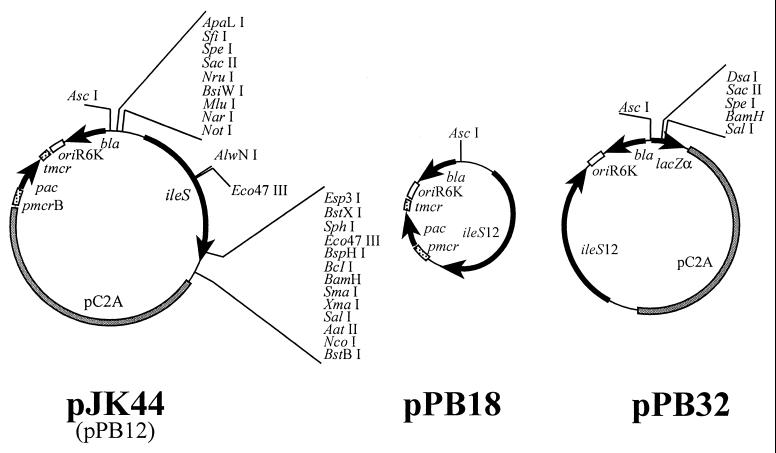
Plasmids used in this study. Plasmid pJK44 carries the M. barkeri strain Fusaro ileS gene in Methanosarcina-E. coli shuttle vector pWM321 (29). The origin of replication from plasmid R6K (oriR6K) allows plasmid replication in E. coli, and the pC2A replicon allows replication in the genus Methanosarcina. The pac cassette confers puromycin resistance upon methanoarchaea, and the β-lactamase gene bla encodes resistance to ampicillin on E. coli. Plasmid pPB12 is identical to pJK44, except that it carries the ileS12 allele in the place of wild-type ileS. Plasmid pPB18 differs from pPB12 by lacking the pC2A replicon and therefore is incapable of replication in Methanosarcina. Plasmid pPB32 is a Methanosarcina-E. coli shuttle vector that carries ileS12, lacZα for blue-white screening of recombinant clones, and a multiple cloning site with numerous unique sites. Plasmids pPB31, pPB33, pPB34, and pPB35 are similar to pPB32 and are described in the text. The promoter (pmcrB) and terminator (tmcr) of the Methanococcus voltae methyl reductase operon regulate expression of the puromycin acetyltransferase (pac) gene from Streptomyces alboniger in methanoarchaea.
FIG. 3
FIG. 3
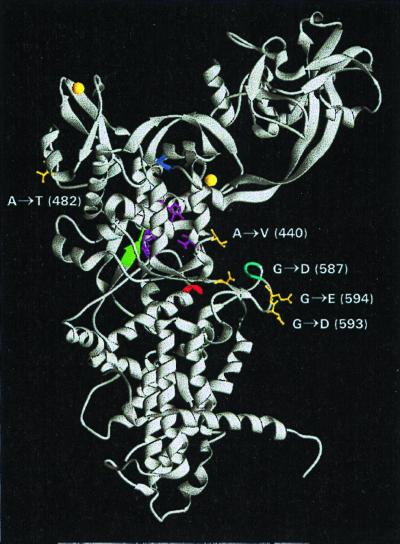
Modeling of IleS mutations that confer PAr. The crystal structure of the isoleucyl-tRNA synthetase from T. thermophilus (34) was used to identify the homologous positions and spatial locations of amino acid changes in the IleS protein of M. barkeri Fusaro that confer PAr. Side chains of mutated amino acids are in yellow. Bound Zn2+ molecules are represented by yellow spheres. The GWD, HIGH, WCISR, and KMSKS consensus sequences of class I aminoacyl-tRNA synthetases are in green, red, blue, and aqua, respectively. The isoleucines binding residues Pro46, Asp85, Trp518, Gln554, and Trp558 in T. thermophilus IleS are in magenta. The IleS structure was drawn using the program Ribbons 2.0 (9). Coordinates were retrieved from the Protein Data Bank (accession no. 1ILE [5]). See the text for details.

References

    1. Adachi J, Hasegawa M. Computer science monographs n 28, MOLPHY version 2.3: programs for molecular phylogenetics based on maximum likelihood. Tokyo, Japan: Institute for Statistical Mathematics; 1996.
    1. Argyle J L, Tumbula D L, Leigh J A. Neomycin resistance as a selectable marker in Methanococcus maripaludis. Appl Environ Microbiol. 1996;62:4233–4237. - PMC - PubMed
    1. Ausubel F M, Brent R, Kingston R E, Moore D D, Seidman J G, Smith J A, Struhl K. Current protocols in molecular biology. 1 and 2. New York, N.Y: John Wiley & Sons, Inc.; 1992.
    1. Beckler G S, Hook L A, Reeve J N. Chloramphenicol acetyltransferase should not provide methanogens with resistance to chloramphenicol. Appl Environ Microbiol. 1984;47:868–869. - PMC - PubMed
    1. Bernstein F C, Koetzle T F, Williams G J B, Meyer E F, Brice M D, Rodgers J R, Kennard O, Shimanouchi T, Tasumi M. The Protein Data Bank: a computer-based archival file for macromolecular structures. J Mol Biol. 1977;112:535–542. - PubMed

Publication types

MeSH terms

Associated data

LinkOut - more resources