. 2000 May;68(5):2503-12.
doi: 10.1128/IAI.68.5.2503-2512.2000.

Tetanus toxin fragment C expressed in live Salmonella vaccines enhances antibody responses to its fusion partner Schistosoma haematobium glutathione S-transferase

Affiliations

Tetanus toxin fragment C expressed in live Salmonella vaccines enhances antibody responses to its fusion partner Schistosoma haematobium glutathione S-transferase

J J Lee et al. Infect Immun. 2000 May.

Abstract

Tetanus toxoid has been used widely as an adjuvant. The atoxic fragment C from tetanus toxin (TetC) is potently immunogenic when expressed in Salmonella vaccine strains and has been used as a fusion partner for antigens (Ag). However, there has been no formal comparison of the immunomodulatory impact of TetC on its fusion partners. In this study, we have addressed this important issue. The protective 28-kDa glutathione S-transferase (GST) from Schistosoma haematobium (Sh28GST) was expressed either as a fusion to TetC or as the full-length Sh28GST alone in a nonvirulent aroA-attenuated strain of Salmonella enterica serovar Typhimurium. The Sh28GST proteins were soluble and stably expressed in Salmonella, as evaluated by Western blotting with TetC and/or Sh28GST antisera. Mice were immunized orally with a single dose of the live recombinant Salmonella. The constructs were stable in mice but, dramatically, only the strain expressing the TetC-Sh28GST fusion elicited significant antibody (Ab) responses directed against Sh28GST as determined by enzyme-linked immunosorbent assay. An analysis of the isotype profiles showed that these mice also produced anti-Sh28GST immunoglobulin A and GST-neutralizing assays revealed high levels of neutralizing Abs in sera. These are important correlates of protection in schistosomiasis. In addition, stimulation of spleen cells from immunized mice with Sh28GST Ag showed that both strains, expressing Sh28GST alone or the TetC-Sh28GST fusion, were able to stimulate the secretion of Th1-related cytokines (gamma interferon and interleukin 2) to comparable levels. Thus, TetC has modulated the immune responses generated against its fusion partner, Sh28GST, by markedly enhancing the Ab responses elicited. These results have important implications in the rational development of live vaccines.


Figures
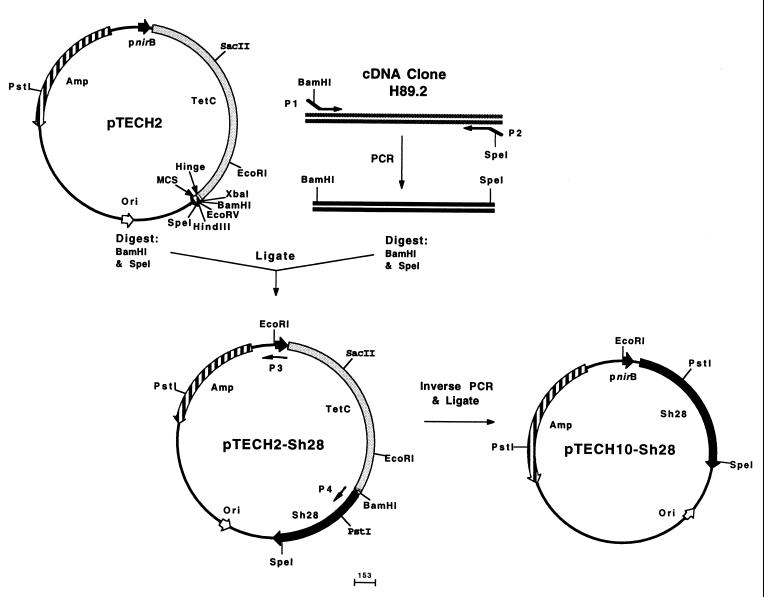
FIG. 1
FIG. 1
Construction of pTECH2-Sh28 and pTECH10-Sh28. See Results for details.
FIG. 2
FIG. 2
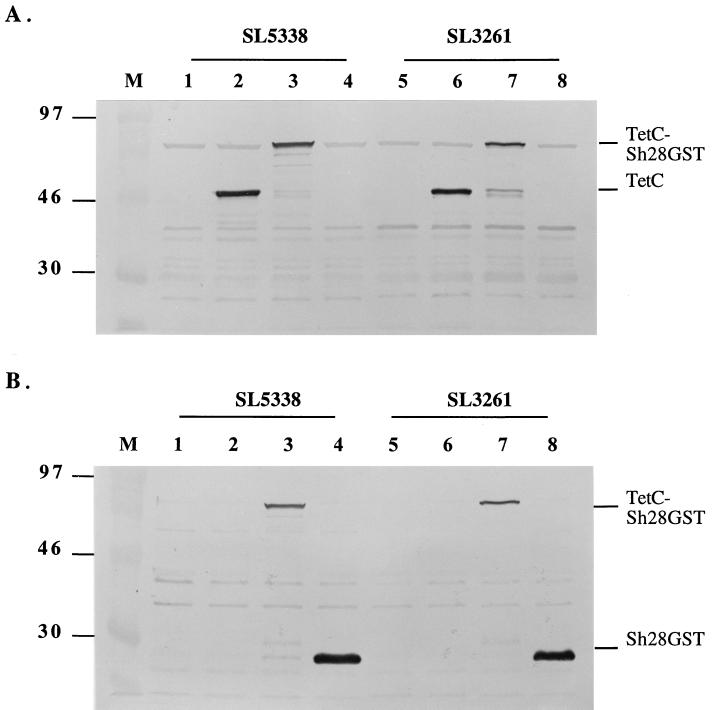
Expression of TetC-Sh28GST fusion and Sh28GST as determined by SDS-PAGE and Western blotting. Shown are the results of probing with a rabbit anti-TetC polyclonal antiserum (A) and a mouse anti-Sh28GST polyclonal antiserum (B). The constructs were in S. enterica serovar Typhimurium strains SL5338 and SL3261, as indicated. Lane M, low-molecular-mass marker proteins (kilodaltons). Lanes 1 to 8, SL5338, JJ502, JJ503, JJ504, SL3261, JJ702, JJ703, and JJ704 cell lysate, respectively.
FIG. 3
FIG. 3
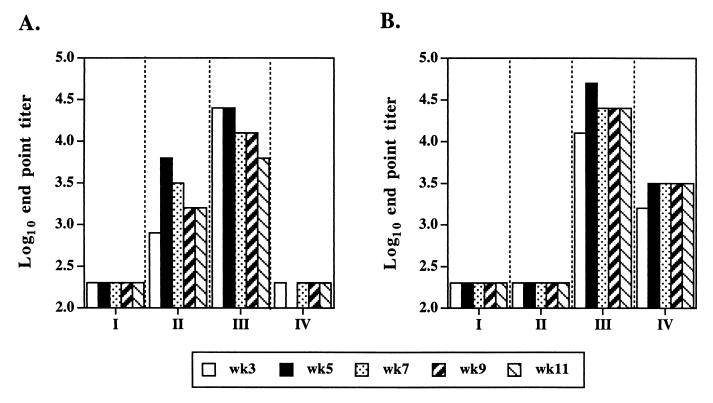
Antibody responses against rTetC (A) and rSh28GST (B), as detected by ELISA, from mice immunized orally with S. enterica serovar Typhimurium strains SL3261 (I), JJ702 harboring pTECH2 (II), JJ703 harboring pTECH2-Sh28 (III), and JJ704 harboring pTECH10-Sh28 (IV). Pooled sera from a group of eight mice bled at weeks 3, 5, 7, 9, and 11 were analyzed, and each value is expressed as the log10 end point titer as described in Materials and Methods.
FIG. 4
FIG. 4
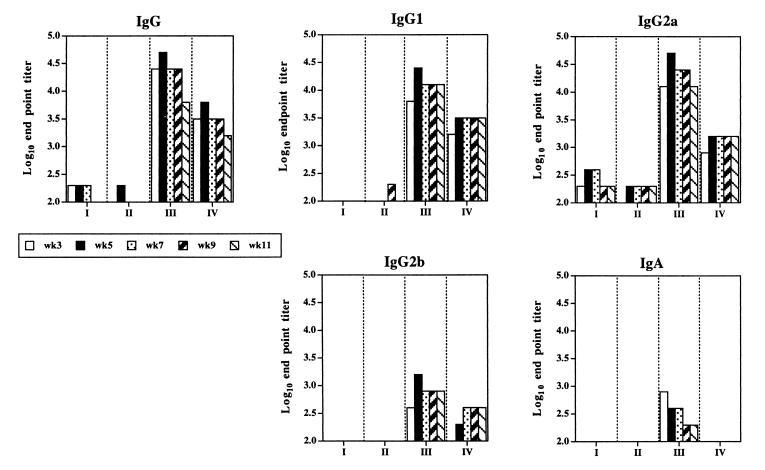
Antibody isotype profiles against rSh28GST as detected by ELISA from mice immunized orally with S. enterica serovar Typhimurium strains SL3261 (I), JJ702 harboring pTECH2 (II), JJ703 harboring pTECH2-Sh28 (III), and JJ704 harboring pTECH10-Sh28 (IV). Pooled sera from a group of eight mice bled at weeks 3, 5, 7, 9, and 11 were analyzed, and each value is expressed as the log10 end point titer as described in Materials and Methods.
FIG. 5
FIG. 5
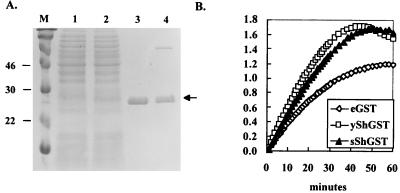
Purification and enzymatic activity of the Sh28GST expressed by JJ704 harboring pTECH10-Sh28. (A) Sh28GST was purified by single-step affinity chromatography on a GSH-agarose column. Purified proteins were subjected to SDS-PAGE and Coomassie blue staining. Lane 1, whole-cell lysate of SL3261; lane 2, whole-cell lysate of JJ704 harboring pTECH10-Sh28; lane 3, purified Sh28GST produced in JJ704; lane 4, purified Sh28GST produced in yeast (∼2 μg). Arrow, position of Sh28GST. The molecular mass markers are shown in lane M, and their sizes in kilodaltons are at the left. (B) GST activity catalyzed by Sh28GST purified from yeast (open squares), S. enterica serovar Typhimurium strain typhimurium JJ704 (solid triangles), and commercially purified GST of equine origin (Sigma; open diamonds) in a time-dependent fashion.
FIG. 6
FIG. 6
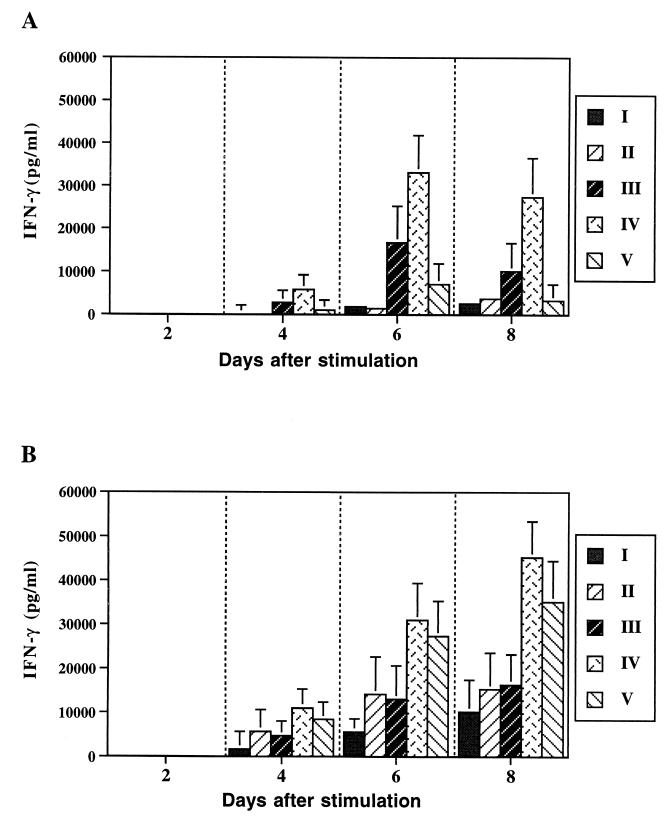
IFN-γ production by whole spleen cells after stimulation with rTetC (A) and rSh28GST (B). Results are expressed as the concentration of cytokine in supernatants of cell cultures collected up to 8 days after stimulation, as detected by ELISA. Each value is the average of the results for three different cultures plus the standard deviation. Statistical significances were analyzed by Student's t test. P values <0.05 were considered significant. Groups: I, naive mice; II, mice immunized with SL3261; III, mice immunized with JJ702; IV, mice immunized with JJ703; V, mice immunized with JJ704.
FIG. 7
FIG. 7
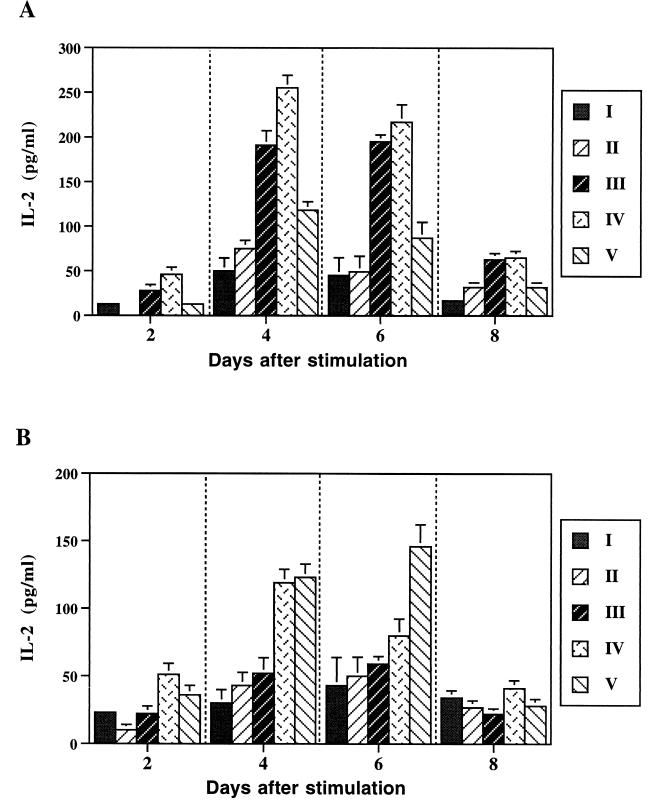
IL-2 production by whole spleen cells after stimulation with rTetC (A) and rSh28GST (B). Results are expressed as the concentration of cytokine in supernatants of cell cultures collected up to 8 days after stimulation, as detected by ELISA. Each value is the average of the results for three different cultures plus the standard deviation. Groups: I, naive mice; II, mice immunized with SL3261; III, mice immunized with JJ702; IV, mice immunized with JJ703; V, mice immunized with JJ704.

References

    1. Aggarwal A, Kumar S, Jaffe R, Hone D, Gross M, Sadoff J. Oral Salmonella malaria circumsporozoite recombinants induce specific CD8+ cytotoxic cells. J Exp Med. 1990;172:1083–1090. - PMC - PubMed
    1. Balloul J M, Grxych J M, Pierce R J, Capron A. A purified 28,000 dalton protein from Schistosoma mansoni adult worms protects rats and mice against experimental schistosomiasis. J Immunol. 1987;138:3448–3453. - PubMed
    1. Bergquist N R, Colley D G. Schistosomiasis vaccines: research to development. Parasitol Today. 1998;14:99–104. - PubMed
    1. Boulanger D, Reid G D, Sturrock R F, Wolowczuk I, Balloul J-M, Grezel D, Pierce R J, Otieno M F, Guerret S, Grimaud J A, Butterworth A E, Capron A. Immunization of mice and baboons with the recombinant Sm28GST affects both worm viability and fecundity after experimental infection with Schistosoma mansoni. Parasite Immunol. 1991;13:473–490. - PubMed
    1. Boulanger D, Warter A, Sellin B, Lindner V, Pierce R J, Chippaux J-P, Capron A. Vaccine potential of a recombinant glutathione S-transferase cloned from Schistosoma haematobium in primates experimentally infected with an homologous challenge. Vaccine. 1999;17:319–326. - PubMed

Publication types

MeSH terms