


Effects of Enterococcus faecalis fsr genes on production of gelatinase and a serine protease and virulence
- PMID: 10768947
- PMCID: PMC97462
- DOI: 10.1128/IAI.68.5.2579-2586.2000
Effects of Enterococcus faecalis fsr genes on production of gelatinase and a serine protease and virulence
Abstract
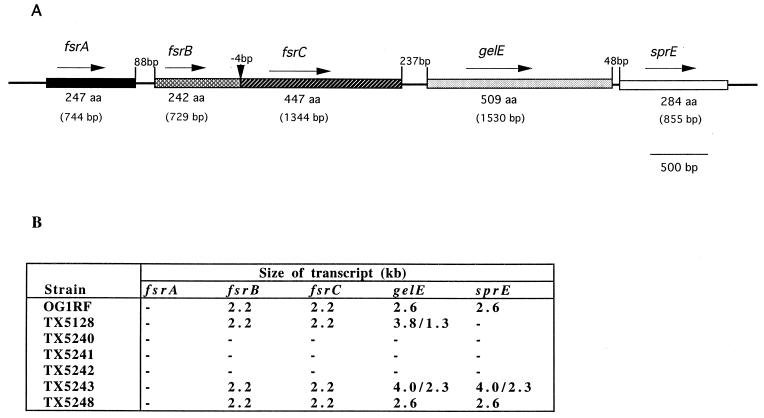
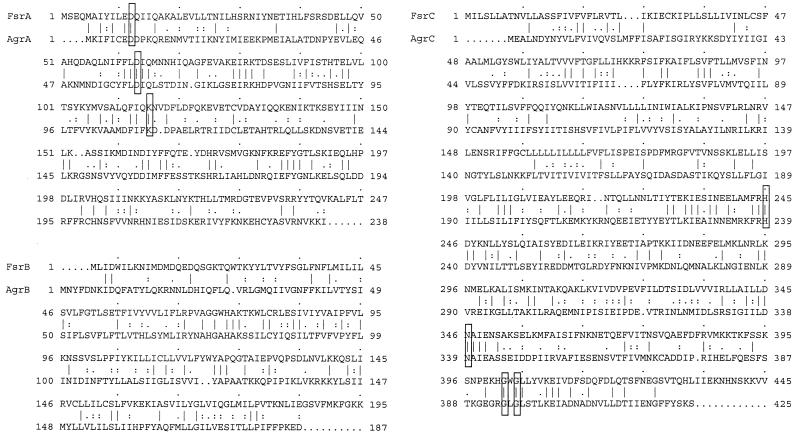
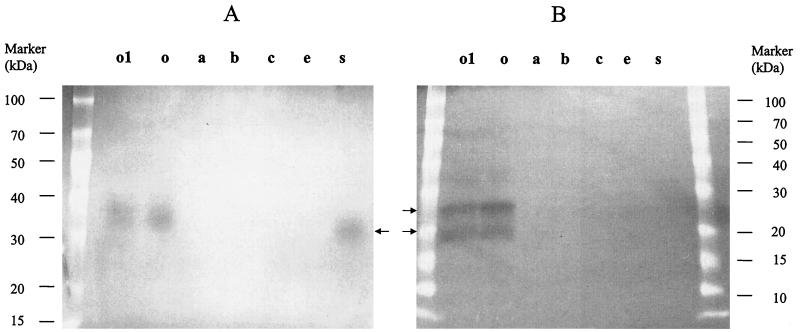
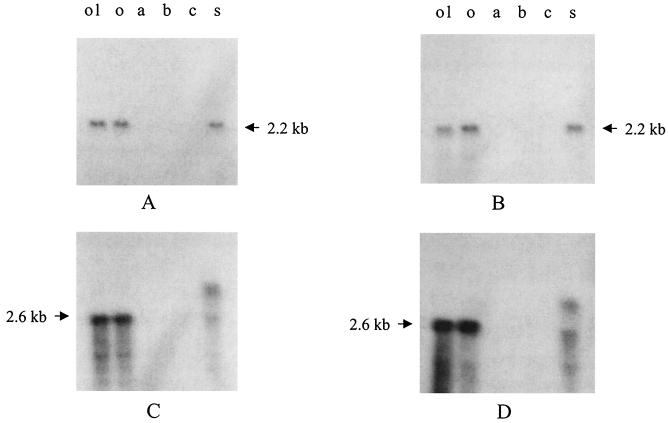
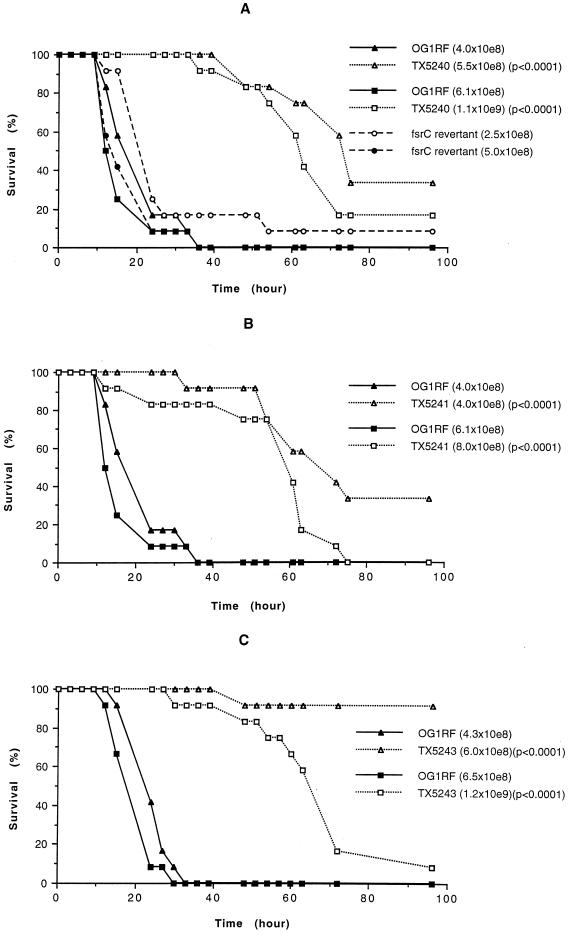
Three agr-like genes (fsrA, fsrB, and fsrC, for Enterococcus faecalis regulator) were found upstream of the previously reported gelatinase gene (gelE) and a downstream putative serine protease gene (sprE; accession number Z12296) of Enterococcus faecalis OG1RF. The deduced amino acid sequence of fsrA shows 26% identity and 38% similarity to Staphylococcus aureus AgrA (the response regulator of the accessory gene regulator system in the agr locus), FsrB shows 23% identity and 41% similarity to S. aureus AgrB, and FsrC shows 23% identity and 36% similarity to S. aureus AgrC (the sensor transducer of Agr system). Northern blot analysis suggested that gelE and sprE are cotranscribed and that fsrB and fsrC are also cotranscribed in OG1RF. Northern blot analysis of fsrA, fsrB, fsrC, gelE, and sprE insertion mutants showed that fsrB, fsrC, gelE, and sprE are not expressed in fsrA, fsrB, and fsrC mutants, while insertion in an open reading frame further upstream of fsrA did not effect the expression of these genes, suggesting that agr-like genes may be autoregulated and that they regulate gelE and sprE expression, as further confirmed by complementation of fsr gene mutations with a 6-kb fragment which contains all three fsr genes in the shuttle vector, pAT18. Testing of 95 other isolates of E. faecalis showed that 62% produced gelatinase (Gel(+)), while 91% (including all Gel(+) strains) hybridized to a gelE probe; 71% (including all Gel(+) strains) hybridized to an fsr probe, corroborating the conclusion that both gelE and fsr are necessary for gelatinase production. Testing of fsrA, fsrB, and sprE mutants in a mouse peritonitis model showed that sprE and agr-like gene mutants resulted in highly significantly prolonged survival compared to the parent strain OG1RF, a finding similar to what we had previously shown for a gelE mutant. These results suggest that sprE and agr-like genes contribute to the virulence of E. faecalis OG1RF in this model.
Figures
References
-
- Coque T M, Patterson J E, Steckelberg J M, Murray B E. Incidence of hemolysin, gelatinase and aggregative substance among enterococci isolated from patients with endocarditis and other infections and from feces of hospitalized and community-based persons. J Infect Dis. 1995;171:1223–1229. - PubMed
-
- Ji G, Beavis R, Novick R P. Bacterial interference caused by autoinducing variants. Science. 1997;276:2027–2030. - PubMed
Publication types
MeSH terms
Substances
Associated data
- Actions
- Actions
- Actions
Grants and funding
LinkOut - more resources
Full Text Sources
Other Literature Sources
Molecular Biology Databases
