. 2000 May 15;28(10):E49.
doi: 10.1093/nar/28.10.e49.

Characterization of the mRNA ligands bound by the RNA binding protein hnRNP A2 utilizing a novel in vivo technique

Affiliations

Characterization of the mRNA ligands bound by the RNA binding protein hnRNP A2 utilizing a novel in vivo technique

S A Brooks et al. Nucleic Acids Res. .

Abstract

Post-transcriptional regulation is an important mechanism in cellular response to stimuli, allowing for the rapid and discrete expression of relevant proteins. Genes regulated by this mechanism have specific cis -acting elements, frequently in their 3' untranslated regions (UTRs), that have been shown to serve as recognition sites for trans -acting RNA-binding proteins. Unfortunately, the identification of specific mRNA ligands for different RNA binding proteins in vivo has been limited by a lack of adequate methodology. We have developed a novel technique that addresses this shortcoming, using immunoprecipitation of RNA binding proteins from polysomes followed by RT-PCR and library screening to identify the in vivo mRNA ligands of RNA binding proteins. Utilizing this approach, we have identified 32 known and 16 novel mRNAs specifically bound by the heterogeneous nuclear ribonucleoprotein (hnRNP) A2. Of the clones identified, 74% contained AU-rich elements and/or poly-uridine tracts in their 3' UTRs, cis -acting elements that have been established as impacting mRNA stability. The high percentage of clones containing these uridine-rich sequences compares favorably with the high affinity binding of poly-uridine RNA by hnRNP A2 in vitro. These data thus support the representative nature of the technique.


Figures
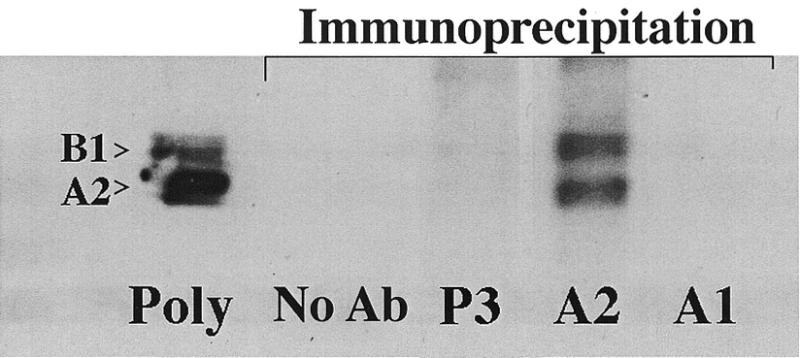
Figure 1
Figure 1
hnRNP A2 can be selectively immunoprecipitated from THP-1 polysomes. Two absorbance units at OD A260 of THP-1 polysomes were individually immunoprecipitated with P3, anti-hnRNP A2 (EF-67), anti-hnRNP A1 (ACT-1) or no antibody (protein A Sepharose beads alone), and resolved by SDS–PAGE and immunoblotting. Two bands, representing hnRNP A2 (36 kDa) and B1 (38 kDa) are present in the polysome (also 2 OD A260) and EF-67 immunoprecipitate lanes only, following blotting with EF-67.
Figure 2
Figure 2
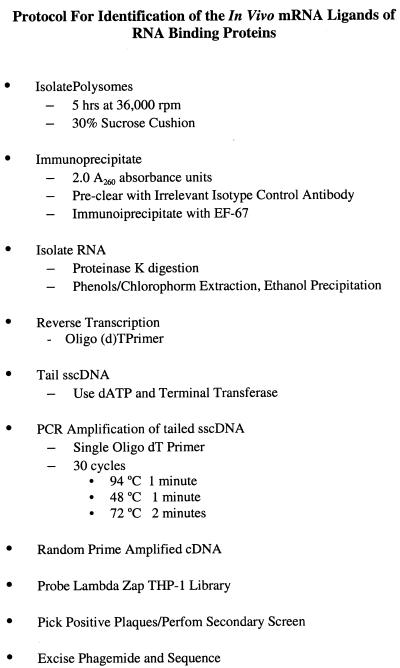
Schematic outline of the isolation of in vivo mRNA ligands of hnRNP A2.
Figure 3
Figure 3
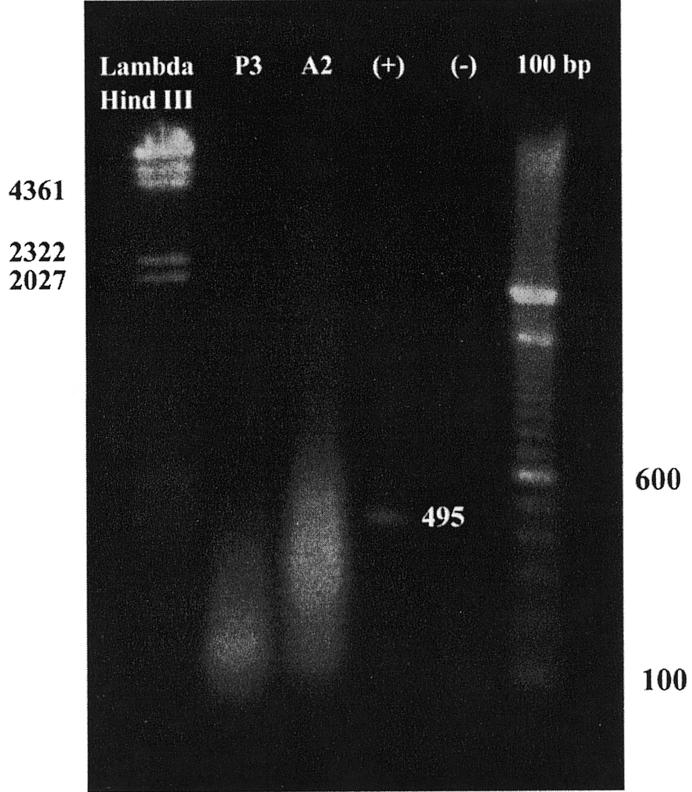
PCR amplification of hnRNP A2 associated polysomal RNA. PCR amplification of the RNA isolated by immunoprecipitation of leukemic polysomes was analyzed by agarose gel electrophoresis and ethidium bromide staining. From left to right, the lanes are as follows: Lambda HindIII markers; amplified cDNA from the P3 immunoprecipitation; amplified cDNA from the EF-67 immunoprecipitation (hnRNP A2); positive control using full-length GM-CSF giving a single 495 bp band, the expected size for the primers used; negative control containing no DNA giving no bands, but a faint smear of primer; 100 bp marker ladder.
Figure 4
Figure 4
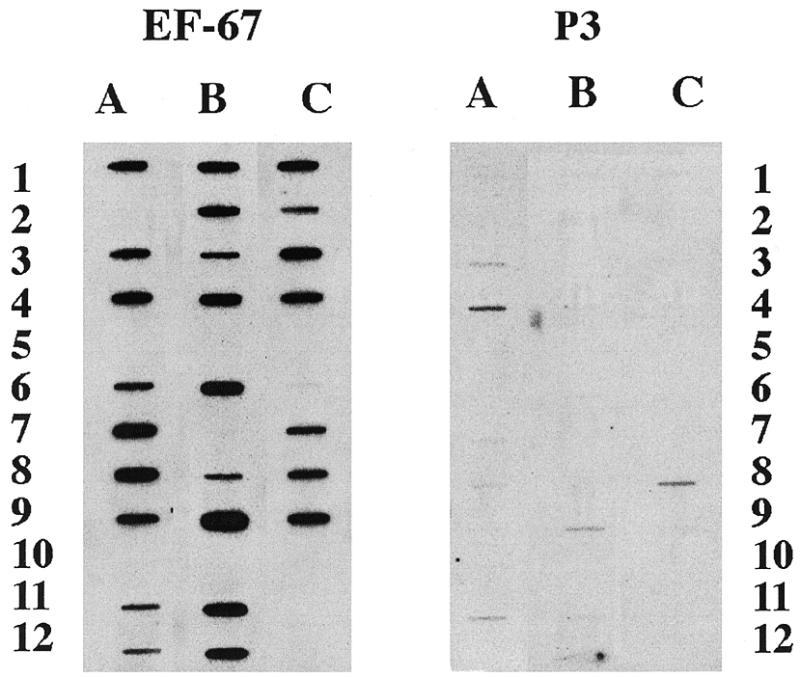
Slot blots of clones from the first immunoprecipitation. Slot blots of 100 ng of insert cDNA from each unique clone isolated by library screening, PMA activated THP-1 library, with RT–PCR of hnRNP A2-associated polysomal RNA was probed at a concentration of 2 × 10⁶ c.p.m./ml and used for autoradiography on the same piece of film with identical exposures shown. The probe was generated by 32P random prime-labeling the RT–PCR of a second immunoprecipitation with the indicated antisera from leukemic polysomes. The identity of each clone is listed in Table 1.
Figure 5
Figure 5
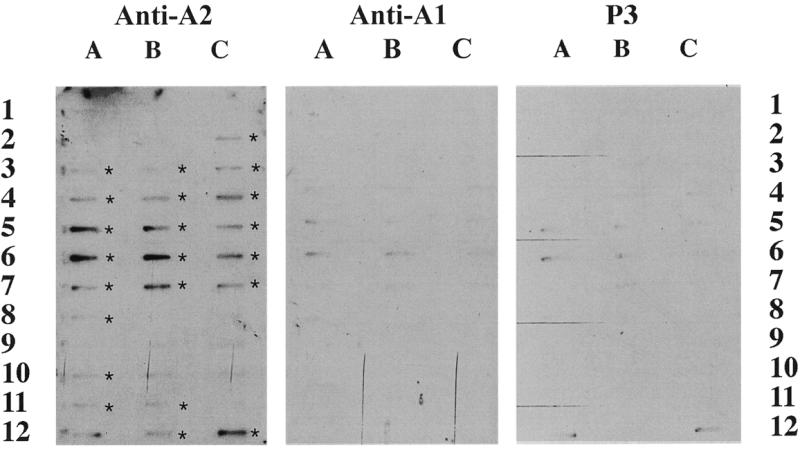
Slot blots of clones from the second immunoprecipitation. Slot blots of 100 ng of insert cDNA from each unique clone isolated by library screening, LPS activated THP-1 library, with RT–PCR of hnRNP A2-associated polysomal RNA were probed at a concentration of 2 × 10⁶ c.p.m./ml and used for autoradiography on the same piece of film. The probe was generated by 32P random primer labeling of the RT–PCR of a set of second immunoprecipitation with the indicated antisera from LPS + THP-1 polysomes. Asterisks indicate positive clones as determined by densitometery. The identity of each clone is listed in Table 2.

References

    1. Shih S.C. and Claffey,K.P. (1998) Int. J. Exp. Pathol., 79, 347–357. - PMC - PubMed
    1. Day D.A. and Tuite,M.F. (1998) J. Endocrinol., 157, 361–371. - PubMed
    1. Ladomery M. (1997) Bioessays, 19, 903–909. - PubMed
    1. Siomi H. and Dreyfuss,G. (1997) Curr. Opin. Genet. Dev., 7, 345–353. - PubMed
    1. Shaw G. and Kamen,R. (1986) Cell, 46, 659–669. - PubMed

Publication types

MeSH terms